
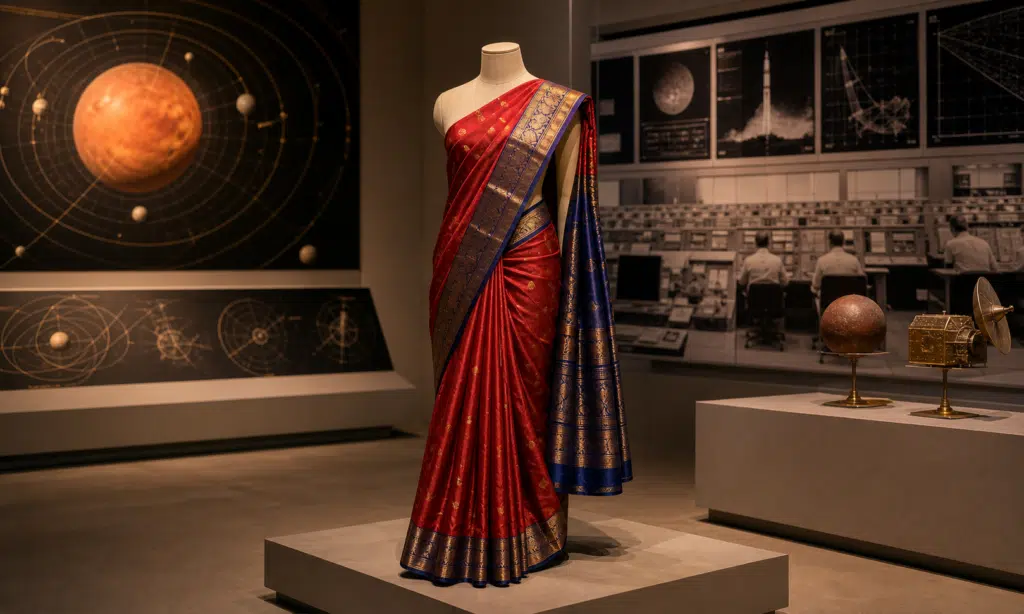
A red and blue silk sari worn by Indian space scientist Nandini Harinath has been described as part of a Smithsonian National Air and Space Museum display in Washington, linking one personal garment to one of India’s most closely watched space missions.
Harinath was deputy operations director for Mangalyaan, India’s first Mars Orbiter Mission. According to the account, she wore the sari on 1 December 2013, the day ISRO teams carried out the operation that sent the spacecraft out of Earth orbit and onto its long journey toward Mars.
The detail matters because the sari is not presented as a costume or a decorative object. It is tied to a working day in mission control: a moment when calculations, timing and operational judgment carried enormous weight. Harinath has described that day as the most critical point of the project, when the team had to determine where the spacecraft would go, how it would travel and when the burn should happen.
Why the Sari Became More Than a Personal Outfit
For Harinath, saris reportedly had long been a preferred choice for important professional occasions, especially when representing India’s space agency. Some were gifts from her father, making the garment both personal and public.
That combination helps explain why the sari became a strong museum object. It carries a story of family, national identity and scientific work without needing technical explanation. Visitors can understand it at a glance, then connect it to the larger history of Mangalyaan and India’s space programme.
Mangalyaan is widely associated with India’s entry into Mars exploration. The mission reached Martian orbit on 24 September 2014, a milestone that placed India among the few nations or blocs to have achieved that feat. internal-link-topic: India Mars Orbiter Mission
The mission also drew attention to women working in and around India’s space programme. A photograph of sari-clad women celebrating at ISRO circulated widely after the Mars success. ISRO later clarified that the women in that specific image were administrative staff, while also saying that women scientists had worked on the mission and were present in the control room.
That clarification is important. The image became symbolic, but the fuller story is more precise: women contributed to the mission in scientific and operational roles, even if the viral photo itself did not show the exact group many viewers assumed it did.
How the Smithsonian Framed the Object
Space history curator Matt Shindell reportedly contacted Harinath in 2020 to discuss what object might best represent India’s Mars mission and her role in it. The sari she wore when Mangalyaan left Earth orbit was chosen for that purpose.
Once the sari and matching blouse reached the museum, the display process became part of the story. Textile conservator Beth Knight is said to have studied sari draping so the garment could be presented properly on a mannequin.
The Smithsonian comparison is also practical. Museums often preserve clothing worn during major space operations, not only spacecraft hardware. Shindell has compared Harinath’s sari with other mission-control garments in the collection, including Gene Kranz’s vest from the Apollo 13 era.
The reported display places the sari in the museum’s “Futures in Space” gallery, near other objects that invite visitors to think about why humans go to space and who gets included in that story. It has also been described as displayed near Sally Ride’s blue T-shirt from the 1983 shuttle mission, when Ride became the first American woman in space.
What Visitors Are Meant to Take From It
The sari’s value is not only historical. It is also interpretive. A museum can use an everyday garment to open up bigger questions: who participates in space exploration, what national pride looks like in scientific achievement, and how personal identity travels into technical workplaces.
For India, the object points back to a mission that became a point of public pride. For Harinath, it tells a more intimate story about the clothing she chose for a decisive professional moment. For visitors, it offers a visible reminder that space history is not made only by astronauts, rockets and control panels.
That is why the sari works as a museum object. It is specific enough to belong to one scientist and one mission day, but broad enough to raise questions about gender, culture and representation in science. internal-link-topic: women in space science
The account of the display also shows how museums choose objects that help visitors enter complex histories. A spacecraft component can explain engineering. A garment can explain presence, identity and memory. In Harinath’s case, the sari connects those ideas to Mangalyaan and to the women whose work helped shape India’s space ambitions.