

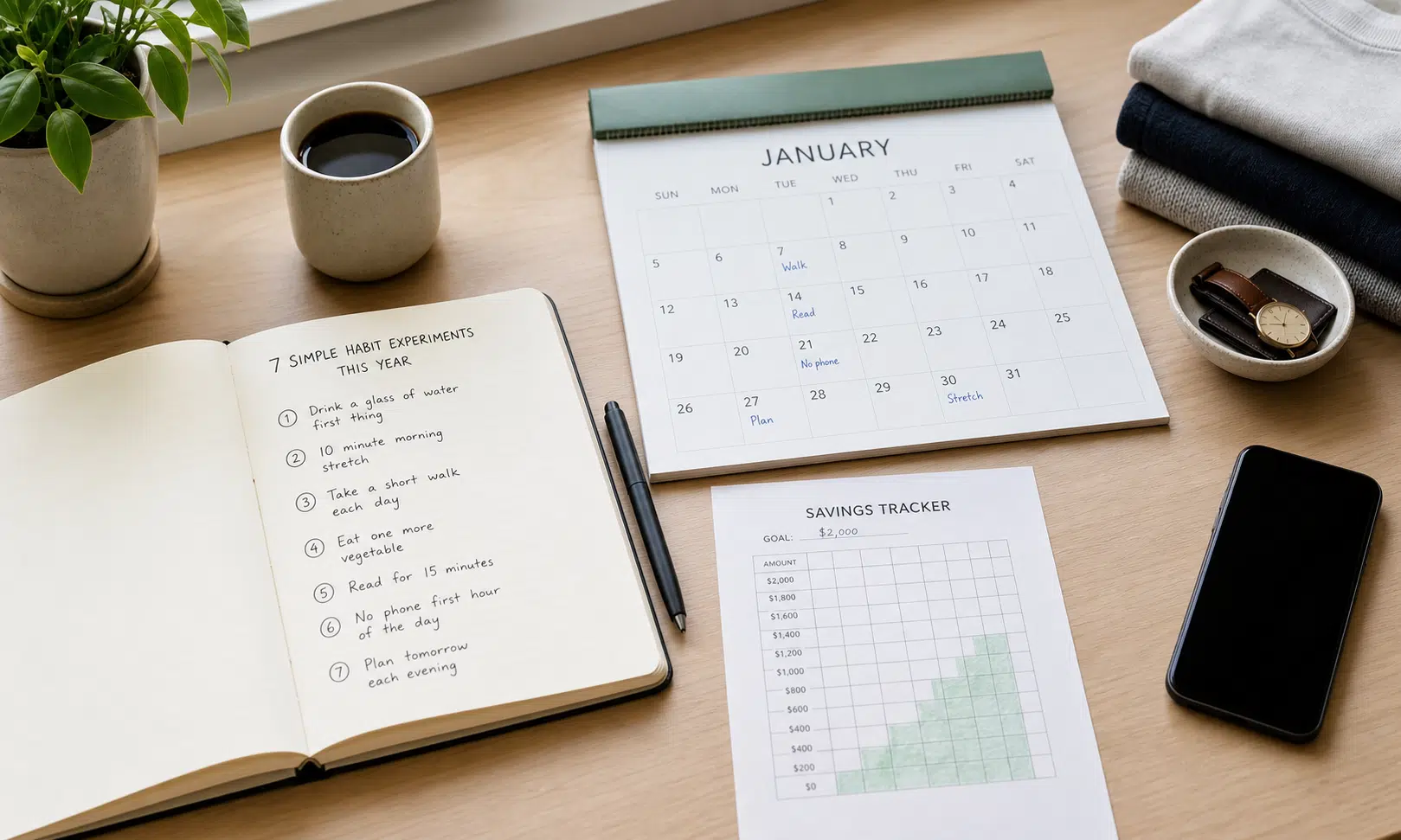

New Year challenges can be useful when they are treated as small experiments, not dramatic personality makeovers. The strongest ones give you a clear rule, a fixed time frame, and an easy way to tell whether the practice is helping.
That is the main value here: each challenge below turns a broad intention, such as saving money, decluttering, spending less time on your phone, or exercising consistently, into a specific system you can test.
The buyer-aware decision is not which challenge sounds most impressive. It is which one you can actually run without creating so much friction that you abandon it in the first week.
Quick Verdict: Pick One Challenge, Not Seven
The best approach is to choose one challenge that fits your current bottleneck. If your space feels chaotic, try the minimalism game. If money habits need attention, try the 52-week savings challenge. If your phone is stealing your mornings, start with the charger experiment before attempting a full screen sabbatical.
Trying all seven at once is likely to blur the feedback. A challenge works best when it gives you a clean signal: this helped, this did not, or this needs to be adjusted.
The Seven Challenges Compared
| Challenge | Best for | Main tradeoff |
|---|---|---|
| 21-Day No-Complaint Experiment | People who want to notice negative speech patterns | Easy to understand, difficult to execute consistently |
| 75 Hard | People looking for a highly structured physical and mental discipline challenge | Demanding schedule; medical guidance is sensible before starting |
| 30-Day Minimalism Game | People who want a concrete decluttering system | Starts easy but becomes harder as the count rises |
| Tech-Free Saturdays | People who need a repeatable break from screens | Requires planning around work, family, maps, payments, and communication |
| 52-Week Money Challenge | People who want a simple savings structure | The weekly amount increases over time |
| 3-Day Phone Charger Challenge | People who want a low-risk reset for mornings and evenings | Small change, but only useful if you stop bringing the phone back to bed |
| Morning Pages | People who process ideas better by writing | Requires uninterrupted morning time |
How Each Challenge Works
21-Day No-Complaint Experiment
This challenge asks you to avoid complaining, criticizing, or gossiping for 21 consecutive days. If you slip, you restart the count. Because the rule is strict, it can quickly show how often casual negativity enters ordinary conversation.
It is best for someone who wants a behavior-awareness challenge rather than a productivity challenge. The setup is simple, but the maintenance is not.
75 Hard
75 Hard is a demanding 75-day discipline challenge associated with Andy Frisella. The commonly described version includes rules around diet, daily water intake, reading, progress photos, and two daily workouts, including one outdoors.
Because the health and training load can be significant, this is the challenge where caution matters most. Anyone considering it should treat it as a serious regimen and consult a medical professional before starting a new health program.
30-Day Minimalism Game
The 30-Day Minimalism Game is a decluttering challenge commonly associated with The Minimalists. The usual structure is simple: remove one item on day one, two on day two, three on day three, and continue that pattern for 30 days.
Its appeal is that the rules are visible and measurable. The hard part is that the challenge becomes more demanding late in the month, when the easy items are already gone.
Tech-Free Saturdays
A weekly screen sabbatical can be useful if digital overload is the problem. The basic idea is to set aside one day each week with little or no use of smartphones, computers, tablets, social media, and similar digital inputs.
This works better with preparation. Tell people how to reach you, print or save anything essential in advance, and make plans that do not depend on constant checking.
52-Week Money Challenge
The 52-week money challenge uses a rising weekly savings amount. In the basic version, you save $1 in week one, $2 in week two, and continue until week 52. Following that formula adds up to $1,378 before any interest.
A doubled version starts at $2, then $4, then $6, rising to $104 in week 52. That formula adds up to $2,756. The benefit is clarity; the drawback is that the later weeks require more room in the budget.
3-Day Phone Charger Challenge
This is the smallest experiment on the list: move your phone charger outside the bedroom for three days. The point is to reduce the chance that your phone becomes the last thing you see at night and the first thing you reach for in the morning.
It is a good starter challenge because the setup cost is almost zero. The result will vary, but the test is short enough to run without overthinking it.
Morning Pages
Morning Pages, inspired by Julia Cameron’s The Artist’s Way, involves writing three pages of stream-of-consciousness thoughts in the morning. It is not meant to be polished writing. It is a clearing practice.
This is best for people who think better after getting thoughts out of their head and onto the page. It is less ideal for someone whose mornings are already tightly scheduled.
How to Choose the Right One
Use the challenge as a diagnostic tool. If you want less clutter, choose the minimalism game. If you want better financial consistency, choose the money challenge. If you want stronger boundaries with devices, choose Tech-Free Saturdays or the charger challenge.
A simple tracking system helps. A journal, spreadsheet, or habit-tracking app is enough; the tool matters less than the consistency of the check-in.
The useful rule is to avoid turning one missed day into a failed month. Miss once, reset quickly, and keep the experiment moving. Small milestones also matter because they keep the challenge from becoming a private endurance contest.
The practical verdict: pick the challenge that solves the problem you actually have, run it long enough to learn from it, and then decide whether it deserves a permanent place in your routine.