


Verdict: Habit Mapping Is Best for People Who Need a Morning System, Not Another Morning Rule
Habit mapping is a practical way to redesign the first hour of your day by walking through it before you actually live it. Instead of copying someone else’s exact morning routine, you map your own sequence of prompts, actions, friction points, and small decisions.
That makes it especially useful if your mornings tend to run on autopilot. If you wake up and immediately check your phone, drift into scattered tasks, or lose time before the day has really started, habit mapping gives you a way to inspect that pattern and replace it with something more intentional.
This is not a product review in the usual sense. There is nothing to buy here unless you choose to support the routine with tools such as an alarm clock, journal, water bottle, workout gear, or a phone charging setup outside the bedroom. The real decision is whether this system is worth testing in your own morning.
How Habit Mapping Works
The basic idea comes from customer journey mapping. Businesses use that method to walk through a customer’s experience step by step, find moments of friction, and improve the overall interaction.
Habit mapping applies the same thinking to your own daily behavior. You become the person designing the experience and the person living it.
For a morning routine, the question is simple: what happens from the moment you wake up through the first hour of the day? More importantly, what should happen if you were designing that hour on purpose?
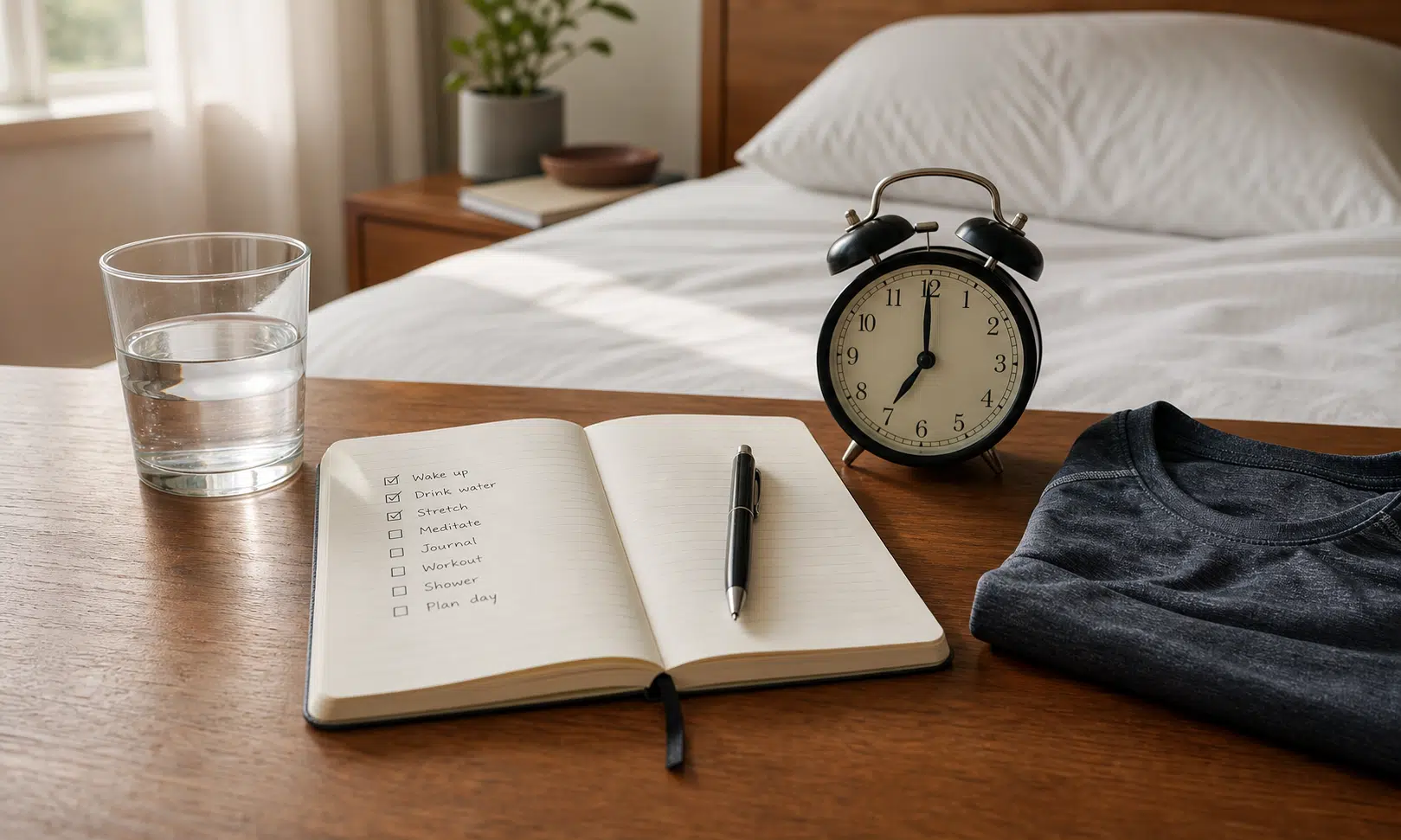
A useful habit map does not need to be complicated. It can be a short sequence of actions written in a notebook or digital note. The value comes from noticing the prompts already around you: where your phone is, what you see first, whether your exercise clothes are available, whether water is easy to reach, and what decision you are likely to face next.

Moleskine Classic Notebook
A dedicated notebook can keep the morning sequence, friction notes, and small adjustments in one place. Use it for the walkthrough list rather than turning the routine into a complicated planning project.
As an Amazon Associate I earn from qualifying purchases.
Setup: The 3-Step Morning Walkthrough
The setup is intentionally physical. You do not just imagine a better morning from your desk. You rehearse it in the actual space where it will happen.
- Lie down where you normally sleep.
- Pretend it is time to wake up.
- Walk through your ideal next actions, step by step, and record the sequence afterward.
That walkthrough might reveal obvious friction. Your phone may be too close to the bed. Your journal may be in another room. Your workout clothes may be buried in a drawer. Your first good action may require three unnecessary decisions.
The goal is not to create a perfect script. It is to design a morning that is easier to follow than the default one.
A sample sequence could look like this:
- Turn off an alarm placed away from the bed.
- Drink a glass of water.
- Do two minutes of light movement, such as jump rope or stretching.
- Write a short gratitude list or morning note.
- Start the first planned task of the day.
Those actions are examples, not a universal prescription. The stronger move is to identify what helps you become alert, steady, and ready for the day without depending on willpower at every step.
Why the Phone Charger Change Matters
One of the clearest applications is moving a phone charger outside the bedroom. That small environmental change removes the easiest prompt for checking notifications or scrolling in bed.
It also changes the first action of the morning. If the alarm is outside the room, you have to stand up to turn it off. Once you are already vertical, the next useful action becomes easier to start.
This is the strength of habit mapping: it focuses less on motivation and more on prompts. If the environment keeps inviting the behavior you do not want, the routine will be harder to maintain. If the environment quietly supports the behavior you do want, the routine has a better chance.

Owala FreeSip Water Bottle
Keeping a filled bottle where you start the day makes the first useful action visible and easy. Choose one that is simple to open, carry, and clean so it does not add another decision in the morning.
As an Amazon Associate I earn from qualifying purchases.
Who Habit Mapping Is For
Habit mapping is a good fit for people who like systems but dislike rigid routines. It gives structure without requiring everyone to wake up at the same time, meditate the same way, or follow a famous founder’s schedule.
It is also useful for people who already know what they want to do in the morning but keep getting pulled off course. In that case, the problem may not be commitment. It may be the sequence, the environment, or the number of small decisions packed into the first few minutes.
Parents, caregivers, shift workers, and people with unpredictable mornings may need a looser version of the system. For them, the useful question may not be “What is my perfect first hour?” but “What are the first three actions that make the day less chaotic?”
Maintenance: Test, Adjust, Repeat
The main weakness of habit mapping is that it will not produce a finished routine on the first attempt. You have to test it in real life.
A practical maintenance loop looks like this:
- Walk through the ideal first hour.
- Try the sequence the next morning.
- Notice what worked, what felt forced, and what broke down.
- Adjust the map and test again.
That trial-and-error process is the point. You may discover that stretching works better than jump rope, journaling works better after coffee, or preparing clothes the night before matters more than any morning decision.
Often, the better morning starts the night before. Laying out clothes, filling a water bottle, moving the phone charger, or clearing the first work surface can remove friction before it has a chance to appear.
Bottom Line
Habit mapping is worth trying if your mornings feel reactive, distracted, or unnecessarily difficult. Its biggest advantage is that it treats your routine as something designed, not something you simply hope will improve.
The system works best when you keep it small, physical, and adjustable. Walk the route. Remove the obvious traps. Make the first good action easy. Then refine the map after the morning has had a chance to test it.
Live by design, not by default.

Anker 3-in-1 Wireless Charging Station
A charging station outside the bedroom can make the phone’s overnight location clear and repeatable. Put it where you naturally end the day so the morning alarm or first check-in is no longer beside the bed.
As an Amazon Associate I earn from qualifying purchases.