OpenAI says it has reorganized its robotics team to work more closely with its research and product groups, while continuing its robotics efforts. The company describes the change as a way to accelerate that work.
Under the arrangement described by OpenAI, robotics researchers are joining the main research team under Chief Research Officer Mark Chen. Applied robotics and hardware teams are moving into the Applied organization led by Greg Brockman.
Co-founder Wojciech Zaremba had previously described shutting down an earlier robotics team. In a 2021 interview, he said limited access to training data had held back its progress.
The restructuring coincides with research into whether general-purpose AI models can control robots. The available results show performance on specific tasks, with substantial differences between simulated testing and physical robot experiments.
Simulation results come with limits
Nvidia researchers reported that an agent powered by GPT-6 Astra achieved a 74.8% success rate on the RoboLab-120 simulation benchmark, compared with 51% for Lakeside, the strongest specialized policy shown on its leaderboard.
The 74.8% result came from an agent-based configuration with persistent context and supporting tools. A configuration that generated robot actions directly reached 66.3%, illustrating that the surrounding system affected the reported performance.
The study used a simulated DROID robot rather than physical hardware. Its simulator paused during model inference, so the experiment did not establish whether the system could respond effectively while its surroundings continued to change.
Nvidia reported that the direct configuration averaged 18.56 seconds per inference call. Its researchers identified latency and computational cost as barriers to practical deployment.
The researchers also cautioned that their evaluation, with five episodes per task, did not establish the statistical significance of differences between configurations. The tasks focused on pick-and-place manipulation and did not cover assembly or highly dynamic situations requiring rapid reactions.
Physical robot tests show low completion rates
In a separate evaluation, StationeryBench researchers compared GPT-6 Astra with Ai2’s MolmoAct2 on five tasks involving desk objects and dual-arm YAM robots. Each model underwent 20 trials per task, for 200 trials overall.
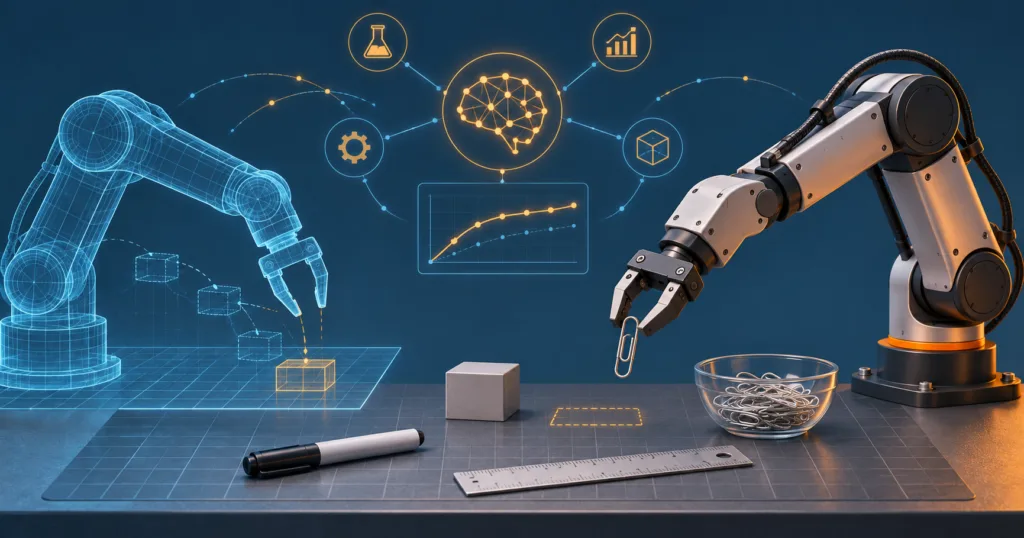
Tasks included removing a marker cap, pouring paper clips into a bowl and passing a ruler between arms. The benchmark authors reported these results:
| Model | Completed trials | Mean progress score |
|---|---|---|
| GPT-6 Astra | 7 of 100 | 46 of 100 |
| MolmoAct2 | 0 of 100 | 12 of 100 |
Progress scores credited intermediate milestones, so a higher score did not necessarily mean a task was completed. Astra’s seven successful trials left most attempts unfinished.
The authors also reported that MolmoAct2’s arms never left their starting pose in 47 of its 100 trials, affecting the comparison.
The authors noted several limitations: graders knew which model they were assessing, MolmoAct2 had no task-specific fine-tuning, and the models were not always tested on the same rig. Those conditions limit broader conclusions about the relative capabilities of general-purpose and specialized robotics models.
Neither evaluation establishes that specialized robotics AI is unnecessary. They measure particular systems under defined conditions, rather than demonstrating reliable robot control across everyday environments.