

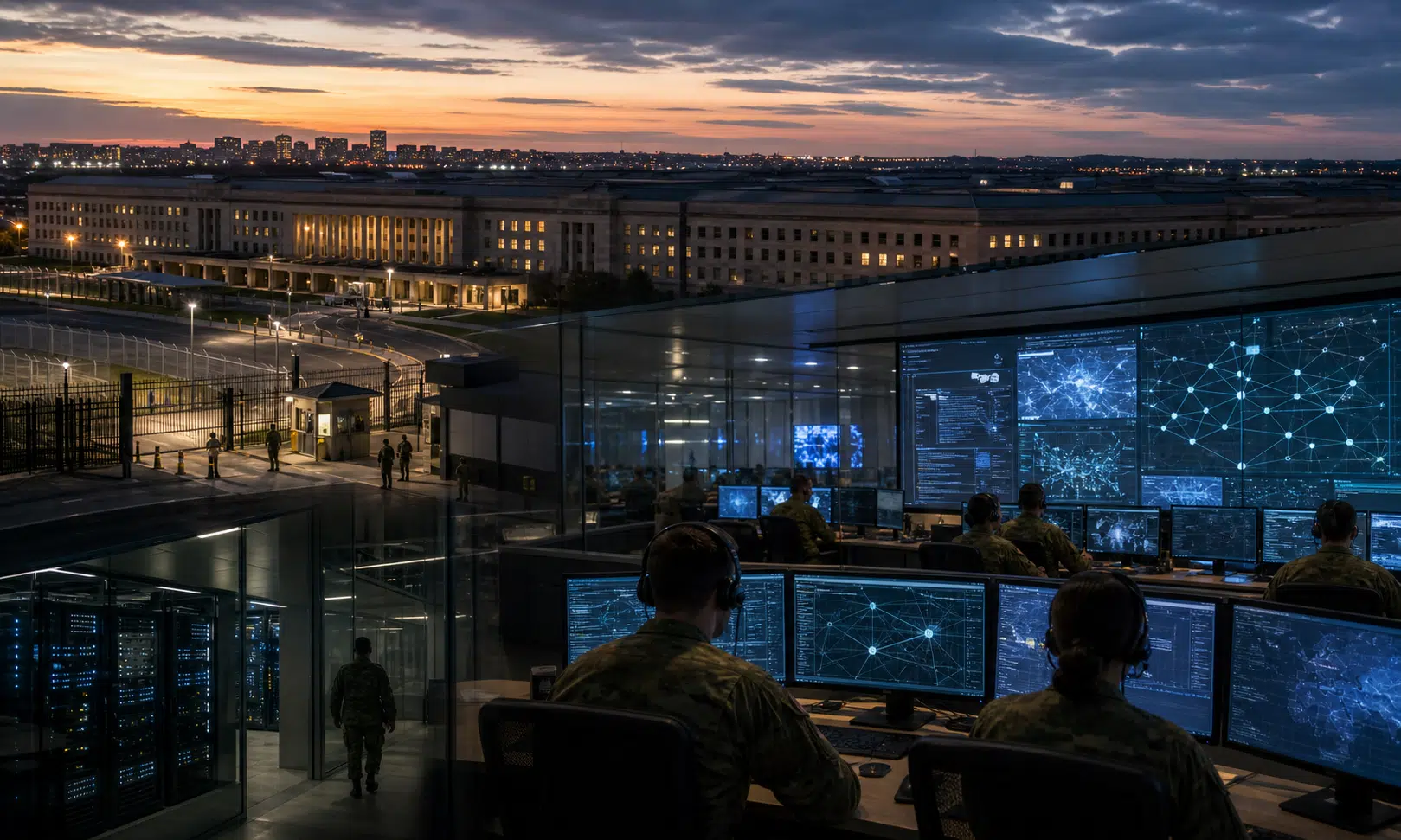

The Pentagon has widened its roster of artificial intelligence suppliers for classified military networks, bringing Google, Nvidia, OpenAI and several other major technology companies into one of the most sensitive areas of government AI adoption.
The agreements cover AI capabilities intended for use inside classified environments, where the Defense Department handles secret and highly restricted national security information. The vendor list includes OpenAI, Google, Nvidia, Microsoft, Amazon Web Services, SpaceX, Reflection AI and Oracle.
For enterprise and public sector technology buyers, the move is a useful signal. The Pentagon is not treating frontier AI as a single-vendor bet. It is building a multi-supplier stack that mixes model providers, cloud platforms, infrastructure companies and newer AI labs, while keeping the systems inside controlled classified networks.
What the Pentagon Agreements Cover
The Defense Department has said the companies will provide resources to deploy AI capabilities in classified network environments, including Impact Level 6 and Impact Level 7 settings. Because the detailed terms have not been fully disclosed, the practical scope of each company’s deployment should be read as still developing rather than as a finished operating model.
Impact Level 6 is associated with classified national security information. Impact Level 7 refers to even more sensitive classified environments, where access, isolation, monitoring and operational controls are expected to be tighter.
The Pentagon’s stated objective is to make advanced AI available for lawful operational use. In practical terms, that could include faster data synthesis, improved situational awareness, internal knowledge work, mission planning support, logistics analysis and other workflows where large volumes of information need to be interpreted quickly.
A firm timeline for broad operational rollout has not been publicly confirmed. That matters for buyers watching the defense market: being named in an agreement is not the same thing as having every model, feature or workflow already live across classified systems.

YubiKey 5C NFC Security Key
For teams thinking about secure AI environments, phishing-resistant multi-factor authentication is one practical layer of access control. A hardware security key can support stronger identity checks for administrators, developers and privileged users.
Why the Vendor Mix Matters
The list of companies shows how defense AI procurement is moving beyond chatbot access. OpenAI and Google bring frontier model capability. Microsoft, AWS and Oracle bring cloud and classified infrastructure relationships. Nvidia adds hardware, AI software and model assets. SpaceX’s inclusion connects the effort to a company already deeply embedded in national security technology. Reflection AI gives the Pentagon exposure to a newer specialist lab.
That mix matters because classified AI is not only about model quality. It depends on secure deployment, auditability, access controls, data handling, latency, compute availability and the ability to operate within government-specific security boundaries.
For commercial buyers, the lesson is straightforward: AI vendor selection increasingly looks like architecture selection. A company may choose one model for coding, another for search or analysis, and a different infrastructure provider for regulated workloads. The Pentagon’s approach reflects that same logic at a far higher security level.
The agreements also suggest that the government wants negotiating room. Relying on one model provider would create pricing, resilience, policy and technical risks. A broader supplier base gives the department more options if a model underperforms, a vendor changes terms, or a particular use case requires different safeguards.
Anthropic Remains Outside the Group
One of the most notable absences is Anthropic, the company behind Claude. Public reporting has described a dispute between Anthropic and the Pentagon over acceptable AI use terms, including questions about model access, surveillance-related limits and autonomous weapons concerns. Those details have not all been independently tested in public, so the dispute should be understood as contested rather than fully settled.
Anthropic has previously been an important AI supplier in government and defense-adjacent settings, particularly through partners that deliver tools into secure environments. Its absence from this round highlights a larger issue that will keep appearing in government AI procurement: how much control a customer receives, and where a vendor’s safety policy sets boundaries.
The Pentagon has signaled that it does not want to depend on a single AI company. That stance is commercially rational, but it also raises governance questions. When several advanced systems are available inside sensitive workflows, agencies need clear rules for model selection, output review, logging, escalation and human decision-making.
Responsible AI in the Enterprise
Readers building regulated AI programs may need a practical reference for explainability, fairness, model governance and monitoring. This title is better suited as background reading than as a substitute for formal legal, security or procurement review.
Buyer Takeaways for Regulated AI Programs
The Pentagon’s AI push is unusual because of its security level, but the pattern is familiar to banks, healthcare providers, utilities and other regulated enterprises. The harder part is rarely getting access to a model. The harder part is deciding where the model can run, what data it may touch, who can use it, how outputs are reviewed and what happens when a system is wrong.
That makes classified AI a useful stress test for enterprise AI governance. If a tool is expected to support high-stakes decisions, buyers need more than performance benchmarks. They need deployment controls, contractual clarity, evaluation records, incident procedures and a clear division of responsibility between vendor and customer.
The same lesson applies to procurement teams. A vendor’s public model ranking does not answer whether it can meet security requirements, support private deployment, integrate with existing identity systems, retain audit logs, or operate under strict data residency and access rules.
The Pentagon’s agreements do not resolve every question about military AI. They do, however, show that frontier AI is moving from pilot projects into controlled production environments, including some of the most sensitive networks in the US government.
For technology leaders outside defense, the signal is clear: AI adoption is becoming a systems problem. The winning strategy is not simply choosing the most capable model. It is building a governed portfolio of models, infrastructure and controls that can survive real operational scrutiny.