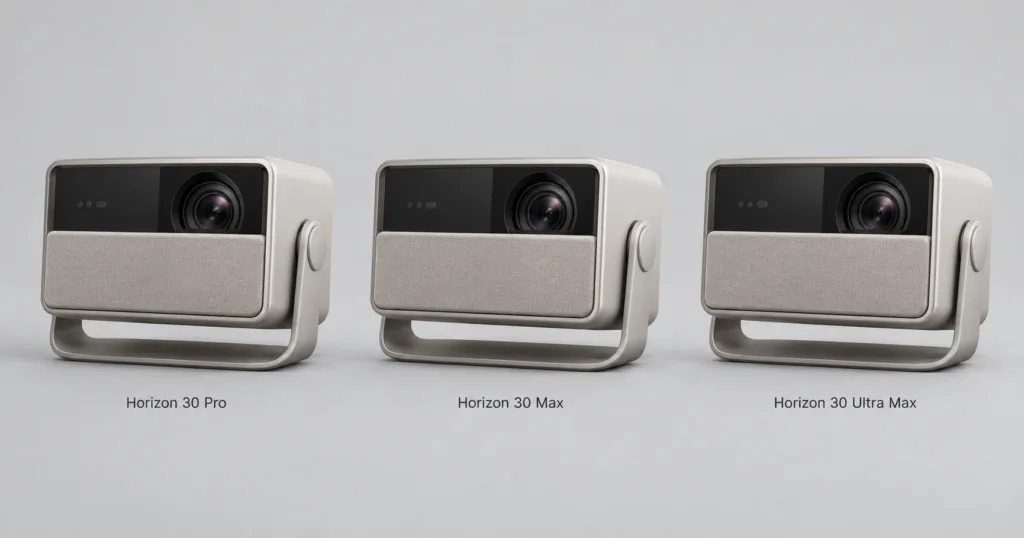
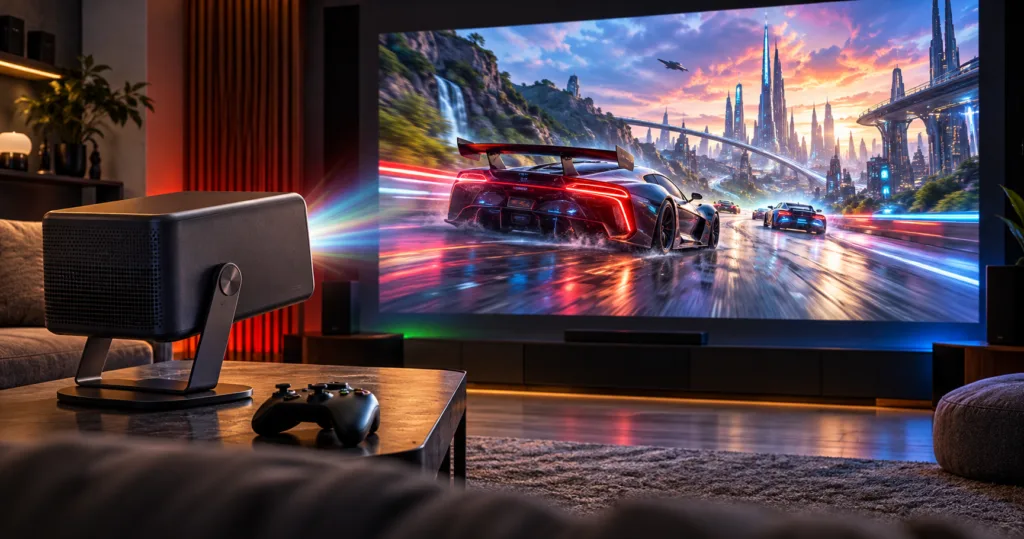
Sony, Optoma, Anker and Xgimi have outlined their arguments for home cinema projectors alongside increasingly large televisions, pointing to room flexibility, portability and dedicated cinema installations. Their responses emphasise differences in how the displays fit into homes, with Sony also highlighting widescreen presentation and the ability to place speakers behind a projection screen.
The companies described several distinct uses for projection, ranging from compact devices moved between rooms to permanent installations with concealed equipment. Those arrangements offer different practical benefits, so their arguments extend beyond a direct comparison between a television and a projector producing the same size image.
Xgimi founder and CEO Apollo Zhong characterised the relationship as one in which both technologies have a role. “We don’t really see larger TVs as a threat. If anything, they confirm that people want bigger and more immersive screens. We also don’t think it’s a zero-sum competition. TVs and projectors solve different problems.”
That interpretation is Xgimi’s assessment of the market. The more specific distinctions raised by the manufacturers concern what occupies the room between viewing sessions, how equipment reaches its destination and which screen and speaker arrangements a home cinema can accommodate.
Retractable screens and room design
Optoma’s UK sales manager, James Fitzgerald, said projection can provide a large image without making a large display a permanent visual feature of a living space. He identified that distinction as relevant to homes where the same room serves several purposes.
“Projection continues to offer something televisions cannot easily replicate: a truly cinematic experience at 100, 120, 150 inches and beyond, without requiring a permanently dominant screen in the room,” Fitzgerald said.
“As homes become more multi-purpose and design-conscious, many consumers still value the ability to enjoy a large-screen experience when they want it while keeping their living spaces flexible and uncluttered,” he added.
Anker’s Faraz Mehdi, managing director for the UK, Ireland, Italy, Spain and Portugal, made a similar argument about the physical presence of the equipment. “Projectors are compact in size, take up no wall space, and become ‘invisible’ once turned off.”
Zhong also focused on the distinction between the projected image and a television’s permanent screen. “A 100-inch TV is still a large piece of furniture that takes up space all day, every day,” he said. “A projector gives you the same scale when you want it, but doesn’t permanently occupy your room when you don’t.”
Sony Europe’s product marketing manager for home projector and Bravia, Adrian Bond, described a specific installation that supports that argument: concealed projection equipment paired with a retractable projector screen.
“A projector in hidden housing with a retractable projector screen is vastly more discreet and flexible in aesthetics than a monolithic super-large screen TV,” Bond said.
The distinction depends on the installation. Bond’s example includes both hidden housing and a screen that retracts; switching off a projector alone does not conceal a separate, permanently installed screen. The manufacturers’ descriptions therefore cover different levels of discretion, from a compact device to an integrated system designed around the room.
Their shared emphasis was on the space between viewing sessions. A television remains a physical display when switched off, while the arrangements described by the companies allow the projected image, and in some cases the screen and equipment, to disappear from view.
Portability and installation present different advantages
Optoma and Anker also highlighted movement between locations, an argument particularly relevant to the compact and portable models they produce. This concerns the ability to reuse a device in different settings, rather than the appearance of a permanent home cinema installation.
“Many of today’s projectors also offer a level of flexibility that televisions simply cannot match,” Fitzgerald said, “with compact designs that can be moved easily from room to room, taken to different locations, or set up indoors and outdoors depending on the occasion.”
Mehdi pointed to a similar range of settings. “They allow portability, being easily moved and used in various settings such as bedrooms, living rooms, and campsites, which TVs cannot offer.”
Those comments concern portable projection. A projector concealed in housing or mounted as part of a dedicated cinema serves a different purpose from one intended to move between bedrooms, living spaces and outdoor locations. The room-design and portability arguments should therefore be understood as benefits of particular configurations, rather than features shared equally by every projector.
Bond raised a separate logistical issue for permanent installations: getting very large equipment into a building and into position. His comparison concerned a 115-inch television, rather than a smaller display that could be moved more readily.
“Transporting, manoeuvring and installing a 115-inch TV is far more challenging than hanging a projector and screen, especially for any premium install in a high-rise apartment building,” he said.
In that example, the claimed benefit is the handling of separate projection components during installation. It is distinct from Anker’s and Optoma’s descriptions of equipment that can be relocated repeatedly after setup. Both arguments concern physical flexibility, but at different stages of a system’s use.
Sony points to viewing angle and CinemaScope screens
Sony’s position spans both display categories because it produces televisions as well as projectors. Bond acknowledged the appeal of very large TVs while arguing that dedicated projection retains advantages for some cinema installations.
He described Sony’s projectors as offering “a different, elevated and more precise experience for the discerning cinephile.” That is Sony’s assessment of the experience, rather than an independently established finding that projectors are categorically superior to televisions.
“A 100-inch+ TV is an epic viewing experience for sure”, Bond said, referring to Sony’s FWD-115XR95M2 as a television intended to deliver that scale. He nevertheless argued that projection has an advantage when the aim is to fill more of the viewer’s field of vision.
“But for the fully immersive experience that engulfs the peripheral vision and has a wider angle, then dedicated home cinema projectors are superior,” he said.
Image size and viewing distance remain relevant to that comparison. A sufficiently large television viewed from an appropriate distance can also occupy a wide field of vision, so that effect does not establish an advantage inherent to projection alone. Bond’s other arguments concerned the configuration of the screen and audio system.
On screen shape, he distinguished a television’s fixed panel from a projection system built around a CinemaScope screen.
“A TV at 100+ inches will still be fixed in 16:9 aspect ratio due to its form factor,” Bond said. “To watch in CinemaScope, you will still incur the black bars at the top and bottom of your screen, whereas with a home cinema projector and screen, you can enjoy CinemaScope as intended, on purpose-built screens.”
His claim concerns the relationship between the film’s aspect ratio and the screen used to display it. A larger 16:9 television retains the same proportions, whereas the projection arrangement he described uses a screen chosen for widescreen cinema presentation.
That benefit is tied to the purpose-built setup in Bond’s example. It does not follow simply from replacing a television with any projector: the screen format is part of the arrangement he cited. This makes the aspect-ratio argument separate from the question of how large an image either technology can produce.
Projection screens can accommodate speakers behind the picture
Bond also highlighted an audio installation option: placing a dedicated centre-channel speaker directly behind a screen that allows sound to pass through. His example involved micro-perforated or woven screens, rather than projection surfaces generally.
“With premium micro-perforated or woven projector screens, super high-end centre speakers can be placed directly behind the screen, perfectly matching audio with the action/dialogue on screen,” he said.
The physical arrangement places the speaker behind the visible action. It reflects the approach used in cinemas, where sound can originate from behind the image, and gives the installer a way to align dialogue with the screen’s position.
This differs from the frame-mounted or rear-mounted speakers typically used in televisions. Bond’s example also involves a separate centre-channel speaker as part of a cinema sound system, so it is a distinction in installation architecture as well as display technology.
The speaker-placement option does not, by itself, establish that every projection system sounds better than every television system. The specific advantage Bond identified depends on a suitable screen and a speaker installed behind it. His argument concerns the ability to accommodate that arrangement within a dedicated home cinema.