


What Changed in the Kyiv Risk Picture
Russia has increased pressure on foreign governments to reduce their presence in Kyiv, telling the United States that Moscow is preparing what it called “systematic” strikes on the Ukrainian capital. The message was delivered by Russian foreign minister Sergei Lavrov during a phone call with US secretary of state Marco Rubio on Monday.
Rubio later said Russia had sent a warning not only to Washington but to embassies more broadly. The practical effect is clear: Moscow is trying to put diplomatic missions, aid organisations, businesses, and foreign citizens on notice before a possible escalation in attacks on Kyiv.
Ukraine’s response has been to frame the warning as coercion. Ukrainian foreign minister Andrii Sybiha urged allies not to yield to what he called Russian blackmail. Katarina Mathernova, the head of the EU mission in Kyiv, said the European Union would remain in the city and continue supporting Ukraine.
For decision-makers, the issue is not whether Kyiv has suddenly become a safe or unsafe city. It has been under threat throughout the war. The more useful question is whether Russia’s public warning changes the risk calculus for people and organisations operating there.
| Group | Main decision | Source-backed signal to watch |
|---|---|---|
| Embassies | Whether to reduce staff, relocate functions, or stay visibly present | Russia’s direct warning to diplomatic missions and allied responses |
| Aid groups | Whether to pause, remote-manage, or harden Kyiv operations | Damage to civilian areas, transport disruption, and casualty reports |
| Businesses | Whether staff travel, supplier visits, and in-person work remain justified | Frequency and intensity of missile and drone attacks |
| Residents | How to balance routine, work, and shelter discipline | Official alerts, local damage, and emergency-service guidance |
Kyiv Keeps Moving After the Latest Strikes
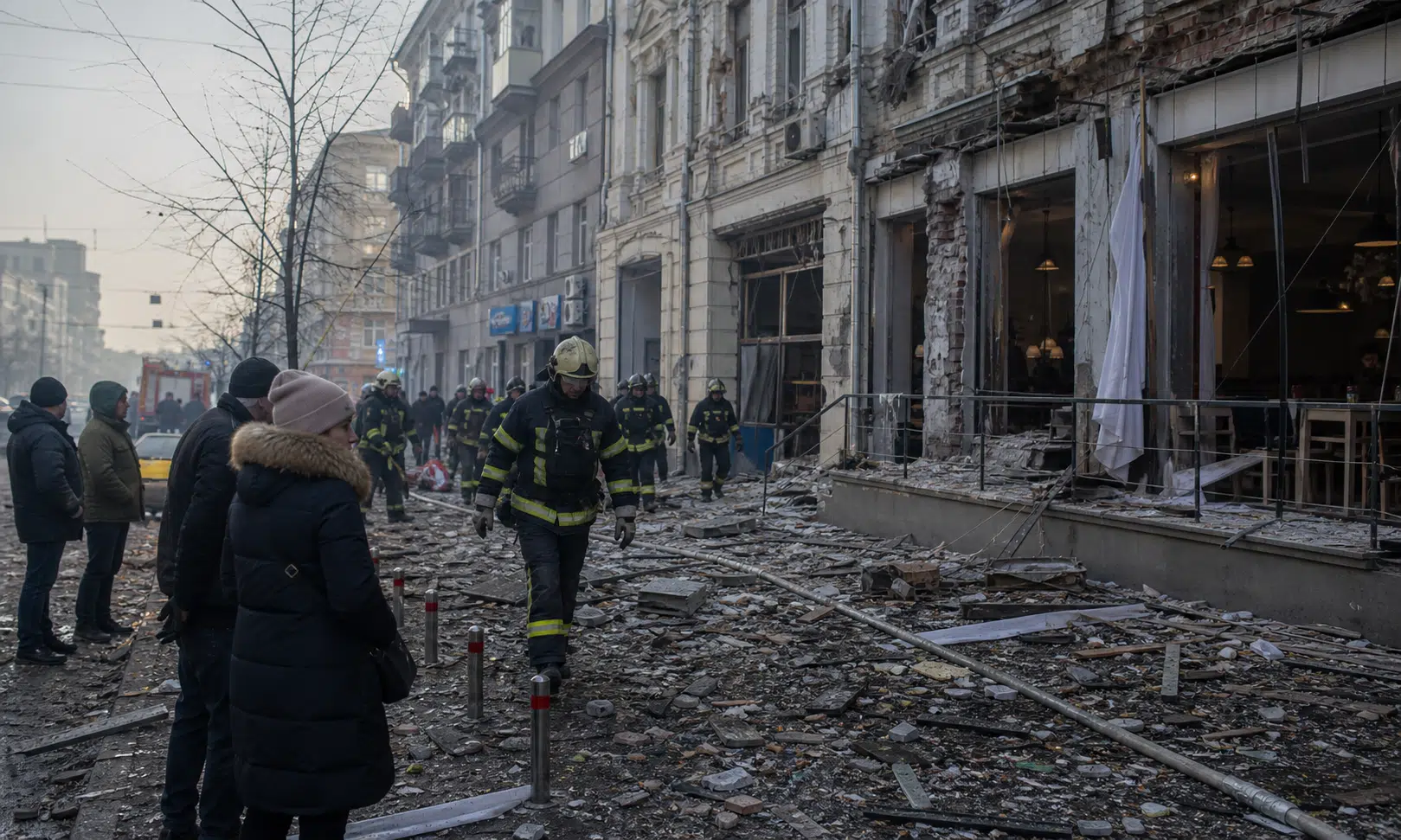
The warning followed a heavy Russian attack on Kyiv over the weekend. Ukrainian authorities said at least four people were killed and 91 injured in Sunday’s strikes. More than 70 foreign diplomats visited the damaged Lukyanivka neighbourhood afterward to pay respects to the victims.
The visible damage was severe, but daily life did not stop. Residents returned to cafes, terraces, streets, and schools on Monday. Some described a kind of exhausted familiarity with danger after more than four years of war.
One firefighter, Roman, said people had become used to the attacks and that emotions often moved into the background while cleanup work continued. Nearby, children played close to damaged buildings as adults warned them about broken glass.
A damaged cafe became one of the most pointed examples of the city’s routine under pressure. Residents queued to support the business after a strike blew out windows. The owner, Yevgen Prusak, was described in local accounts as drawing attention online after serving hot drinks to rescuers through the damaged storefront; that account has not been independently verified here. He said he had thought the cafe might close for good, but the return of customers made the purpose of the work clear.
The Kyiv-Mohyla Academy was also among the damaged buildings. Students still came to class. One student, Mykola, said life was not stopping, although he also said the attacks affected sleep more than anything else.
That mixture of defiance, fatigue, and routine matters for anyone assessing Kyiv from outside the country. A city can be functioning and still be under serious threat. Normal activity should not be mistaken for normal risk.
How to Read Moscow’s Warning
Russia’s message serves several purposes at once. It warns foreign governments. It tries to create pressure inside allied capitals. It signals to Ukrainians that Moscow can escalate against the capital. It also gives Russia a public pretext before additional attacks.
The warning does not prove exactly when, where, or how Russia will strike. It does, however, raise the cost of assuming that recent attack patterns will simply continue unchanged.
For embassies and international organisations, the decision is not binary. Staying in Kyiv can be a political signal of support. Reducing visible presence can protect staff while preserving essential diplomatic or operational work. The tradeoff is between solidarity, continuity, and duty of care.
- Staying fully present signals confidence and support for Ukraine, but increases exposure if strikes intensify.
- Partial relocation can preserve core work while lowering staff risk, but may be read politically by Moscow and Kyiv.
- Remote operations reduce exposure, but can weaken local coordination and public confidence.
Wider Pressure Across Ukraine
Kyiv was not the only focus of the war’s latest violence. Ukraine said it continued striking Russian infrastructure and industrial assets, including an oil depot in Russia’s Bryansk region that Kyiv’s general staff described as part of the fuel supply chain for the Russian army.
In Russia’s Belgorod region, local authorities said a missile and drone attack cut power and water supplies and killed one man. The Russia-installed head of parts of Donetsk region, Denis Pushilin, said seven people were killed in Ukrainian attacks. Those reports could not be independently verified here.
Inside Ukrainian-held territory, officials reported more casualties from Russian attacks. In Kherson region, the regional governor said two people were killed and 16 wounded over 24 hours. Near Kharkiv, a missile attack on Derhachi killed two people and injured more than 20, according to officials.
In Odesa, the city’s top official said one person was killed and three injured in a Russian strike. Officials also reported 14 wounded in Dnipropetrovsk region, where emergency services said drones hit a nine-storey apartment building in Pavlohrad. In Kramatorsk, the Ukrainian-held Donetsk regional governor said 12 people were hurt.
The pattern is familiar but important: Russia’s warning about Kyiv is happening within a broader exchange of strikes, infrastructure attacks, and civilian harm across multiple regions.
Border Concerns and Diplomatic Signals
Ukraine is also tightening security around its northern border with Belarus because of the threat of renewed Russian attacks from that direction. That concern coincided with a symbolic visit to Kyiv by exiled Belarusian opposition leader Sviatlana Tsikhanouskaya, her first visit to Ukraine.
Tsikhanouskaya visited the grave of Maria Zaitseva, a Belarusian woman who took part in anti-Lukashenko protests and later supported Ukraine’s defence before being killed. She described Zaitseva as part of a generation that sees Belarusian and Ukrainian freedom as inseparable.
The visit matters because Belarus remains tied to the strategic geography of the war. Even when the front line is elsewhere, the northern border shapes Ukrainian security planning.
President Volodymyr Zelenskyy, in his nightly address on Monday, said Ukraine had made little progress with the United States on expanding anti-missile defence production. He also said Kyiv expected new diplomatic measures from Washington.
Practical Verdict: The Warning Raises Risk, But It Is Also Political Pressure
For diplomats, aid organisations, companies, and analysts, the most practical reading is this: Russia’s warning should be treated as a serious risk signal, not as a reason to accept Moscow’s framing at face value.
The safest decision depends on exposure. A small aid team with limited evacuation options faces a different calculation from an embassy with hardened facilities and layered contingency planning. A foreign business sending staff into Kyiv for non-essential meetings has a weaker case than an organisation delivering critical humanitarian support.
The next signals to watch are concrete: whether foreign missions reduce staff, whether Ukraine reports a shift in the scale or targeting of strikes on Kyiv, whether air-defence needs become more urgent in public statements, and whether Washington announces new diplomatic or military support.
Kyiv’s resilience is real. So is the danger. The mistake would be to read one as cancelling out the other.