


Sam Altman’s wealth has often been discussed through the lens of OpenAI, the company he leads. But his recent court appearance pointed to a different source of financial power: a wide portfolio of private and public technology investments.
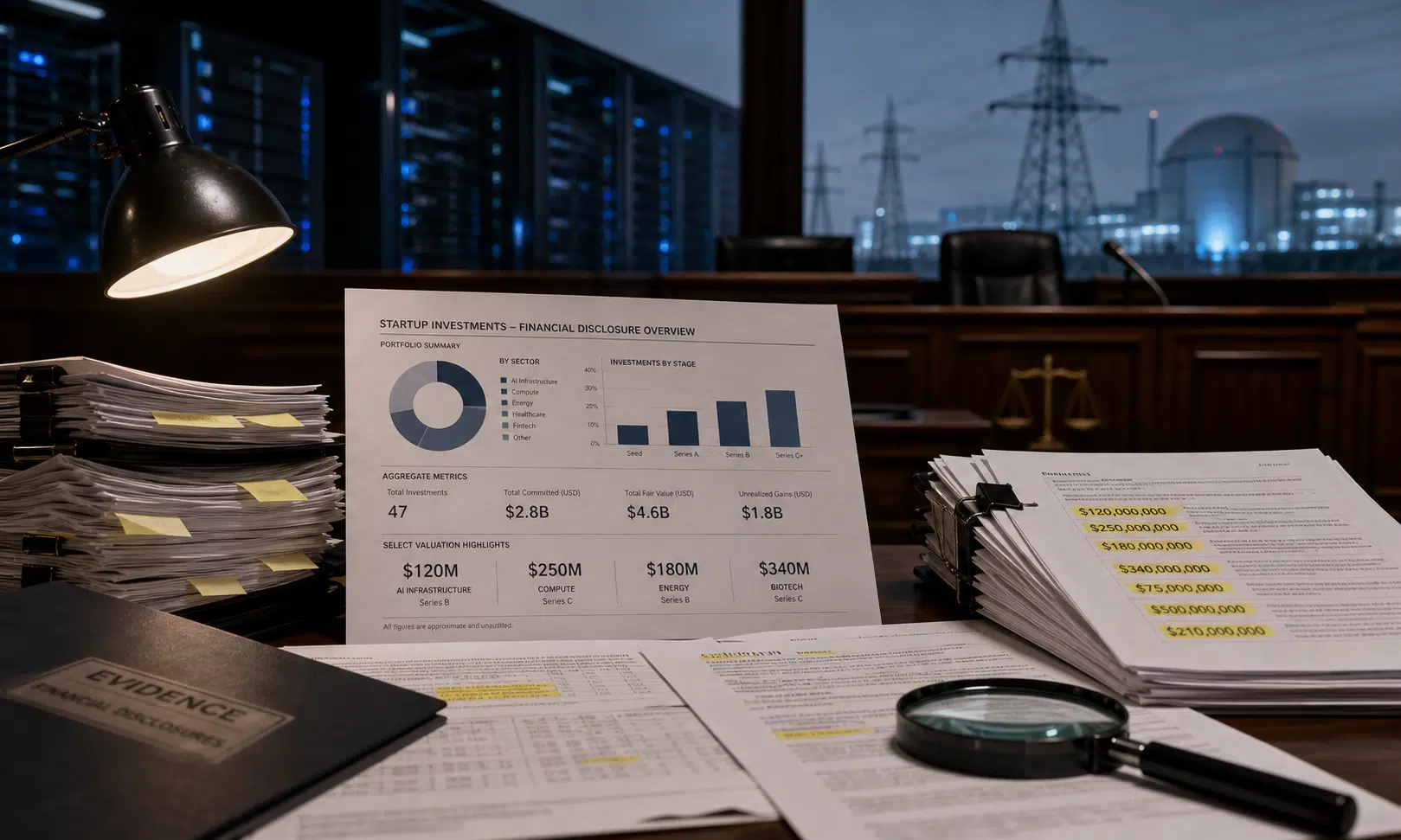
During testimony in the trial over OpenAI’s shift toward a for-profit structure, Altman was shown a document he had signed on April 24. The exhibit offered an unusually detailed snapshot of his holdings in several prominent startups and technology companies, including Helion Energy, Stripe, Retro Biosciences, Formation Bio, Cerebras and Reddit.
The numbers matter because they help explain why questions about conflicts of interest have become central to scrutiny of OpenAI’s business decisions. Altman has said he does not own OpenAI equity, but the exhibit showed that he has large financial interests in companies that sit close to OpenAI’s orbit, especially in energy, AI infrastructure and data.
Helion Is The Biggest Number In The Filing
The largest stake disclosed in the exhibit was Altman’s position in Helion Energy, a nuclear fusion startup. According to the testimony described in the court proceedings, Altman said his Helion stake was worth more than $1.6 billion as of the end of 2025.
That figure is far above the $375 million Altman invested when he led Helion’s Series E round in November 2021. Altman said his first investment in the company was in 2015 and that he has participated in multiple funding rounds since, though that detail has not been independently verified beyond the courtroom account. He also estimated that he owns roughly one-third of the company and said he has warrants to buy more shares.
Helion is not just another venture investment in this context. The company is working on fusion power, a technology that, if commercialized, could become important to energy-hungry AI companies. OpenAI has been in discussions around a power purchase agreement with Helion, making Altman’s ownership stake especially relevant to the conflict-of-interest questions raised in court.
Fusion remains speculative. It promises enormous upside because it could eventually provide a major source of clean, reliable energy. But commercial fusion has also been a long-running technical challenge, and investors face the risk that timelines, costs or engineering limits could move slower than company ambitions.
For buyers, enterprise customers and investors evaluating AI infrastructure, the Helion discussion is a reminder that power supply is becoming part of the AI stack. Chips, models and data centers get most of the attention, but energy contracts may become just as strategically important if demand keeps rising.

Data Center Handbook
This handbook gives readers a practical reference for how modern data centers are planned, powered, cooled and operated. It is most useful for readers who want technical context behind the energy and infrastructure issues shaping AI growth.
As an Amazon Associate I earn from qualifying purchases.
The Startup Stakes Disclosed In Court
The exhibit listed several of Altman’s major holdings, with Helion far ahead of the rest by disclosed value. The figures also show how diversified his wealth is across financial technology, longevity research, pharmaceuticals, AI chips and online platforms.
| Company | Disclosed stake value | Why it matters |
|---|---|---|
| Helion Energy | More than $1.6 billion | Fusion startup tied to possible AI energy demand and a potential OpenAI power deal |
| Stripe | $632 million | Large private fintech company with major payments infrastructure value |
| Retro Biosciences | $258 million | Antiaging and longevity research company backed by Altman |
| Formation Bio, formerly Trialspark | $19 million | Pharmaceutical company in the broader biotech and drug development market |
| Cerebras | $3 million | AI chipmaker preparing for an IPO, according to the source account |
The numbers do not mean each holding is easy to sell or convert into cash. Private-company valuations can change quickly, and large stakes in private startups are usually illiquid. Still, the exhibit helps explain how Altman can be a billionaire without OpenAI shares.
That distinction is important. Altman’s financial position is not primarily presented here as a traditional founder-equity story. Instead, it looks more like the product of early and concentrated bets on companies that later became significant parts of the technology economy.
Why The Helion And OpenAI Connection Drew Scrutiny
The trial placed Altman’s investments under a microscope because Elon Musk is challenging OpenAI’s for-profit direction. Musk’s side has argued that OpenAI’s founders and executives benefited from a structure that moved the organization away from its original nonprofit mission.
Within that broader argument, Helion became a useful example for Musk’s attorneys. A power arrangement between OpenAI and a company in which Altman holds a major stake would naturally raise questions about governance, approval processes and recusal.
Former OpenAI board member Shivon Zilis was described as testifying that she was on the board when she first heard about a potential OpenAI deal with Helion, though that account has not been independently verified. The source account says she expressed concern because both Altman and Greg Brockman were investors. It also says she called the proposal unexpected and questioned why OpenAI would make a major bet on speculative technology; that specific account has not been independently verified.
Musk attorney Steven Molo also questioned Altman about the proposed Helion power deal and whether he was involved on both sides. According to the court account, Altman said he spoke with people at OpenAI about the deal but recused himself from the decision and final approval of terms. He also said he did not sign the agreement.
Altman stepped down as Helion’s board chair in March 2026, according to the source account. That timing does not erase the conflict questions, but it is relevant to how governance around the relationship may be viewed going forward.
Reddit Added Another Conflict Question
The questioning also turned to Reddit, where Altman has a long history. He briefly served as interim CEO and held a sizable position through direct shares and venture funds.
Around Reddit’s March 2024 IPO, Altman controlled roughly $300 million in Reddit shares, according to the court account. A few months later, Reddit and OpenAI announced a major content licensing deal. That sequence gave Musk’s attorney another opening to ask whether Altman had a conflict.
Altman answered yes, according to the account, and said he went through a recusal process at OpenAI. The questioning was interrupted by a recess before the exchange developed further.
The Reddit example differs from Helion but points to the same governance issue. OpenAI’s commercial relationships increasingly touch companies across media, data, computing and infrastructure. When its CEO has investments in some of those companies, buyers, partners and regulators are likely to care less about whether a conflict exists in the abstract and more about how it is managed in practice.
What The Disclosures Say About Altman’s Wealth
Altman’s financial profile is unusual because OpenAI is central to his public identity, yet the disclosed wealth sits elsewhere. His largest known stake from the exhibit is Helion, followed by Stripe and Retro Biosciences.
Those investments reflect several themes that have shaped Altman’s career: frontier technology, long time horizons, large capital needs and markets that could become enormous if the science or infrastructure works. Helion fits the energy side of that pattern. Cerebras fits the AI hardware side. Retro Biosciences and Formation Bio point toward biotech and longevity.
For investors and business buyers watching the AI market, this matters for two reasons. First, it shows how closely linked AI’s next phase may be to sectors outside software, especially power and chips. Second, it highlights why governance around conflicts is becoming a core business issue for companies operating near OpenAI.

Venture Deals
Venture Deals explains term sheets, financing rounds, warrants and investor rights in plain business language. It pairs well with the article’s discussion of private stakes that may be valuable but difficult to convert into cash.
As an Amazon Associate I earn from qualifying purchases.
How To Read The Numbers Without Overreading Them
The exhibit gives a rare look at Altman’s holdings, but it should not be treated like a full personal balance sheet. The disclosed values are snapshots tied to particular companies and a particular moment. They do not necessarily reflect liquidity, tax obligations, debt, changes in private valuations or other assets and liabilities.
A $1.6 billion private-company stake is not the same as $1.6 billion in cash. Startup valuations can rise or fall based on funding rounds, market demand, technical milestones and investor appetite. A stake in a private fusion company also carries a very different risk profile from public shares in a mature company.
The same caution applies to smaller holdings. A $3 million stake in Cerebras may be small next to Helion, but Cerebras is still relevant because it sits in the AI chip market, where supply, performance and cost are central to the industry’s future. The dollar value is modest in the exhibit, but the strategic category is not.
The Practical Takeaway
The court appearance did not simply show that Altman is wealthy. It showed how his wealth is connected to the same markets that are becoming critical to OpenAI’s future: energy, data, chips, fintech infrastructure and biotechnology.
That overlap is why the disclosures are commercially important. They give investors, partners and competitors a clearer view of where Altman’s personal financial interests sit, and they sharpen questions about how OpenAI manages deals involving companies connected to its leadership.
The most important disclosed figure is Helion, both because of its size and because of its potential relationship with OpenAI’s power needs. The Reddit discussion adds a second example, this time involving data and content licensing. Together, they show why recusal processes, board oversight and transparent governance will remain central to how OpenAI’s business relationships are evaluated.

Valuation
Valuation is a detailed reference for understanding how companies are valued and why headline numbers can differ from realizable economic value. It is best suited to readers who want a finance-heavy framework for interpreting private-market figures.
As an Amazon Associate I earn from qualifying purchases.