

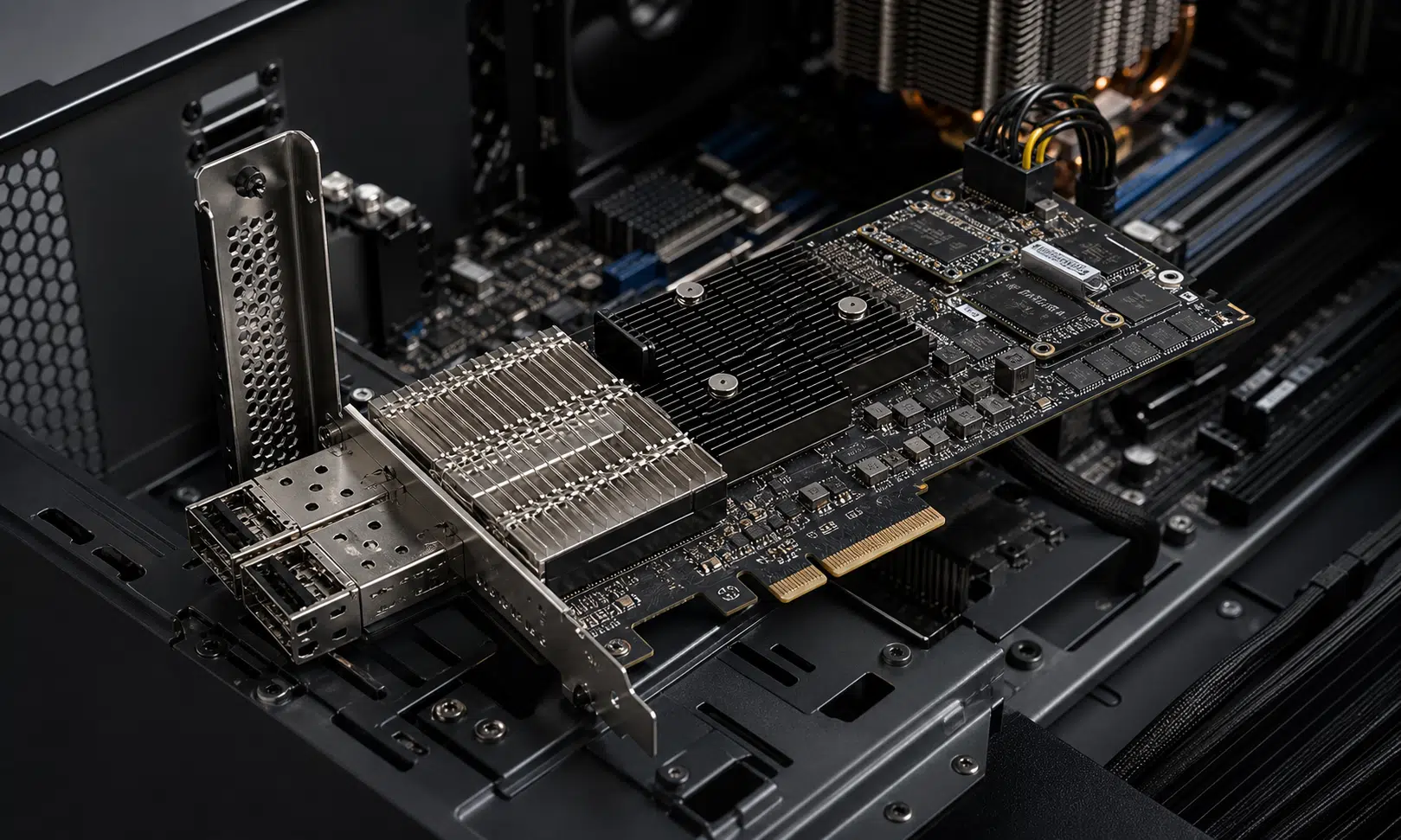

Senao’s SX906 is the kind of PCIe card that makes the usual SmartNIC label feel a little too small. The company is positioning it as a network-focused card built around Intel’s Xeon 6 SoC platform, but the spec sheet reads much closer to a compact server that happens to live in a dual-slot add-in-card format.
The headline configuration is the one likely to get attention: up to 38 Xeon cores, up to 64GB of ECC memory, two M.2 NVMe SSD slots, and dual 100G QSFP28 networking. In the higher-end configurations, Senao lists total network throughput of up to 200GbE. That puts the SX906 in a narrow but interesting category for buyers looking at edge compute, packet processing, media workloads, or security appliances where moving data and processing it locally matter more than fitting into a conventional server layout.
What Senao Is Packing Onto The Card
The SX906 is presented in three processor configurations based on Intel Xeon 6 SoC parts: the Xeon 6523P-B, Xeon 6553P-B, and Xeon 6563P-B. Senao’s listed options scale from 24 cores to 38 cores, with power envelopes that run from 295W to 355W depending on the model.
| Configuration | Listed cores | Listed frequency | Power envelope | Network throughput |
|---|---|---|---|---|
| Xeon 6523P-B | 24 | 2.5GHz | 295W | Up to 100GbE |
| Xeon 6553P-B | 36 | 2.6GHz | 355W | Up to 200GbE |
| Xeon 6563P-B | 38 | 2.4GHz | 355W | Up to 200GbE |
All three versions are listed with support for up to 64GB of 4-channel DDR5-4600 ECC memory, two M.2 2280 NVMe SSD slots, and up to 128GB of eMMC storage. The 36-core and 38-core versions are also described as adding a media transcode accelerator, which would make those models more relevant for workloads that need both network throughput and local processing.
That combination is the main point. A typical network adapter moves packets. The SX906 appears designed to inspect, process, store, or transform data close to the network interface itself, reducing the need to hand everything back to the host CPU.
The Physical Design Is Just As Unusual
Senao lists the card at 266 x 98.4 x 40.6mm and around 1kg. Power comes through both the PCIe edge connector and a 16-pin 12VHPWR connector, the same broad power-connector class associated with high-end graphics cards. That alone signals that this is not a low-power adapter meant to disappear inside any spare expansion slot.
The I/O mix also pushes the SX906 beyond a conventional NIC. Alongside the dual 100G QSFP28 ports, Senao lists a MiniDP display output, an RJ45 1GbE management port, a USB 3.0 Type-C port, a second Type-C console port, and two PCIe Gen5 x8 MCIO connectors exposing 24 PCIe Gen5 lanes for expansion.
The USB Type-C port is described as capable of charging a smartphone, which is not the reason anyone would buy this card, but it does underline how much general-purpose system hardware is sitting on the board. The SX906 is also listed with an ASPEED AST2600 BMC for out-of-band management through OpenBMC, plus an AST1060 controller for Intel Platform Firmware Resilience.
What Buyers Should Actually Watch
The SX906 is not a mainstream server upgrade, and it probably should not be judged like one. The practical question is whether a workload benefits from collapsing compute, storage, management, and high-speed networking into a PCIe-attached module.
That could make sense for specialized network security systems, AI edge deployments, traffic processing, media pipelines, or lab environments where density and proximity to the network path matter. It is less obvious as a general-purpose server replacement, especially given the 295W to 355W power range and the cooling, chassis, firmware, and support considerations that come with a card this ambitious.
Senao lists Ubuntu 22.04 and Ubuntu 24.04 support, along with TPM 2.0 Secure Boot. Those details make the SX906 look more like a managed server node than an accessory card, but the commercial fit will depend on how easily system builders can integrate it into real deployments.
For now, the SX906 stands out because it compresses a surprising amount of infrastructure into a PCIe form factor: Xeon 6 compute, ECC memory, local NVMe storage, high-speed networking, out-of-band management, and expansion lanes on one board. That is a very specific answer to a very specific infrastructure problem, but for the right buyer, that specificity is exactly the point.