

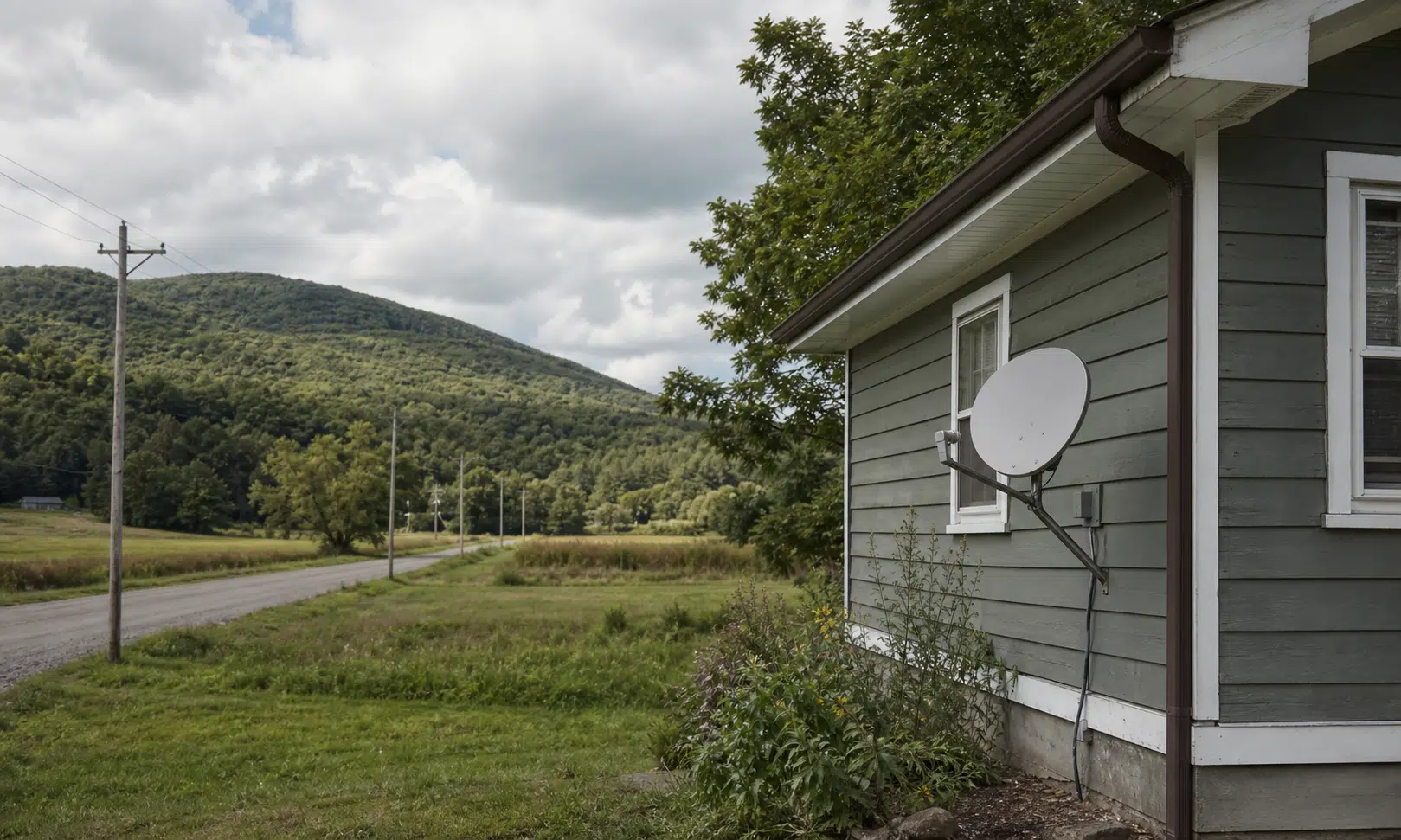

SpaceX is pressing the Federal Communications Commission to rethink one of the federal government’s long-running rural broadband support programs, arguing that satellite internet has changed the basic math of serving remote homes.
The company’s position is straightforward: if Starlink can deliver broadband speeds to places that were once hard or expensive to reach, then legacy subsidies for some rural telecom providers may no longer be justified. SpaceX says the old problem of simply getting high-speed access into remote areas has, in many cases, been overtaken by newer technology.
That is a consequential argument. The FCC’s High-Cost program, part of the Universal Service Fund, has been used to support communications services in rural and remote communities where building and maintaining networks can be expensive. SpaceX is now telling regulators that low-Earth orbit satellite broadband should force a reset.
Critics are not convinced that Starlink has solved the rural broadband problem. They argue that satellite service can be useful, and sometimes the best available option, but that it does not erase concerns about price, capacity, reliability, competition, and performance in places with trees, mountains, buildings, or other obstructions.
The fight is not only about Starlink. It is about how the United States should define broadband access in rural areas, whether taxpayer-supported funding should keep flowing to local providers, and what happens when a satellite provider becomes the main alternative to wired or fixed wireless service.
What SpaceX Is Asking the FCC to Consider
SpaceX’s core argument is that federal universal service programs should adapt to a market where satellite broadband can now reach many locations that were historically expensive to serve. In the company’s view, the rise of Starlink makes parts of the High-Cost program redundant.
The High-Cost program has traditionally helped support voice and broadband service in rural areas where providers say costs are too high to recover through customer bills alone. The exact mechanics vary by support mechanism, but the broad goal is to keep service available in areas where market forces may not produce the same level of coverage as in cities or suburbs.
SpaceX argues that this model deserves a fresh look because satellite broadband does not require the same kind of last-mile buildout as fiber, cable, or many fixed wireless networks. A Starlink customer needs a clear enough view of the sky, user equipment, and an active subscription. The satellites and ground network do the rest.
That difference matters for policy. If a household can already buy broadband from Starlink, regulators may ask whether a local carrier still needs support to serve that same area. If the answer is no, the FCC could eventually reduce or remove some subsidies, redirect money elsewhere, or lower the burden on consumers who contribute to universal service funding through telecom-related charges.
SpaceX’s filing also points to the federal Broadband Equity, Access, and Deployment program, known as BEAD. That program is separately funding broadband expansion in underserved areas, including some support tied to alternative technologies. SpaceX has been pursuing public funding through broadband programs even as it argues that certain ongoing support systems should be wound down.
That tension is part of why the debate is getting attention. SpaceX is not merely saying satellite broadband is useful. It is making a broader policy case that older subsidy structures should not continue unchanged if newer networks can provide adequate service without the same recurring support.
The Buyer Question: Is Starlink a Substitute or a Backup?
For rural households, the policy fight comes down to a practical decision: should Starlink be treated as a full replacement for local broadband options, or as one option in a mixed market?
Starlink can be compelling for people who have no reliable cable, fiber, DSL, or fixed wireless service. It is often faster than legacy rural connections and can be ordered directly by the customer rather than waiting for a network buildout. For some farms, cabins, small towns, and remote homes, that can make it the first broadband service that feels modern.
But satellite broadband is not identical to a local wired network. Starlink requires user equipment, power, a suitable installation location, and a clear enough view of the sky. Performance can vary by geography, network load, and physical obstructions. It can also be affected by service plan rules, availability limits, and local congestion.
That makes the comparison more nuanced than “Starlink versus subsidies.” A household shopping for internet service will care about monthly price, up-front hardware costs, installation difficulty, speed, latency, reliability, data policies, customer support, and whether another provider is available as a fallback.
Quick Comparison
| Image | Product | Best fit | Link |
|---|---|---|---|
 |
Starlink Standard Kit | For homes without usable cable, fiber, DSL, or fixed wireless, the Starlink Standard Kit is the core hardware to compare against local rural broadband options. Confirm service availability at the exact address before buying equipment. | Check Price on Amazon |
 |
Starlink Standard Pipe Adapter | A pipe adapter can help position a Starlink dish on an existing compatible metal pole when the included stand is not enough. Check pole diameter, roof safety, cable routing, and obstruction visibility before installing. | Check Price on Amazon |
 |
TP-Link Deco X55 Mesh Wi-Fi 6 System | A mesh Wi-Fi system can help distribute a satellite or fixed-wireless connection across a larger house, office, or outbuilding. It will not improve the satellite link itself, but it can reduce weak indoor Wi-Fi spots. | Check Price on Amazon |
 |
APC BE600M1 Back-UPS 600VA | A small UPS can keep a router, modem, or satellite networking gear running through brief power interruptions. Match the UPS capacity to the actual devices plugged in and avoid overloading it with non-network equipment. | Check Price on Amazon |
As an Amazon Associate I earn from qualifying purchases.
| Decision factor | Starlink-style satellite broadband | Subsidized local broadband networks |
|---|---|---|
| Availability | Can reach many remote locations without a new cable or fiber buildout | Depends on whether a provider has built or maintained local infrastructure |
| Installation | Requires customer equipment and a suitable sky view | Usually depends on a local provider visit, line, tower, or premises equipment |
| Performance | Can offer strong speeds, but results may vary with congestion and obstructions | Can be very stable when the local network is modern, but some legacy systems remain slow |
| Competition | May be the only practical option in some areas | Can preserve another local option where satellite is not ideal |
| Policy concern | Regulators may ask whether public support is still needed where satellite works well | Regulators may ask whether ongoing subsidies are paying for outdated or underperforming service |
For buyers, the strongest case for Starlink is simple: it can bring broadband to places where other providers have failed to deliver usable service. The strongest case for keeping local support is also simple: not every rural property is a good satellite location, and competition matters.
Why SpaceX Says the Old Model Is Outdated
SpaceX’s policy argument rests on three ideas.
First, satellite internet has improved. Low-Earth orbit systems are designed to reduce latency compared with older geostationary satellite services, and Starlink has built enough scale to become a real consumer option rather than a niche service. SpaceX has pointed to speed data showing that Starlink performance in the United States has improved and that typical download speeds can be competitive with many terrestrial offerings.
Second, the economics are different. A rural fiber line, fixed wireless tower, or copper network may require local construction, maintenance, and customer density that is hard to justify in sparsely populated regions. A satellite network spreads infrastructure over a much wider area. That does not make it free to operate, but it changes the cost structure.
Third, SpaceX says keeping legacy support in place can distort the market. If a provider receives ongoing subsidies to maintain service in an area that can already be reached by a commercially available satellite provider, SpaceX argues that public money may be propping up networks that no longer need that support.
Supporters of winding down parts of the High-Cost program make a related argument about consumer bills. Universal service contributions can function like a regressive charge because they are passed through to phone customers. Critics of the current structure say reducing or redirecting support could ease that burden or shift money toward programs that target affordability more directly.
That is where Lifeline enters the discussion. Some policy analysts argue that low-income households, whether rural or urban, would be better served by consumer-focused assistance than by carrier-focused subsidies. In that framing, the affordability problem remains real, but the policy tool should change.
SpaceX’s version of the argument is not that every rural household has perfect service today. It is that the FCC should stop treating rural access as though satellite broadband does not exist.
Why Critics Say the Case Is Too Broad
Rural broadband advocates and carrier groups say SpaceX is making a leap from “Starlink can help” to “the problem is solved.” They view those as very different claims.
The first concern is reliability in difficult terrain. Starlink works best with an open view of the sky. A rural customer surrounded by tall trees, hills, mountains, or nearby buildings may not get the same experience as a customer with a clean installation point. In some locations, the service can be usable only after extra mounting work, tree trimming, or other setup changes.
The second concern is competition. If subsidies are removed and a local provider exits or stops upgrading service, customers may be left with fewer choices. A satellite provider with little local competition could raise prices, restrict plan availability, or impose up-front charges in high-demand areas. Some customers may also face higher costs if equipment, installation, or congestion-related charges apply. Reports of demand-based up-front charges and pricier plan limits in congested areas have circulated, but those details should be treated carefully because they can vary by location and availability.
The third concern is capacity. A satellite constellation can cover wide areas, but capacity is not infinite. If too many customers in a region rely on the same satellite resources, speeds can decline or plans can become harder to obtain. SpaceX says Starlink will become more capable over time, but regulators still have to decide how much future improvement should count when setting current subsidy policy.
The fourth concern is accountability. Subsidized terrestrial providers may be subject to program rules, reporting requirements, performance obligations, and service commitments. Critics argue that if public policy shifts customers toward satellite, regulators need confidence that the alternative can consistently meet the same public-interest goals.
The Rural Wireless Association has pushed back especially hard on SpaceX’s framing. Its position is that the High-Cost program exists because market forces have not delivered reliable, scalable broadband to rural America on their own. From that perspective, Starlink is a useful competitor, not proof that federal support has outlived its purpose.
The FCC’s Competition Problem
The FCC’s challenge is that both sides are describing real risks.
On one hand, continuing to fund slow or outdated networks forever is hard to defend. If a subsidized provider is only required to meet older performance thresholds while a satellite option can deliver faster service, regulators have reason to ask whether the public is getting enough value.
On the other hand, removing support too quickly could reduce local competition and leave some households dependent on a single provider that may not work equally well for every property. A rural broadband map can say service is available, while the experience at a specific home is shaped by trees, terrain, equipment placement, and local network load.
This is where the policy question becomes buyer-aware. Consumers rarely care which federal program funded their connection. They care whether the internet works at dinner time, whether video calls hold up, whether gaming latency is tolerable, whether the bill is predictable, and whether they have another option when service fails.
A reasonable FCC review would likely need to separate areas where Starlink or another satellite provider is clearly adequate from areas where satellite is only a partial answer. The agency may also need to distinguish between subsidies that keep genuinely necessary service alive and subsidies that preserve networks no longer delivering competitive value.
That kind of review is harder than a broad sunset date. It requires looking at performance, price, availability, reliability, and the number of meaningful alternatives in a given area.
How Amazon Leo Changes the Argument
SpaceX also points to future competition from Amazon’s satellite broadband effort, Leo, as evidence that the market is moving beyond a single-provider model. If multiple low-Earth orbit networks compete for rural customers, the case for continuing some legacy subsidies could weaken.
That argument has logic, but it depends on timing and execution. A planned or emerging competitor is not the same as a fully available consumer service with proven rural capacity. Until customers can actually compare plans, prices, speeds, equipment, and support, the FCC has to be cautious about treating future competition as a present substitute.
For buyers, Amazon Leo could eventually matter in three ways:
- It could give rural households another satellite option if no wired provider is available.
- It could pressure Starlink on pricing, equipment costs, and plan terms.
- It could make regulators more comfortable reducing subsidies in areas where multiple non-subsidized providers are available.
But those are future possibilities, not a complete answer to today’s rural broadband gaps. A household that needs internet now still has to choose from the services currently available at its address.
What Rural Customers Should Watch
The FCC debate may sound abstract, but it could affect the choices rural customers see over the next few years. If regulators decide that satellite broadband is enough in certain areas, some local providers could receive less support. That could change upgrade plans, service availability, or prices.
If the FCC keeps support in place, local networks may continue to operate or improve, but consumers may also continue paying into a universal service system that critics say has become too expensive and poorly targeted.
For households comparing options, the practical checklist is more immediate:
- Check whether Starlink is actually available at the service address, not merely available in the region.
- Look at the full first-year cost, including equipment, shipping, installation hardware, and any location-specific charges.
- Confirm whether the property has a clear sky view before assuming satellite service will be reliable.
- Compare latency needs, especially for gaming, remote work, video calls, and real-time business tools.
- Keep a local wired or fixed wireless option if it is reliable and priced competitively.
- Watch for plan changes if the area is congested or waitlisted.
The best rural internet choice is often not ideological. It is address-specific. Starlink may be the obvious pick for one household and a poor fit for another property a mile away.
The Bottom Line
SpaceX has a strong point when it says rural broadband policy cannot ignore Starlink. Low-Earth orbit satellite internet has changed what is possible for customers far outside traditional cable and fiber footprints. In many remote areas, it may be the fastest and most practical service a household can buy.
But that does not automatically prove the rural broadband problem has been solved. Starlink still has tradeoffs, including installation constraints, capacity limits, price uncertainty, and performance differences from one location to another. A satellite connection can be excellent in the right setting and frustrating in the wrong one.
The FCC’s task is to avoid both outdated subsidies and premature assumptions. If public money is supporting providers that no longer deliver competitive value, the program deserves reform. If removing support would leave rural customers with one imperfect option, regulators should be careful.
For buyers, the clearest takeaway is this: Starlink belongs on the rural broadband shortlist, but it should be compared against local options on real-world cost, reliability, and address-level availability. For policymakers, the harder question is whether satellite broadband is now good enough to replace some subsidies, or whether it is best treated as a powerful addition to a market that still needs more than one path to reliable service.