

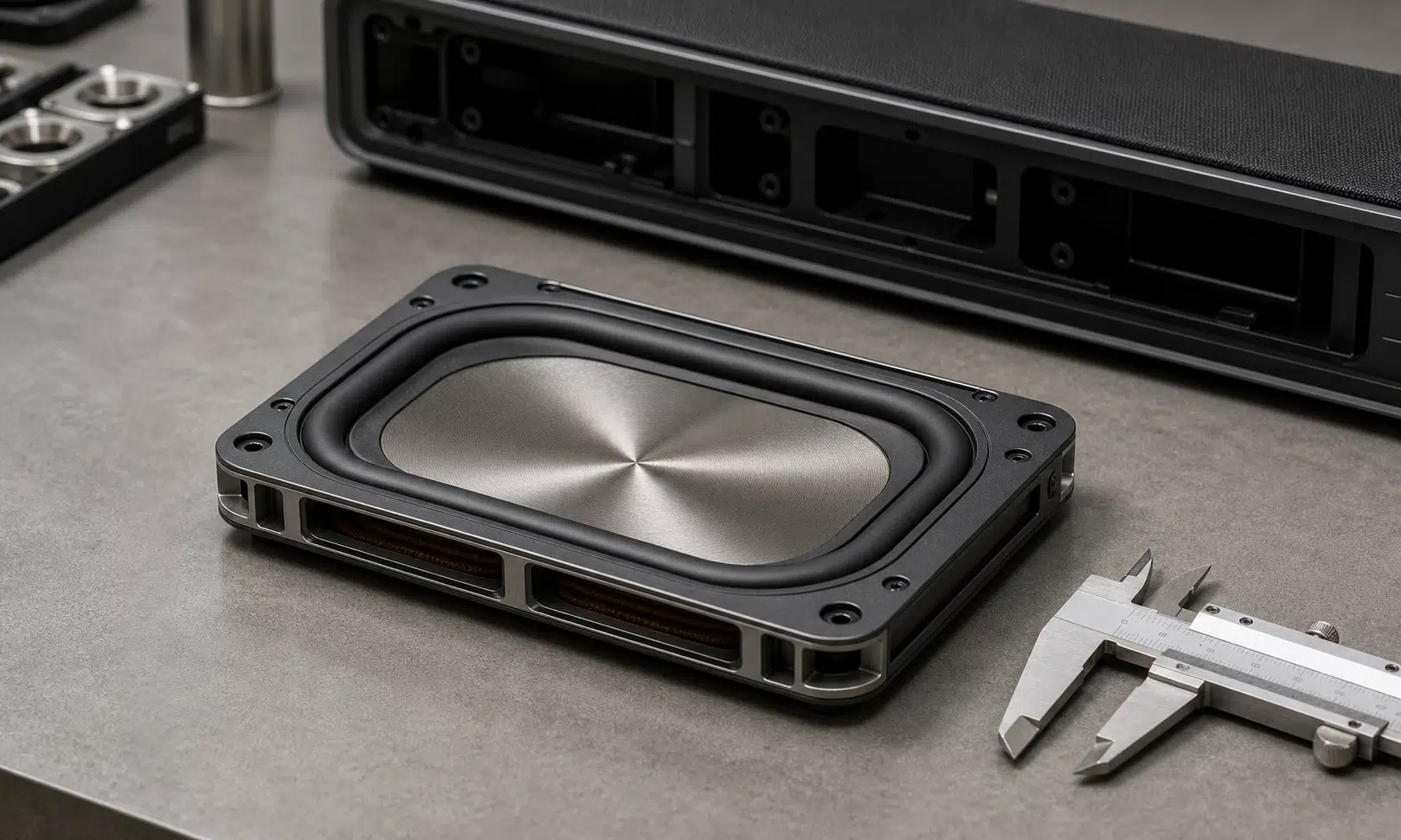

Compact speakers have always had a bass problem. You can make a soundbar thin, a wireless speaker neat, or a wall-mounted speaker easy to live with, but deep low-end usually asks for cabinet volume, driver movement, and space. That is why a small subwoofer driver shown by GSS Audio at High End Vienna 2026 is interesting, even with the usual caveat that this was a show demo rather than a finished consumer product.
The component, called the Model S1 by GSS Audio, was presented as a slim bass transducer intended to work in very small enclosures. The company described it as measuring 62.5mm tall and 299mm wide, and as being able to operate in a box with a volume of 1.75 liters. Those specifications have not been independently verified here, so they should be treated as manufacturer claims rather than settled performance data.
Still, the idea is easy to understand: if a driver can move enough air from a much smaller cabinet, it could change the design options for products where conventional subwoofer space is hard to justify. Soundbars, desktop audio systems, wall-mounted speakers, and compact home theater setups are the obvious targets.
What GSS Audio Is Claiming
According to the show presentation, two Model S1 drivers can be placed in a force-cancelling configuration inside a sealed enclosure roughly the size of a chunky hardback book. The source demo described that kind of box as around 65mm tall, 310mm wide, and 200mm deep. Again, those figures come from the original show report and company demonstration, not from independent lab measurement.
GSS Audio also claimed that its system can produce bass comparable to something much larger, with the original demo materials suggesting performance from a box about six times smaller than a more conventional subwoofer design. That is a broad comparison, because subwoofer output depends on cabinet type, driver size, tuning, amplification, distortion limits, and room behavior. A more careful way to frame it is that GSS is pitching the Model S1 as a way to get the feel of a larger 8-inch or 10-inch subwoofer from a much smaller enclosure.
The main technical point is excursion, meaning how far the moving part of the driver can travel forward and backward. The Model S1 was described as having 17mm of movement in each direction, or 34mm total travel. If accurate, that would help explain how such a shallow driver could displace enough air to create meaningful low bass.
The diaphragm was also described as a more elaborate shape than a flat cone, with ridges and spiral-like forms intended to manage the surface as it moves. The company also pointed to work around the magnet configuration and spider suspension. Those design details sound plausible for a compact high-excursion driver, but without teardown analysis or measurements, they are best treated as part of GSS Audio’s explanation of its design rather than independently confirmed engineering findings.
How the Demo Was Set Up
The listening setup described at the show used two small bass boxes, each reportedly fitted with dual drivers. Each box was paired with a two-way Neumann studio monitor speaker, creating a stereo arrangement with added low-end support on both sides.
That matters because this was not the same as hearing one hidden subwoofer across a full living room. The original report notes that the listening position was closer than a typical home theater seat, closer to a near-field setup than a normal lounge arrangement. That kind of placement can work strongly in favor of compact bass systems, because the listener is nearer to the speakers and the room has less distance over which to complicate the impression.
Within that context, the reported listening impression was very positive. The bass was described as forceful and physically felt, but also controlled rather than loose. The account specifically highlighted deep sub-bass on music, using Nikki Nair’s “Sugar Kingdom” as a test track, and said the system avoided the strained, artificial quality that can make some small woofers sound uncomfortable when they are pushed too hard.
That is useful as an early subjective impression, but it is not the same as a full review. There are no published measurements in the source, no distortion figures, no maximum SPL numbers, no room-corrected response charts, and no comparison against known compact subs under controlled conditions. The better reading is that the demo suggests real promise, not that the technology has already proven itself in consumer products.
Why This Matters for Soundbars
The most practical use case may not be a tiny standalone subwoofer. It may be products where the subwoofer has always been an awkward add-on.
Soundbars are the clearest example. Many buyers want better bass than TV speakers can provide, but they do not always want a separate wireless sub box sitting beside the sofa. Apartment dwellers, renters, desktop users, and people with clean living-room layouts often accept weaker bass simply because a conventional subwoofer is physically inconvenient.
If a compact driver like the Model S1 can be built into a bar, a slim speaker, or a wall-mounted enclosure without losing control, manufacturers could design systems that feel more complete without adding another large box. The original booth reportedly included prototype ideas for a soundbar using two of the drivers and a wall-mounted speaker using four. Those prototypes were not heard in the source report, so their performance should not be assumed.
The wall-speaker idea is particularly interesting for home theater. In theory, several speakers around a room could share low-frequency work, creating a more distributed bass system while reducing the need for one large subwoofer location. That would still require careful system design, crossover behavior, room correction, and amplification. But as a product direction, it points to a cleaner path for people who want fuller sound without a traditional subwoofer footprint.
What We Still Do Not Know
The biggest unanswered question is when, or whether, this driver will appear in shipping products. The source report says GSS Audio mentioned partners planning to use its products, but did not name them. Without named partners, launch windows, prices, or confirmed product designs, it is too early to talk about what buyers will actually be able to purchase.
There are also practical questions that matter more than a trade-show demo:
- How loud can the system play before distortion becomes obvious?
- How deep can it reach in a normal room, not just a close listening setup?
- How much amplifier power and heat management does it require?
- How expensive will it be for consumer speaker makers to use?
- Can the same impact be maintained inside a thin soundbar chassis?
Those are the questions that separate a clever component from a product that changes what people actually buy. A small driver can sound impressive in a controlled demonstration, but mass-market audio products have to work across many rooms, volumes, placements, and price points.
A Broader Push Toward Smaller Bass
GSS Audio is not alone in trying to solve the small-bass problem. The same source points to other compact subwoofer approaches, including the Brane X wireless speaker and Sonos Sound Motion technology in the Sonos Arc Ultra. Those references show the broader direction of travel: speaker makers are looking for ways to get more low-end authority from enclosures that do not look or behave like old-school subwoofer boxes.
The Sonos example is especially relevant because Sound Motion is built around movement in two directions, helping the driver act in a force-opposed way inside a compact soundbar. The Brane X example is another sign that compact low-frequency design is becoming a serious area of audio engineering rather than a niche curiosity.
The GSS Model S1, based on the reported demo, belongs in that same conversation. It may not make big subwoofers obsolete, and it should not be judged as if a short show listen has already proved every claim. But it does suggest a credible path toward smaller speakers that do not give up as much physical bass as their size would imply.
For buyers, the practical takeaway is simple: the next meaningful jump in soundbar and compact speaker performance may come less from virtual surround processing and more from better bass hardware hidden inside smaller cabinets. If GSS Audio’s claims hold up in finished products, the most interesting part will not be the driver itself. It will be the first soundbars and wall speakers that use the idea well enough that people stop feeling they need a separate subwoofer at all.