

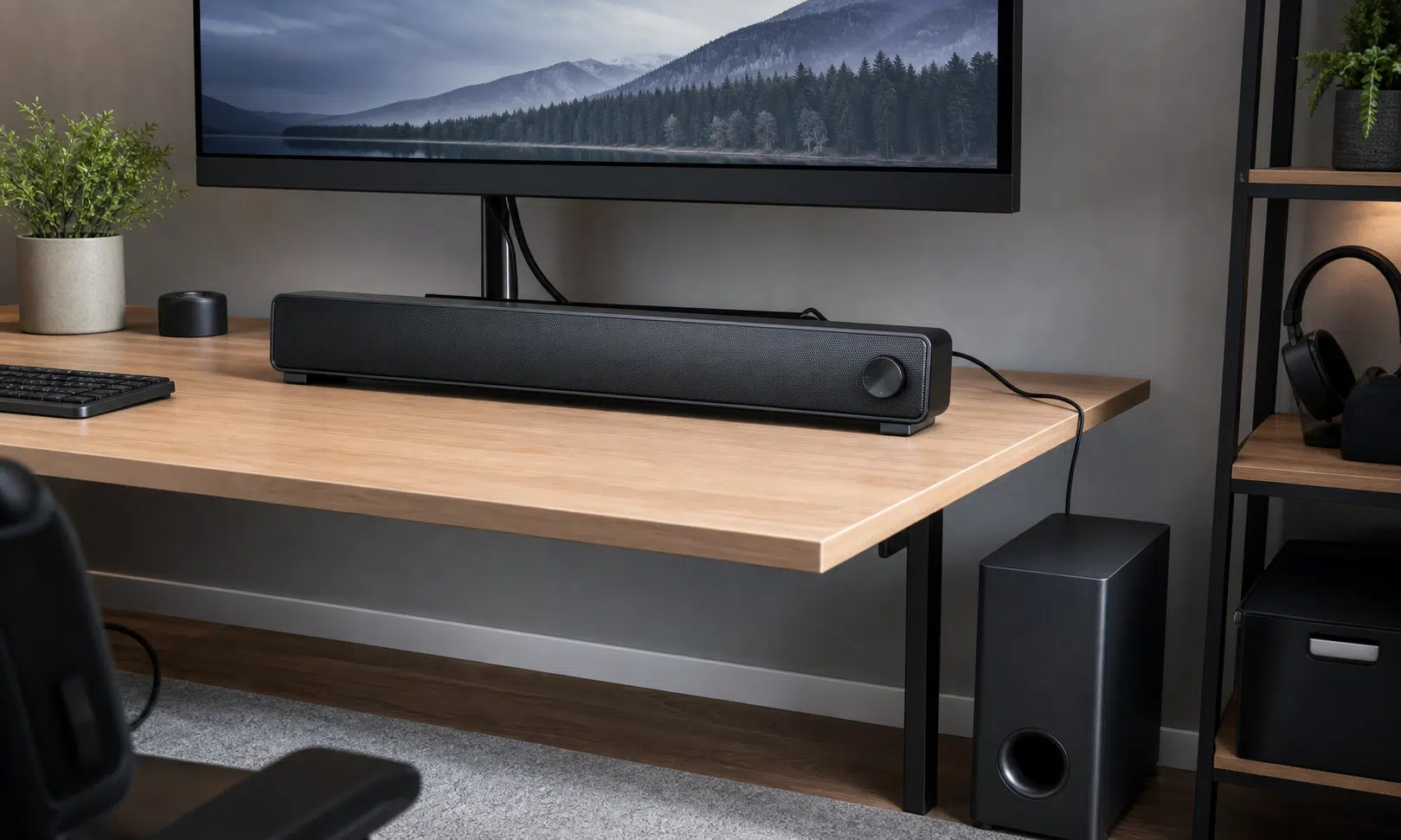

The Creative Stage Pro is the kind of compact 2.1 soundbar that makes the most sense when expectations are kept realistic. It is not trying to replace a full home cinema system, and it does not pretend to offer the tuning depth or spatial scale of more expensive audio setups. Its appeal is simpler: give a TV, monitor, or desktop setup a fuller sound without adding much complexity.
That buyer angle matters. For someone moving up from built-in TV or monitor speakers, the Stage Pro has a clear purpose. It brings a separate subwoofer, several common connection options, and a small enough footprint to fit into spaces where larger soundbars would be awkward. The question is not whether it can compete with premium sound systems. It is whether the compromises feel reasonable for a compact 2.1 package around the $200 mark.

Creative Stage Pro 2.1 Soundbar
The Creative Stage Pro is the most relevant pick if you want the exact compact 2.1 soundbar covered in this review. It makes the most sense for desks, smaller TVs, and setups where HDMI ARC, optical, USB-C, Bluetooth, and a wired subwoofer are useful.
As an Amazon Associate I earn from qualifying purchases.
Design and Setup
The Stage Pro presents itself as a functional soundbar first. At roughly 55 cm wide according to the review sample details, it should fit comfortably beneath many monitors and smaller TV setups. Its slightly angled shape is also useful on a desk, where directing the drivers upward can help the sound feel more immediate from a seated position.
The build is mostly plastic, but the overall impression is sturdy enough for the category. It does not come across as a premium object, though the front grille and restrained styling help it avoid looking overly cheap. This is a soundbar designed to blend into a setup rather than become the visual centerpiece.
The separate subwoofer is where the setup asks for more planning. It is tall, fairly slim, and wired to the soundbar, so placement is less flexible than it would be with a wireless subwoofer. That will not matter much if the bar is going under a desk or near a media stand, but it is worth considering if cable routing or floor space is already tight.
For connectivity, the Stage Pro covers the practical basics. The source review lists HDMI ARC, optical, AUX, USB-C, and Bluetooth, which gives it enough flexibility for common TV, console, PC, and mobile audio use cases. That range is one of the stronger buyer-facing points here, because the soundbar is not locked into one narrow setup.
Features and Controls
The Stage Pro keeps its feature set straightforward. It includes listening modes for near-field and far-field use, which are meant to adapt the sound depending on whether the listener is close at a desk or farther away in a room. In practice, the review impressions describe a noticeable change in presentation: closer listening feels more focused, while the room-oriented mode opens the sound up more.
That said, this is not a system built for deep adjustment. There is no companion app mentioned in the source material, no detailed EQ suite, and no room calibration. Control is handled through presets and basic remote adjustments. For many buyers, that will be enough. For anyone who likes to fine-tune bass, dialogue, treble, or source profiles, it may feel limiting.
| Area | What the Stage Pro Offers | Buyer Impact |
|---|---|---|
| System type | Compact 2.1 soundbar with separate subwoofer | More bass presence than built-in speakers, with extra placement needs |
| Connections | HDMI ARC, optical, AUX, USB-C, Bluetooth | Works across common TV, PC, and desktop setups |
| Listening modes | Near-field and far-field modes | Useful if switching between desk and room listening |
| Tuning | Presets and basic remote controls | Simple to use, but limited for detailed adjustment |
Sound Quality
For a compact 2.1 setup, the Stage Pro is best understood as a meaningful step up from weak built-in speakers rather than a dramatic hi-fi upgrade. The separate subwoofer gives movies, games, and music more body, especially in the low end. It does not reach the kind of deep, room-shaking bass associated with larger home theater systems, but it adds enough weight to make everyday listening feel less thin.
Dialogue is one of the more useful strengths. Voices come through clearly in the review impressions, which matters for streaming, TV watching, YouTube, and games with a lot of spoken audio. That alone can justify a small soundbar for people who are tired of pushing TV volume higher just to understand speech.
The midrange and treble are serviceable rather than exceptional. There is enough clarity for casual music and gaming, but busier scenes can start to sound congested. This is where the product’s size and price point show. It can make audio fuller and more direct, but it does not create the separation or refinement of a more capable speaker system.

Yamaha SR-C20A Compact Sound Bar
The Yamaha SR-C20A is worth comparing if you want a compact soundbar but would rather avoid placing a separate subwoofer. It still supports common TV connections like HDMI ARC and optical, with Bluetooth for simpler wireless playback.
As an Amazon Associate I earn from qualifying purchases.
SuperWide Mode and Soundstage
Creative’s SuperWide processing is meant to make the sound feel broader than the physical bar. Based on the review impressions, the results are mixed. In some content, the effect can add a sense of width. In other cases, it can make the presentation feel less natural or reduce clarity.
That makes SuperWide less of a must-use feature and more of a situational option. It may be worth trying for games, movies, or casual viewing, but it should not be the main reason to buy the Stage Pro. The core soundbar still behaves like a compact unit, and its soundstage remains relatively narrow compared with larger or more advanced systems.
This is an important distinction for buyers. The Stage Pro can sound bigger than a TV’s built-in speakers, but it does not fully escape the limits of its size. Anyone expecting convincing surround-style immersion from a small 2.1 bar is likely to come away disappointed.
Best Use Cases
The Stage Pro appears strongest as a desktop-first soundbar. On a desk, the sound is direct, the bar is appropriately sized, and the subwoofer can add impact without needing to fill a large room. For PC gaming, videos, casual music, and general monitor use, that combination makes practical sense.
In a living room, the value depends heavily on room size and expectations. In a smaller room or secondary TV setup, it should still offer a cleaner and fuller experience than basic built-in speakers. In a larger space, its limited width and scale become easier to notice.
- Best fit: desktop setups, small rooms, gaming monitors, secondary TVs
- Less ideal fit: large living rooms, buyers expecting cinematic surround effects, users who want deep EQ control
- Main strength: fuller low end and clearer everyday listening from a compact system
- Main limitation: narrow soundstage and limited tuning flexibility
Trade-Offs
The Stage Pro is not held back by one fatal flaw. Its limitations are more about accumulated compromises. The soundstage is narrow, SuperWide mode is inconsistent, and the lack of detailed tuning makes it harder to tailor the sound to a room or personal preference. The wired subwoofer also reduces placement freedom, and the source review notes that volume differences between sources can occasionally stand out.
None of those issues make the product unusable. They simply keep it in budget soundbar territory. That is fair enough if the buyer wants a simple upgrade, but it is worth being clear about what the Stage Pro is and is not.
Verdict
The Creative Stage Pro is a compact 2.1 soundbar for buyers who want a straightforward audio upgrade without turning their setup into a project. Its strongest case is on a desk or in a smaller room, where the separate subwoofer, clear dialogue, and practical connectivity can make everyday audio feel noticeably better.
It is less convincing as a home cinema substitute. The soundstage remains limited, SuperWide mode is not consistently persuasive, and the control options are basic. Still, for its intended role, the Stage Pro makes sense: a simple, compact soundbar system that adds weight and clarity where built-in speakers often fall short.
Review sample provided by the manufacturer.