DisplayPort has a strong case on paper. It is common on PC monitors, supports high-bandwidth video, and has long been tied to the kind of gaming and workstation setups where refresh rate, resolution, and multi-display support matter. So it is reasonable to wonder why a modern smart TV, even an expensive one, usually gives you a row of HDMI ports instead.
The short version is that TVs are not built around the same ecosystem as desktop monitors. A TV is expected to work with game consoles, streaming boxes, soundbars, Blu-ray players, cable boxes, and AV receivers. Those devices overwhelmingly expect HDMI. Even when DisplayPort can offer more bandwidth or PC-friendly features, that advantage usually does not solve a mainstream living room problem.
DisplayPort is stronger in some technical areas
DisplayPort is not absent from TVs because it is technically weak. In several situations, especially around PCs, it can be the more capable connector. Recent DisplayPort versions can support very high bandwidth, and the standard is closely associated with features that matter to desktop users, including high refresh rates, adaptive sync, daisy chaining, and USB-C DisplayPort Alt Mode.
That is why DisplayPort makes so much sense on monitors. A gaming monitor or productivity display may be plugged directly into a graphics card, used alongside other screens, or connected through a USB-C dock. In that world, DisplayPort is not an odd extra port. It is often the default.
HDMI has narrowed the gap for TV use, though. HDMI 2.1-class ports can handle common premium TV features such as 4K at 120Hz, variable refresh rate, HDR formats, and console-friendly gaming modes when the TV and connected device support them. For most buyers, that covers the real-world use case: a PlayStation, Xbox, streaming device, soundbar, or AV receiver plugged into a big screen.
HDMI won the living room
The biggest reason smart TVs still use HDMI is not that DisplayPort failed. It is that HDMI became the expected language of home theater hardware. TV makers, console makers, disc player manufacturers, streaming device companies, and audio brands have spent years building around it.
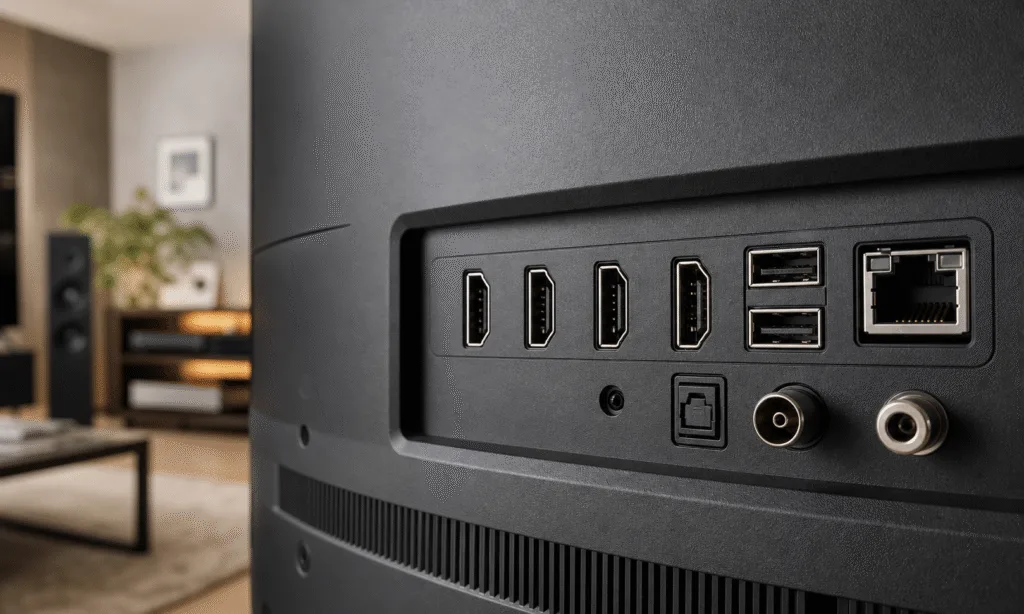
That matters more than a spec-sheet win. Adding DisplayPort to a TV would mean another input, another compatibility surface, and another thing to test and support. It would also take up space on a product where manufacturers already have to balance HDMI ports, USB ports, antenna input, Ethernet, optical audio, and other connections.
For a monitor, DisplayPort helps sell the product to PC users. For a TV, the value is harder to explain. Most people shopping for a television want to know whether their console can run at 4K 120Hz, whether their soundbar can use eARC, and whether their streaming box will work without adapters. HDMI answers those questions directly.
HDMI also brings living-room-specific conveniences. HDMI-CEC can let one remote control multiple connected devices, and eARC is built around sending audio from the TV back to a receiver or soundbar. Those features are not about maximum bandwidth. They are about making a pile of home entertainment gear feel less annoying to use.
8K and extreme refresh rates are still niche TV problems
DisplayPort’s bandwidth advantage becomes more interesting when you talk about very high resolutions and very high refresh rates. That is where a desktop PC connected to a specialized display can push beyond what many TVs are designed to handle.
But the TV market has not moved around those edge cases. 8K televisions remain a niche category, and 8K video is not a normal part of most streaming, gaming, or disc libraries. HDMI 2.1 can already support 8K-style use cases with compression in supported setups, and HDMI 2.2 raises the ceiling further with up to 96Gbps of bandwidth. That does not instantly make older TVs obsolete, because ports and cables still have to support the newer spec, but it does weaken the argument that TVs need DisplayPort to prepare for future formats.
For PC gamers, the edge case is more obvious: someone may want to connect a high-end gaming PC to a large TV and chase refresh rates beyond the usual console target. That user may reasonably wish the TV had DisplayPort. But TV makers design for the broader market, and the broader market is still centered on HDMI devices.
For most buyers, HDMI is the practical answer
The absence of DisplayPort on smart TVs can look strange if you are coming from the PC monitor world. It makes less sense if you think of the TV as a giant monitor and more sense if you think of it as the hub of a living room system.
DisplayPort remains excellent for PCs, workstations, docks, and multi-monitor setups. HDMI remains the practical standard for televisions because the devices people plug into TVs are built around it. A DisplayPort input would be useful for some PC-first users, but for most households it would sit unused while HDMI handles the devices that actually live under the screen.
That is why DisplayPort can be better in specific technical scenarios and still lose the TV port war. Smart TVs are not just chasing the highest possible bandwidth. They are built for the hardware people already own, and that hardware speaks HDMI.