


Casimir Inc. has introduced MicroSparc, a proposed semiconductor chip that the company says could one day provide continuous low-level electrical power without a battery, cord, or charger.
That is a large claim. It is also exactly the sort of claim that deserves a buyer-aware reading before anyone treats it as a near-term replacement for batteries, solar cells, or conventional energy-harvesting hardware.
The company was founded and is led by Harold G. “Sonny” White, the former NASA EagleWorks researcher widely associated with advanced propulsion and warp-drive concepts. Casimir says MicroSparc is based on custom microscale Casimir-cavity structures designed to interact with quantum vacuum fields. The company’s stated commercialization target is 2028, though that timeline and the performance claims around it have not been independently verified.
For practical readers, the important point is not whether the phrase “free energy” sounds exciting. It is whether the device can produce repeatable, independently measured power at useful levels, at a manufacturable cost, under real-world conditions. On that score, MicroSparc remains an early-stage technology claim, not a product category that buyers can evaluate in the normal way.
Quick Verdict: Interesting Research Claim, Not a Battery Replacement Yet
MicroSparc is best understood as a claimed future ultra-low-power energy source. Casimir has described prototype chips and a roadmap toward commercial devices, but the company’s public claims still need independent validation before buyers can compare MicroSparc against proven options such as lithium batteries, supercapacitors, solar cells, thermoelectric generators, vibration harvesters, or RF energy harvesting.
If the company’s stated target is achieved, the first plausible use cases would be narrow: tiny sensors, remote monitoring devices, low-duty-cycle electronics, and systems where even microwatts of continuous power are valuable. That is a very different proposition from powering a phone, vehicle, home, or city.
For now, buyers should treat MicroSparc as a technology to monitor, not a part to design into a commercial product unless they have direct access to validated samples, test data, and engineering support.

INA219 Current Sensor Breakout
A current-sensing breakout can help makers and engineers measure how much power a small circuit actually uses before comparing batteries or harvesting options. It is best suited to prototype-level DC measurements, not validating extraordinary power-source claims by itself.
As an Amazon Associate I earn from qualifying purchases.
What Casimir Says MicroSparc Is
Casimir describes MicroSparc as a chip that uses custom Casimir cavities, fabricated at microscopic scale, to produce a continuous electrical output. In the company’s explanation, specially engineered cavity walls and central micropillars create a structure where electrons are more likely to move in one direction than the other, producing what the company characterizes as a usable current.
The claimed concept draws on two real areas of physics: the Casimir effect and quantum tunneling. Both are established scientific phenomena. The open question is whether Casimir’s specific device architecture can turn those effects into a practical, continuous power source as described.
The distinction matters. A real physical effect is not the same thing as a commercially useful generator. Many energy-harvesting ideas work in a narrow laboratory sense but fail when they are scaled, packaged, exposed to temperature changes, connected to actual loads, or manufactured at acceptable cost.
Casimir says its work grew out of earlier theoretical and experimental investigations into custom Casimir cavity structures. White has said the company has already fabricated prototype chips in university nanofabrication environments and tested them in low-noise setups. Those claims should be read as company statements until independent labs publish repeatable results.
The Physics Claim, in Plain Terms
The Casimir effect is often described through a simple setup: two closely spaced conductive plates in a vacuum. At very small separations, quantum field effects create a measurable force between the plates. This has been part of mainstream physics for decades, and it has been experimentally studied in multiple settings.
In a traditional Casimir setup, however, the force between plates does not automatically create a practical energy source. If the plates move together, work can occur, but resetting the system requires energy. That is one reason “vacuum energy” claims are usually met with skepticism, especially when they sound like a perpetual power source.
Casimir’s claim is that MicroSparc avoids the usual collapse-and-reset problem by using fixed structures on a substrate. According to the company’s description, the cavity walls do not move, and central micropillar structures are electrically isolated from the walls while remaining physically fixed. The company says this geometry creates a kind of directional electron flow.
That explanation has not been independently verified in public, buyer-ready terms. A careful reading should separate three things:
- The Casimir effect itself is real physics.
- Quantum tunneling is real physics.
- MicroSparc’s claimed ability to produce practical continuous power from its specific structure remains a company claim pending independent confirmation.
That third point is where the commercial risk sits.
What Output Is Being Claimed?
Casimir has described a target device around 5mm by 5mm that would produce about 1.5 volts at 25 microamps. White has characterized that as roughly 40 microwatts of continuous power. That output target, including the 2028 availability goal, has not been independently confirmed.
Even if the target is met, 40 microwatts is a very small amount of power. It may be meaningful for some low-power electronics, but it is not close to the continuous power needed by phones, laptops, appliances, vehicles, or household electrical loads.
The practical value of microwatt-scale power depends heavily on the device being powered. Some sensors sleep most of the time and wake briefly to take a reading or transmit a tiny packet of data. In that kind of system, a steady trickle of power can matter. For active electronics with displays, radios, motors, heaters, or processors running continuously, it usually will not be enough.
| Use case | How MicroSparc would need to perform | Buyer reality today |
|---|---|---|
| Passive or low-duty-cycle sensors | Continuous microwatt output could be useful if stable and affordable | Most plausible early category, but still unverified |
| Wearables | Would need enough output to reduce charging or extend standby life | Possible only if power, size, safety, and cost targets are proven |
| Smartphones | Would need far more power than a single microwatt-scale chip | Not a near-term replacement for charging |
| Electric vehicles | Would require massive aggregation and very low cost per watt | Speculative |
| Homes or businesses | Would require kilowatt-scale systems and validated economics | Highly speculative |
How It Compares With Proven Energy Sources
A useful comparison is not “MicroSparc versus fossil fuels.” At the claimed early output level, the more realistic comparison is MicroSparc versus other ways to power small electronics.
For sensor designers, the existing toolbox is already broad. Coin cells are cheap and predictable. Lithium primary cells can last for years in low-power devices. Small solar panels work well when light is available. Thermoelectric generators can harvest heat gradients. Piezoelectric systems can harvest vibration. RF harvesting can work in specific environments, though it is often power-limited.
MicroSparc’s potential attraction would be different: continuous power without needing light, motion, heat gradients, fuel, or a scheduled battery replacement. That would be valuable if the device works as claimed. It would also need to survive packaging, contamination, temperature cycling, aging, electromagnetic noise, and integration into normal circuit designs.
| Power option | Strength | Tradeoff | Best fit |
|---|---|---|---|
| Coin cell or primary battery | Cheap, available, predictable | Eventually depleted | Low-cost sensors and consumer devices |
| Rechargeable battery | High energy storage for size | Needs charging and ages over time | Wearables, phones, portable electronics |
| Small solar cell | Proven energy harvesting | Depends on light exposure | Outdoor or well-lit indoor sensors |
| Thermoelectric generator | Can harvest waste heat | Needs temperature difference | Industrial monitoring and heat-rich environments |
| Vibration harvester | Useful around machinery | Needs consistent motion | Equipment sensors |
| MicroSparc, if validated | Could provide continuous low-level power without common environmental inputs | Not yet independently proven as a commercial product | Future ultra-low-power devices |
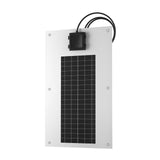
10W Flexible Solar Panel
Small solar panels remain one of the more practical choices when a sensor or battery-maintenance project has reliable light exposure. They are not always suitable indoors or in shaded locations, so the installation environment matters.
As an Amazon Associate I earn from qualifying purchases.
What Buyers Should Ask Before Taking It Seriously
The best way to evaluate MicroSparc is not to argue over labels like “free energy.” Buyers should ask the same questions they would ask about any new component that claims to change a power budget.
- Independent replication: Has a credible outside lab measured the claimed output under controlled conditions?
- Load behavior: What happens when the chip is connected to realistic circuits, not only high-sensitivity measuring equipment?
- Power over time: Does output remain stable over days, months, and years?
- Environmental tolerance: How does it behave under heat, cold, vibration, humidity, radiation, and electromagnetic interference?
- Manufacturing yield: Can the structures be fabricated reliably at scale?
- Cost per watt: Does the device compete with batteries or conventional harvesting methods in the target application?
- Integration: Does it require unusual packaging, shielding, conditioning circuitry, or operating constraints?
- Safety and compliance: Can it pass normal electronics certification requirements?
Those questions are not dismissive. They are the normal gatekeeping steps between a laboratory claim and a product that engineers can design around.
Why the Smartphone and Car Claims Need Extra Caution
Casimir’s broader roadmap includes consumer electronics, vehicles, residential systems, and other larger applications. The company has described possible aggregation approaches, such as stacking or combining many chips to increase output. It has also suggested cost targets that, if achieved, could make larger systems possible.
Those statements should be treated as long-range projections rather than buyer-ready specifications. Scaling a microwatt-class device into watt, hundred-watt, or kilowatt systems is not just a matter of making more copies. Power electronics, heat, packaging, cost, failure rates, materials supply, manufacturing yield, and regulatory approval all become central.
A phone that never needs normal charging would be commercially important. A compact vehicle charger that produces meaningful daily driving energy without fuel or grid input would be more than important; it would be a major energy-market disruption. Claims at that level require unusually strong evidence.
The practical position is simple: low-power sensors are the first place to look. Phones, cars, homes, and cities belong in the speculative column until independently verified hardware demonstrates a credible path from microwatts to much higher power levels.
Where MicroSparc Could Make Sense First
If MicroSparc works and if the economics make sense, the first viable market would likely be devices where battery replacement is expensive, inconvenient, or impossible.
That could include remote environmental sensors, asset trackers, industrial monitors, sealed medical or laboratory devices, infrastructure sensors, defense systems, or space-related electronics where persistent low-level power has a high value. In these markets, the question is not always “How many watts can I get for the lowest price?” Sometimes the question is “Can this device stay alive for years without a service visit?”
That is where microwatts can become commercially meaningful. A tiny amount of continuous energy can maintain a clock, preserve memory, trickle-charge a storage element, or support intermittent sensing if the rest of the system is designed around extreme efficiency.
Still, even those early use cases would need careful engineering. A power source that produces a high open-circuit voltage but almost no usable current may not help much. A chip that only works in a laboratory enclosure may not survive a real installation. A device that requires expensive nanofabrication may lose to a cheap battery even if the science is sound.
Red Flags and Green Flags to Watch
For buyers, investors, and engineers, the next phase should be judged by evidence quality.
Green flags would include independent replication, detailed power curves, published test protocols, third-party lab measurements, sample availability, clear device datasheets, realistic application notes, and transparent explanations of failure modes. A credible commercial path would also include manufacturing partners, packaging details, quality-control methods, and conservative claims about first-generation use cases.
Red flags would include vague demonstrations, shifting explanations, claims that jump quickly from microwatts to cities, missing load data, no independent measurements, or heavy reliance on extraordinary language without engineering specifics.
The most useful middle ground is to remain interested without becoming credulous. MicroSparc does not need to power a house to be valuable. A validated microwatt-scale source could still matter. But it does need to be validated.

Power Profiler Kit II
A power profiler is useful when evaluating low-power embedded devices because it can show sleep current, active-current spikes, and average consumption over time. That kind of measurement is essential before deciding whether a microwatt-scale source could support a real circuit.
As an Amazon Associate I earn from qualifying purchases.
Bottom Line for Product Teams
MicroSparc is not something most product teams can buy, qualify, and ship today. It is a claimed emerging power technology with a proposed 2028 commercial target and a first-step output level aimed at ultra-low-power electronics.
If you build low-power devices, it may be worth tracking Casimir’s progress. The right posture is to watch for independent measurements, sample programs, and datasheets. Do not redesign a product roadmap around the assumption that quantum-vacuum power will arrive on schedule or scale quickly.
If you need a power source now, conventional options remain the practical choices: batteries, rechargeable cells, solar, heat harvesting, vibration harvesting, or wired power. If MicroSparc eventually proves itself, it could become another tool in that set. Until then, it belongs in the promising-but-unproven category.
The careful buyer’s summary is this: Casimir’s claim is intriguing because it points at a real pain point in electronics, especially for sensors and devices that are hard to service. But the leap from a claimed prototype to a dependable commercial component is large. The next evidence that matters will not be more ambitious projections. It will be independent, repeatable performance data under real electrical loads.