

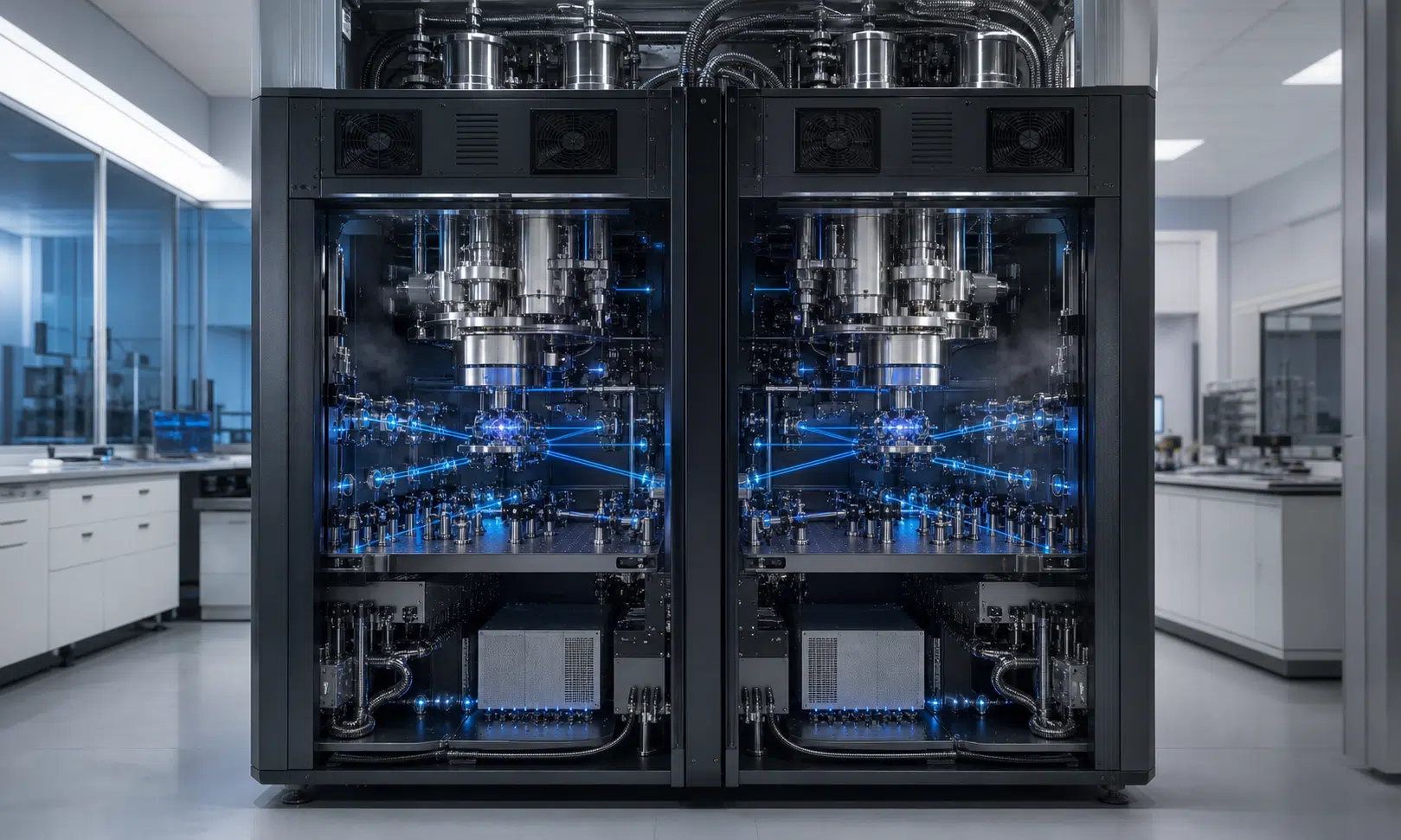

China’s Hanyuan-2 has been presented as a “world’s first” dual-core quantum computer, but the announcement leaves the most important commercial question unanswered: how well does it actually perform?
CAS Cold Atom Technology, a Wuhan-based company affiliated with the Chinese Academy of Sciences, says Hanyuan-2 uses two independent neutral atom arrays inside one cabinet-sized machine. According to the company’s description, the system totals 200 qubits, split between 100 rubidium-85 atoms and 100 rubidium-87 atoms. Those hardware details have not been independently verified, so they should be treated as vendor-reported specifications rather than confirmed performance data.
The dual-core pitch is the headline. CAS Cold Atom Technology has described the two arrays as capable of running in parallel to divide workloads, or operating in a main-and-auxiliary arrangement in which one array supports real-time error correction while the other runs computations. A company expert quoted in Chinese state-linked coverage framed the system as a move from single-core to dual-core quantum processor architecture, though that characterization also depends on the vendor’s own framing.
What Hanyuan-2 appears to be claiming
Hanyuan-2 is described as a neutral atom quantum computer. In neutral atom systems, individual uncharged atoms are trapped and manipulated with laser-based controls so they can function as qubits. That general approach is well established in quantum computing, but the specific implementation and performance of Hanyuan-2 remain unclear from the public announcement.
The company also says the system uses a compact cabinet-style design, a smaller laser cooling setup, and total power consumption below 7 kilowatts. If accurate, that power figure would be notable for buyers comparing early quantum systems on facility requirements and operating costs. Still, power draw alone does not say much about computational usefulness.

Quantum Computing: An Applied Approach
Readers comparing quantum hardware announcements need enough grounding to ask about fidelity, coherence, error correction, and workload results. This applied reference can help technical buyers and analysts frame those questions before treating a qubit count as a buying signal.
As an Amazon Associate I earn from qualifying purchases.
For enterprise teams tracking quantum hardware, the missing details matter more than the cabinet size. The useful buying questions are not only how many qubits a machine contains, but how stable those qubits are, how accurately gates can be applied, and whether the system can run meaningful workloads with repeatable results.
The benchmark gap is the real issue
The public description of Hanyuan-2 does not appear to include the benchmark data that would let outside researchers or customers compare it cleanly with other neutral atom platforms. Key metrics such as gate fidelity, coherence time, error rates, connectivity, and demonstrated workload results are not optional details in this market. They are the evidence buyers need before treating a system as more than a technical claim.
That gap is especially important because 200 physical qubits, by itself, does not settle much. Other neutral atom companies have reported larger arrays or have published more detailed technical material around error correction and system performance. Atom Computing, Microsoft, QuEra, Pasqal, IBM, and others are pursuing different approaches to scaling quantum processors and connecting quantum resources, but comparing any of those efforts against Hanyuan-2 is difficult without equivalent published metrics.
| Claim area | What was described | What buyers still need |
|---|---|---|
| Architecture | Two neutral atom arrays in one machine | Evidence that the second array improves real workloads |
| Scale | Vendor-reported 200 qubits | Quality metrics for those qubits |
| Efficiency | Vendor-reported power below 7 kW | Performance per watt, not just power draw |
| Error correction | Main-and-auxiliary operating mode described | Published demonstrations and error-rate data |
Dual-core branding needs careful reading
The “dual-core” label is easy to understand because it echoes classical CPU language, but quantum systems do not map neatly onto desktop processor marketing. A better way to read the claim is as a modular or multi-array architecture inside a single machine, at least based on the information currently available.
That could be useful. A tightly integrated two-array design might help with parallel runs, calibration workflows, or error-correction experiments. It might also prove less valuable than scaling one larger array or linking multiple processors through a broader networked architecture. Without public benchmark results, none of those possibilities can be judged with confidence.
Hanyuan-2 reportedly follows the company’s earlier Hanyuan-1 system, but public technical information on that first-generation machine is also limited. For now, the announcement is best read as a watchlist item for quantum hardware buyers, not as proof that a new commercial benchmark has been set.
The practical takeaway is simple: Hanyuan-2 may be an interesting neutral atom design, but the next thing to look for is not another “world’s first” claim. It is a technical paper, third-party testing, or detailed benchmark disclosure that shows what the machine can do under measurable conditions.