

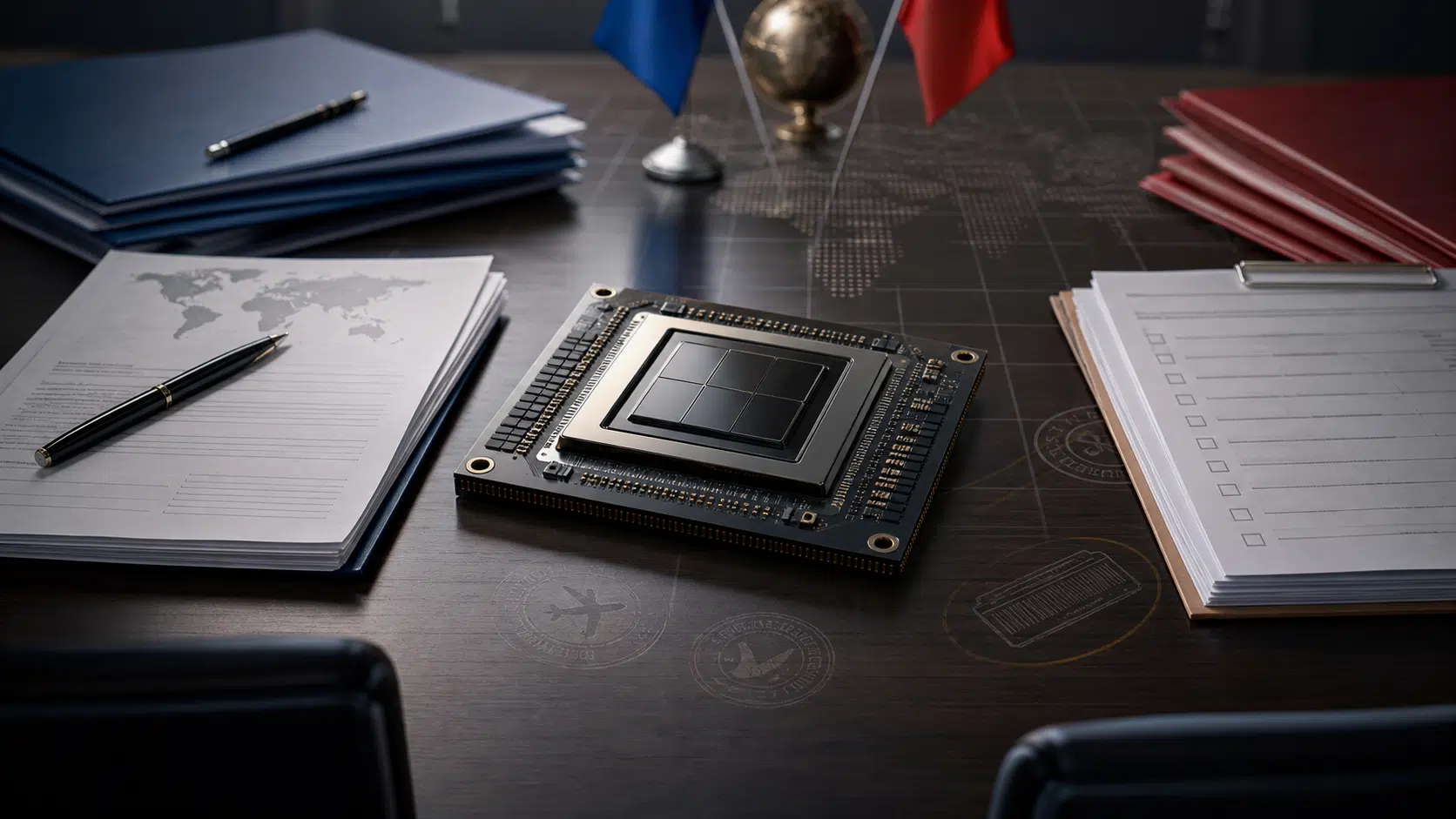

Donald Trump left Beijing saying he and Xi Jinping had discussed AI guardrails and Nvidia H200 chips. For companies watching the AI infrastructure market, the more important detail is what did not happen: no signed AI governance framework was announced, and the H200 issue still appears unresolved in practical terms.
Asked aboard Air Force One what kind of guardrails the two leaders discussed, Trump described them as “standard guardrails that we talk about all the time.” He also said the two sides had talked about possibly working together on them, though that claim has not been independently verified beyond the reported remarks.
That leaves buyers, suppliers, investors and compliance teams in a familiar position. The political signal is meaningful, but it is not yet an operating rule. Until there is signed text, a published process or a confirmed shipment path, the Beijing meeting is better read as a risk marker than a buying green light.
What Changed For H200 Buyers?
The reported H200 clearance is the part of the story with the most immediate commercial weight. Shortly before the summit, Washington was reported to have cleared roughly ten Chinese technology firms, including Alibaba, Tencent, ByteDance, JD.com and Lenovo, to buy up to 75,000 Nvidia H200 chips each under a new export-licensing regime. That reporting has not been independently verified here, so buyers should treat the numbers as provisional rather than confirmed procurement capacity.
The distinction matters. A license pathway is not the same as inventory in a data center. The reported structure points to a heavily controlled channel, with China-bound H200 volume capped relative to Nvidia’s US domestic sales, shipment verification by a US-headquartered third-party laboratory, buyer certification against military use and a 25% revenue share routed through US territory.
If those conditions hold, the H200 would not be a normal commercial order. It would be a monitored, politically exposed procurement route with compliance checkpoints built into the transaction.
For AI infrastructure buyers, the immediate question is not simply whether H200s are “available.” The sharper question is whether a project can tolerate uncertainty around approval timing, shipment verification, policy reversal and downstream audit requirements.
| Buyer Question | Why It Matters | Current Read |
|---|---|---|
| Is there a signed AI framework? | Signed rules would reduce policy ambiguity. | No signed framework was announced. |
| Are H200 deliveries confirmed? | Physical delivery matters more than paper clearance. | The delivery picture remains unclear. |
| Are license terms simple? | Complex terms can slow procurement and deployment. | Reported terms appear unusually restrictive. |
| Can buyers plan capacity around this? | AI projects need predictable hardware timelines. | Only with contingency planning. |
Why “Guardrails” Is Still Too Vague
The phrase “standard guardrails” is doing a lot of work. The US and Chinese governments have not publicly agreed, on the record, what those guardrails would cover in this context. They could mean export controls, military-use restrictions, model safety discussions, lab verification, autonomous weapons limits or a broader diplomatic process.
Reports have suggested that AI was discussed alongside trade and the H200 question, with deeper issues such as autonomous weapons, model misuse and dual-use AI addressed only in outline. That account has not been independently verified here, and no schedule, working group or signed text has emerged from this round.
For enterprise buyers, that ambiguity should change how the news is used. It is useful as a signal that AI governance remains part of US-China negotiations. It is not yet useful as a dependable rulebook for procurement, deployment or long-term capacity planning.
How Buyers Should Read The Nvidia Angle
Nvidia sits at the center of the commercial tension. The administration’s argument, echoed publicly by Nvidia chief executive Jensen Huang, is that the H200 is behind the Blackwell generation that remains inside tighter export controls. In that view, regulated sales to Chinese customers keep revenue and jobs tied to US companies while limiting access to the most advanced chips.
Critics see the same facts differently. Senate Democratic leader Chuck Schumer argued that giving China access to premier US technology threatens America’s AI lead. That objection points to the political risk around any China-facing AI hardware deal: even if a license exists today, the policy environment can shift quickly.
The reported 25% revenue pass-through also changes the commercial math. If the structure is implemented as described, Nvidia could gain a controlled China revenue stream, but buyers would still face added friction. Compliance cost, timing risk and uncertainty around future restrictions would remain part of the total cost of ownership.
Decision Criteria For AI Hardware Planning
For buyers making infrastructure decisions, this is not a simple Nvidia-versus-alternative moment. It is a planning exercise under policy uncertainty. The best reading of the summit is that H200 access may remain possible under strict conditions, but no public outcome from Beijing removes the need for backup plans.
- Use licensed H200 access only for workloads that can absorb delays. If a deployment depends on a fixed go-live date, policy-dependent supply is a weak foundation.
- Separate technical fit from geopolitical exposure. A chip can be attractive on performance and still carry procurement risk.
- Ask suppliers for compliance documentation early. Verification, end-use certification and shipment approval can become schedule drivers.
- Model a fallback path. Buyers should compare delayed H200 access against domestic capacity, alternative accelerators or phased deployment plans.
- Watch rare-earth constraints alongside chips. Reports suggest rare-earth controls remain a pressure point for Western magnet and motor supply chains, though the specific effect on each buyer should be verified case by case.
Bottom Line
The Beijing summit produced a political read-out, not a settled AI buying environment. Trump said AI guardrails and Nvidia H200 chips were on the agenda. No signed framework was announced. The reported H200 licensing path remains important, but it should not be treated as a confirmed delivery channel until buyers can see enforceable terms, shipment mechanics and compliance requirements.
For now, the practical buyer takeaway is conservative: keep monitoring the H200 licensing regime, but do not build an AI infrastructure plan that depends on smooth China-bound deliveries. The useful move is to price in delay, compliance overhead and policy reversal before treating any clearance as real capacity.