

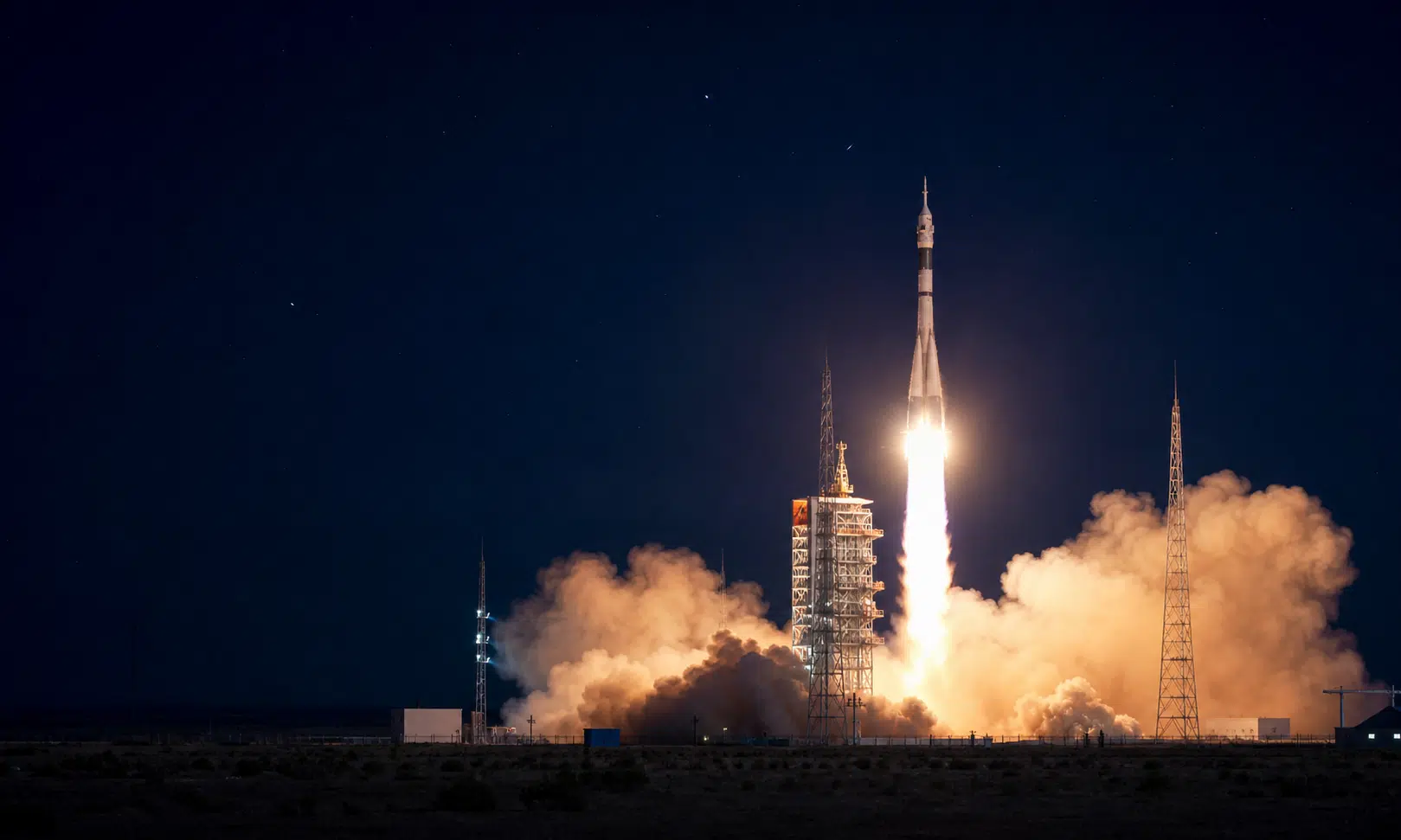

China launched the Shenzhou 23 spacecraft Sunday night, sending three astronauts toward the Tiangong space station in a mission that includes one of the country’s most ambitious human spaceflight tests yet: a planned yearlong stay in orbit.
The spacecraft lifted off from the Jiuquan Satellite Launch Center in northwestern China on May 24, 2026. The crew is led by commander Zhu Yangzhu and includes Zhang Zhiyuan and Lai Ka-ying, also identified by Chinese authorities as Li Jiaying in Mandarin transliteration.
Lai, who was born and raised in Hong Kong and holds a doctorate in computer forensics, is the first astronaut from the city to take part in a space mission.
Why the Mission Matters
Shenzhou 23 is part of China’s steady expansion of crewed operations aboard Tiangong, the country’s permanently crewed space station. The crew is expected to carry out dozens of science and application projects while also completing an in-orbit handover with the Shenzhou 21 crew, which has spent more than 200 days aboard the station.
The mission’s most closely watched element is the planned yearlong stay by one of the three astronauts. Chinese state media described the goal as studying human adaptability and performance limits during long-duration spaceflight. The astronaut selected for the extended stay was not identified in the source report.
| Mission element | What is known |
|---|---|
| Spacecraft | Shenzhou 23 |
| Destination | Tiangong space station |
| Crew | Zhu Yangzhu, Zhang Zhiyuan, Lai Ka-ying |
| Notable first | Lai Ka-ying is the first astronaut from Hong Kong on a space mission |
| Extended stay | One crew member is scheduled to remain in orbit for about one year |
China’s Broader Space Push
The launch comes as China prepares for its first crewed lunar landing, which it aims to carry out by 2030. Its space program has moved quickly in recent years, with repeated crew rotations to Tiangong and growing attention on long-duration flight, lunar technology and future exploration missions.
China developed Tiangong after being effectively excluded from the International Space Station because of U.S. national security concerns. The United States remains China’s most visible space rival, with NASA targeting a crewed return to the lunar surface in 2028.
Tiangong, whose name translates as “Heavenly Palace,” first hosted a Chinese crew in 2021. The Shenzhou program, meaning “Divine Vessel,” has since become the backbone of China’s crewed orbital operations.