Reports about honey recovered from ancient Egyptian tombs often sound like a legend: sealed jars, royal burials, and a food that remains recognizable after thousands of years. Some popular versions go further, saying the honey was tasted and found sweet. Those details are harder to pin down than the chemistry.
What is much clearer is why well-sealed honey can remain remarkably stable. Honey is naturally low in available water, acidic, and shaped by bee enzymes that can produce small amounts of hydrogen peroxide under the right conditions. Those traits do not make every ancient-honey anecdote automatically true, but they do explain why honey is unusually resistant to the bacteria, yeasts, and molds that ruin most foods.
That distinction matters. The story is not simply that ancient jars performed a miracle. It is that honey starts with a preservation system built into it, and a sealed, dry burial environment could keep that system from being undone.
The Famous Tomb Honey Story Needs Careful Wording
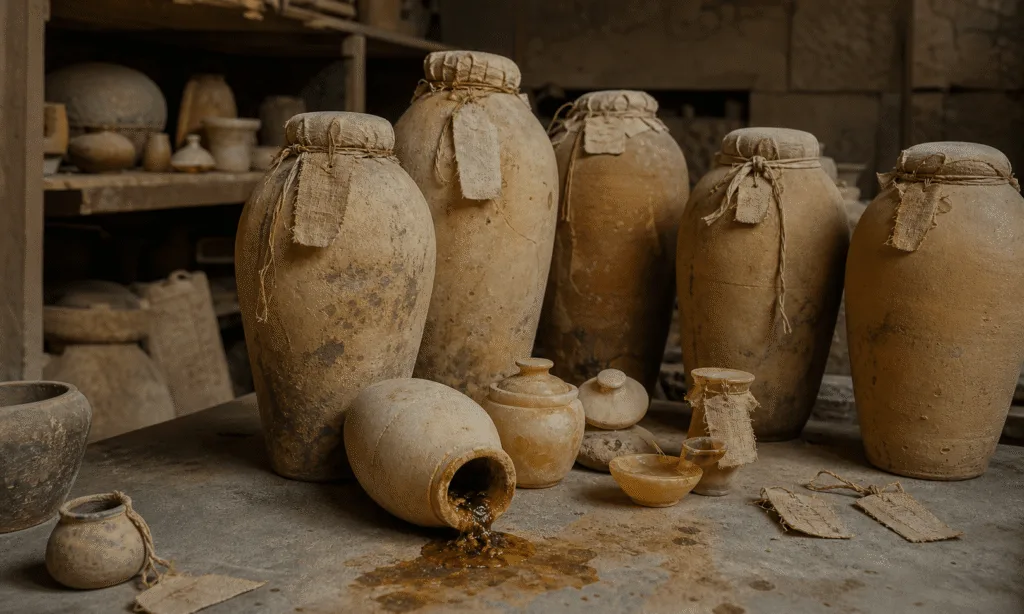
The best-known version of the story is tied to the opening of Tutankhamun’s tomb in 1922, when Howard Carter’s team cataloged a large number of vessels and food offerings. Popular accounts often describe alabaster jars containing honey or honey-like residue, then add that archaeologists tasted ancient honey and found it still sweet.
The broad idea that honey or honey residues have been associated with Egyptian tomb contexts is plausible and widely repeated. The specific claims are less tidy. A precise closing date for any individual jar, the exact plants visited by the bees, and whether a named archaeologist actually tasted a particular sample are not details that should be treated as settled without better documentation.
A more careful reading is this: ancient Egyptians placed food offerings, including sweet substances, in tombs; honey was important in Egyptian life; and sealed honey-like material from ancient contexts can remain chemically recognizable for very long periods. That is enough to make the science worth explaining without leaning on the more theatrical versions of the tale.
Why Honey Is So Hard For Microbes To Use
Fresh nectar is watery. Honey is not. Bees transform nectar by moving it through the colony, adding enzymes, and evaporating much of its water before storing it in wax cells. The result is a dense sugar solution dominated by fructose and glucose.
That density is the first major reason honey lasts. Bacteria and fungi need usable water to grow. In honey, much of the water is tied up by sugar, so microbes that land in it face strong osmotic pressure. In plain terms, the environment pulls water away from cells instead of feeding them. That makes growth difficult even before honey’s other chemical defenses come into play.
This is related to familiar preservation methods such as heavy salting and sugaring, though honey has its own mix of sugars, acids, enzymes, and trace compounds. The useful point is not that honey is magic. It is that the available-water problem is severe enough to make ordinary spoilage organisms struggle.
Honey can still change over time. It may crystallize, darken, lose some aroma, or shift in flavor. Those changes can make it less appealing, but they are not the same as ordinary spoilage. A jar that has stayed sealed and dry is very different from one that has been left open in a humid kitchen.
Acidity Adds A Second Barrier
Honey is also naturally acidic. Its exact pH varies by floral source and handling, but it commonly falls in a range that is unfriendly to many microbes. Much of that acidity is associated with gluconic acid, which forms through the action of glucose oxidase, an enzyme bees add during honey production.
Acidity alone is not unusual in food. Citrus juice, vinegar, fermented vegetables, and many preserved foods rely on acidic conditions. Honey’s advantage is that acidity works alongside low available water. A microbe that might tolerate one stress still has to cope with the other.
That is why the phrase “honey does not spoil” needs context. Properly stored honey is unusually shelf-stable. Poorly stored honey can absorb moisture from the air. Once enough water is present, dormant yeasts may become active and fermentation can begin. The food’s reputation for longevity depends heavily on keeping the jar sealed, dry, and protected from contamination.
For buyers, that has a practical takeaway, even though this is not a product review: honey’s durability depends more on storage than on a printed date. Keep it tightly closed, use a clean utensil, and do not treat crystallization as a sign that the honey has gone bad.
The Enzyme Chemistry Behind Honey’s Antimicrobial Reputation
The same enzyme linked with honey’s acidity, glucose oxidase, also helps explain honey’s long reputation in wound care. When honey is diluted, glucose oxidase can generate hydrogen peroxide in small amounts. Hydrogen peroxide is a familiar disinfecting compound, though the concentrations and behavior in honey are not the same as pouring a pharmacy bottle onto a surface.
This mechanism helps explain why honey has been studied for antimicrobial activity and why ancient medical traditions used honey in dressings and remedies. The historical record includes Egyptian medical texts that mention honey in treatments, though claims about exactly what ancient healers understood should be kept modest. They did not know modern enzymology. They could observe outcomes.
There is another reason to avoid overstating the point: honey’s antimicrobial activity is not fixed forever. Enzymes can weaken with age, heat, light, and processing. Very old honey may still be stable as a sugar-rich food, while no longer behaving like fresh medical-grade honey. Food preservation and wound treatment are related topics here, but they are not the same claim.
Modern medical honeys are prepared and controlled for clinical use. An old jar from a pantry, let alone an archaeological vessel, should not be treated as a wound-care product.
Why A Sealed Tomb Could Help Honey Last
The storage environment is the other half of the story. Honey that sits open in damp air will slowly absorb moisture. A sealed vessel in a dry, dark chamber has far fewer chances to do that.
Ancient Egyptian tombs were not designed as food laboratories, but some of their conditions were favorable for preservation. Burial chambers could be dark, relatively stable, and cut off from everyday air exchange. Jars and vessels were often sealed in ways meant to protect or preserve their contents as offerings. If honey began with very low available water and then stayed sealed, the usual route toward fermentation would be limited.
That does not mean every tomb jar survived perfectly. Archaeological materials are affected by vessel quality, cracks, temperature shifts, humidity, contamination, and handling after discovery. It does mean that the survival of honey-like material is chemically plausible in a way that the survival of many other foods would not be.
Grain can mold or be attacked by insects. Meat contains fats and proteins that break down. Wine can age, but it changes chemically until it is no longer what it once was. Honey is mostly sugar, with relatively little water and no meaningful fat load. Over centuries, it may become darker, thicker, grainier, and less aromatic. It can remain recognizably honey because there is so little in it for spoilage organisms to exploit.
Ancient Honey Would Not Taste Like A Fresh Jar
The romantic image of golden syrup poured from a pharaoh’s tomb is probably too clean. Old honey would be expected to look and taste different from fresh honey. It could be dark, crystallized, and heavy, with much of its floral aroma gone.
Fresh honey gets much of its character from volatile compounds linked to the flowers visited by bees. Orange blossom, buckwheat, clover, eucalyptus, and other floral sources can produce noticeably different honeys. In an ancient Egyptian setting, bees would have foraged from the plants available along the Nile and cultivated landscapes, but assigning a specific flavor profile to a particular tomb jar without analysis would go beyond the evidence.
What would likely remain after very long storage is the core structure: concentrated sugars, organic acids, traces of pollen or plant material, and the slow effects of aging. The honey might still be sweet. It might still be chemically identifiable. It would not be interchangeable with fresh honey from a modern beekeeper.
That is the more useful version of the ancient-honey story. The claim that honey can last for extraordinary periods is supported by known food chemistry, provided the storage conditions stay dry and sealed. The more specific claims about a particular jar, a precise date, or a dramatic tasting should be handled with caution.
Honey’s long life comes from a rare combination: very little available water, natural acidity, and enzyme-driven chemistry that can discourage microbial growth. Ancient Egyptian tombs supplied something just as important: isolation. Put those together, and a food made by bees can outlast most of the world that produced it.