


The first 1GB-class hard drives were not something you casually screwed into a home PC. IBM’s 3380 Direct Access Storage Device arrived in 1980 for mainframe environments, and it belonged to a very different era of computing: large cabinets, enterprise budgets, and storage measured in characters as much as bytes.
The first 1TB hard drive that felt recognizable to modern PC users came much later. Hitachi announced the Deskstar 7K1000 in 2007, a standard 3.5-inch desktop drive that could fit inside a consumer PC. That jump from gigabyte-class storage to terabyte-class storage took decades.
It is tempting to stretch that timeline forward and assume the first 1PB drive, equal to 1,000TB, should be arriving sometime around the mid-2030s. That rough comparison is not useless, but it hides the real story. Hard drives and SSDs are now moving along very different tracks, and the first petabyte-class drive is unlikely to be the kind of storage upgrade an everyday builder can buy, install, and forget about.
The more likely outcome is stranger: SSDs may reach 1PB first in data centers, while old-fashioned hard drives may remain the more realistic path to giant in-PC storage for many years.
Hard Drives Are Still Growing, Just Not Fast Enough for 1PB Soon
Hard drives are not dead. In fact, they are still central to cloud storage, backup systems, media libraries, surveillance archives, and AI data pipelines. When the priority is storing huge amounts of data at a lower cost per terabyte, spinning disks remain hard to displace.
That does not mean a 1,000TB hard drive is around the corner.
The largest announced and shipping enterprise hard drives are still measured in the tens of terabytes, not hundreds. Seagate’s HAMR-based Exos M family has pushed capacity up to the 36TB class, and the company has publicly discussed a goal of reaching roughly 100TB hard drives by 2030. That would be an enormous step for magnetic storage, but it would still be only one-tenth of a petabyte.
This is where the easy historical comparison breaks down. Going from 1TB in 2007 to around 36TB today is impressive, but it is not the same kind of thousand-fold jump that storage history sometimes makes look inevitable. Hard drive makers are fighting physics, materials limits, heat, platter count, head technology, and manufacturing cost all at once.
Technologies such as HAMR, higher-density platters, improved media, and denser 3.5-inch designs should keep HDD capacity moving upward. A 60TB or 100TB hard drive would be a major product for data centers and NAS vendors. A 1PB hard drive, however, remains a much longer-term target.

WD Red Pro 24TB NAS Hard Drive
A high-capacity NAS hard drive is the practical version of huge storage today. It fits home servers and multi-bay NAS systems better than enterprise SSDs meant for data centers.
As an Amazon Associate I earn from qualifying purchases.
For buyers, that distinction matters. If you are building a home server or upgrading a NAS, the practical question is not when a 1PB hard drive exists. It is when today’s 20TB, 24TB, 30TB, and larger drives become affordable enough to populate a system without turning the build into an enterprise storage project.
SSDs Have the Clearer Path to Petabyte Capacity
Flash storage is moving differently. Enterprise SSDs already reach capacities that would have sounded absurd for a single drive not long ago. The 122.88TB class has been a high-end benchmark for commercially available data center SSDs, while Kioxia has announced a 245.76TB LC9 enterprise SSD and has described it as sampling to select customers.
That does not mean you can order a petabyte SSD for a gaming PC. It does mean the SSD side of the industry has a more believable route to 1PB than hard drives do.
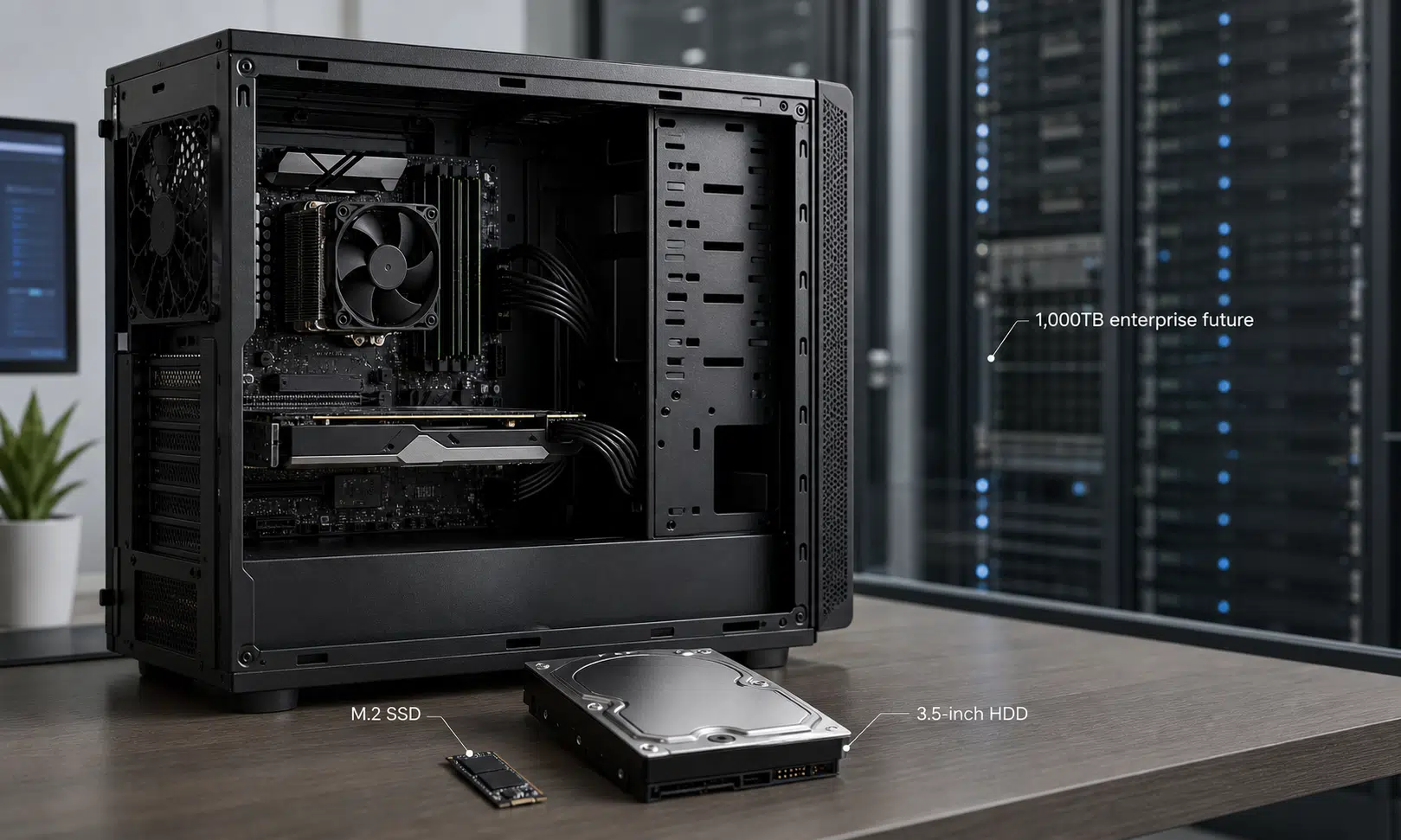
The reason is packaging. Enterprise SSDs can stack large numbers of NAND dies, use dense QLC flash, and move into server-focused form factors designed for capacity instead of consumer convenience. These drives are not limited to the tiny M.2 stick most desktop users think of when they hear “SSD.”
Modern enterprise systems use form factors such as U.2, E1, E3, and other EDSFF designs. These are built for racks, airflow, serviceability, power delivery, and density. They can house far more flash than a standard desktop M.2 drive, and they are intended to sit in servers that may contain many of them.
That is why a 245TB enterprise SSD is easier to imagine than a 245TB consumer M.2 SSD. The former is a data center component. The latter would need to fit inside a tiny slot on a motherboard, stay cool, draw reasonable power, and sell into a market where most buyers are still choosing between 1TB, 2TB, 4TB, and 8TB drives.
The First 1PB SSD Will Probably Be a Data Center Product
A 1PB SSD is not a normal PC upgrade waiting for a price drop. The first models will almost certainly be designed for data centers, AI infrastructure, cloud platforms, and other environments where density is worth paying for.
That changes the buying logic completely. A desktop builder usually wants a drive that is fast, simple, compatible, and reasonably priced. A data center operator may care more about reducing rack space, lowering power per stored terabyte, simplifying service, and feeding huge workloads without spreading data across too many devices.
For those customers, one very dense SSD can make sense even if the sticker price looks absurd to everyone else. Fewer drives can mean fewer bays, fewer cables, fewer failure points, and less physical space used per petabyte. That is valuable in a server room where power and floor space are real constraints.

Samsung 990 PRO 4TB M.2 NVMe SSD
A mainstream 4TB NVMe SSD is the kind of upgrade that actually fits modern desktops and laptops. It makes more sense for active files and games than waiting for extreme enterprise drives.
As an Amazon Associate I earn from qualifying purchases.
For a home user, the same drive would be a mismatch. It may use a form factor your case does not support, require a server backplane, demand more airflow than your desktop provides, or cost more than the rest of your computer by a ridiculous margin. Even if an adapter technically exists, that does not make it a sensible purchase.
This is the key point: the first 1,000TB drive may arrive before many people expect, but that does not mean 1,000TB personal storage will arrive at the same time.
Why M.2 Drives Will Lag Behind
Most desktop PCs now treat M.2 NVMe as the default SSD format. It is compact, fast, cable-free, and easy to install. It is also a poor shape for extreme capacity.
An M.2 drive has very little board space. There is only so much room for NAND packages, the controller, power management, and thermal design. Higher-capacity M.2 drives already tend to be expensive, specialized, and heat-sensitive compared with mainstream models.
That is why the consumer market moves more slowly at the very high end. A 4TB M.2 SSD is now ordinary. An 8TB model is available but still expensive for many buyers. Higher-capacity M.2 drives exist in specialized or enterprise lines, but they are not mainstream parts for ordinary builds.
A 1PB M.2 SSD would require a dramatic shift in NAND density, packaging, power use, controller design, and cost. It is not impossible forever, but it is not the near-term version of petabyte storage.
That is also why hard drives may remain relevant to PC builders for longer than many SSD fans expect. A 3.5-inch hard drive has much more physical volume to work with. It is slower, noisier, and less shock-resistant than an SSD, but it is still a practical container for cheap bulk storage. If a future desktop-friendly 100TB, 200TB, or larger drive arrives, it may be an HDD long before an M.2 SSD reaches the same capacity at a sane price.
What This Means for Buyers
If you are shopping for storage today, the 1PB race should not change your immediate buying plan. It should change how you think about storage categories.
SSDs are the right choice for operating systems, games, active projects, editing work, virtual machines, and anything that benefits from low latency and high throughput. Hard drives still make sense for media collections, backups, archives, surveillance footage, bulk NAS storage, and cold data that does not need SSD speed.
A balanced storage setup still looks familiar:
- Use a fast NVMe SSD for your operating system, applications, and active files.
- Use a larger SSD if your work involves video editing, large project files, or frequent transfers.
- Use high-capacity hard drives for bulk storage, backups, and home server workloads.
- Keep at least one backup separate from your main machine or NAS.

Crucial BX500 4TB 2.5-Inch SATA SSD
A large SATA SSD is a practical middle ground when you want silent storage and broad 2.5-inch compatibility. It is not as fast as NVMe, but it is much more responsive than a hard drive.
As an Amazon Associate I earn from qualifying purchases.
The mistake is assuming that SSDs will automatically replace hard drives at every capacity point. For laptops and most desktops, they already have. For enormous storage pools, the answer is more complicated. Data centers care about density, power, cost, workload type, and lifecycle management. Home users care about price, compatibility, noise, reliability, and whether the drive fits in the case they already own.
The Petabyte Era Is Close, But Not Personal Yet
The first 1PB drive will be an important milestone, but it probably will not feel like the arrival of the first 1TB desktop hard drive. The Deskstar 7K1000 mattered because it brought a huge round-number milestone into a standard consumer form factor. You could buy it, install it, and use it like any other desktop hard drive.
The first 1PB SSD is likely to be different. It will probably live in a rack, serve enterprise workloads, and cost far beyond consumer reach. It may prove that petabyte-class single-drive storage is technically possible before it proves that ordinary people can use it.
So yes, SSDs appear more likely than hard drives to hit 1,000TB first. But for everyday builders, that victory may be mostly symbolic. The storage war that matters at home is not about which technology reaches the biggest number first. It is about which technology gives you the capacity you can actually afford, in a form factor your PC can actually use.
For the next several years, that means SSDs will keep winning speed and responsiveness, while hard drives keep defending bulk capacity. The first petabyte drive may arrive early, but the first practical petabyte drive for a normal PC is still a much longer wait.