

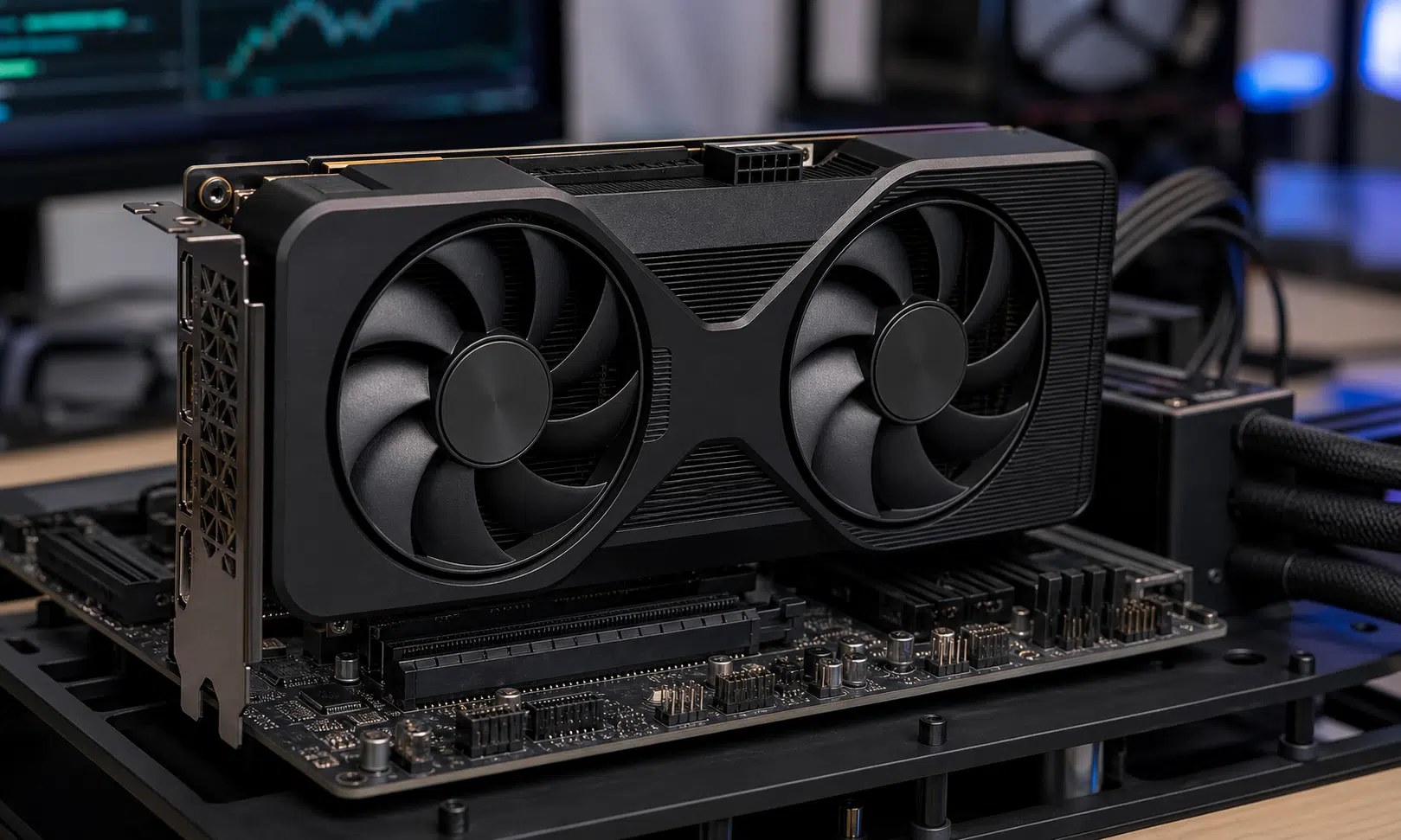

The PNY GeForce RTX 5060 Ti OC is presented as a compact mid-range graphics card built around Nvidia’s Blackwell generation, but the buying decision is less about the name on the box and more about the resolution you actually play at.
For Full HD gaming, the card makes the strongest case. The source review describes smooth performance in that class and occasional WQHD suitability, especially when Nvidia features such as DLSS 4 and Multi Frame Generation are part of the equation. The caution is video memory. As game settings, texture packs, and resolution rise, the card can run into limits that raw GPU performance alone will not solve.
That makes this a more specific recommendation than a broad one. If your monitor is 1080p and you want access to the latest Nvidia feature set in a smaller, efficient card, the PNY model belongs on the shortlist. If you expect to stay at WQHD for several years or regularly use very demanding texture settings, the memory configuration deserves closer scrutiny.
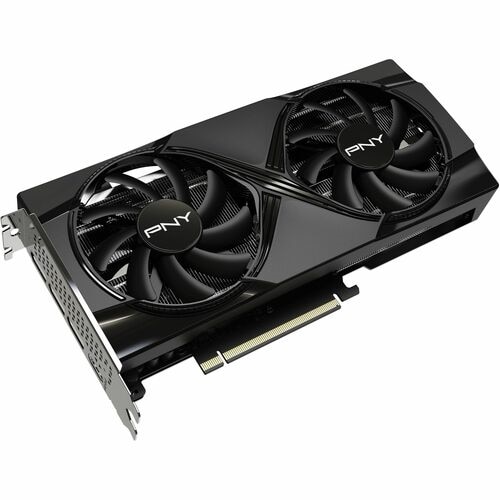
PNY GeForce RTX 5060 Ti 8GB Dual Fan
This PNY RTX 5060 Ti fits the article’s 1080p-first recommendation, with a compact dual-fan design and a single 8-pin power connector. It is best matched with Full HD gaming and sensible texture settings rather than long-term 4K ambitions.
As an Amazon Associate I earn from qualifying purchases.

PNY GeForce RTX 5060 Ti 16GB EPIC-X RGB OC
A 16GB RTX 5060 Ti is the more natural comparison if you like this GPU class but are concerned about VRAM limits. It gives more memory headroom for WQHD gaming, heavier texture settings, and some creator workloads, though the larger cooler may not suit every compact case.
As an Amazon Associate I earn from qualifying purchases.
Verdict: A Sensible Full HD Card With a Clear Ceiling
The practical verdict is straightforward: the PNY GeForce RTX 5060 Ti OC is best treated as a Full HD-first graphics card. It can stretch into WQHD in some games and settings, but the review’s repeated warning is that available VRAM can become the brake before the rest of the card feels exhausted.
That distinction matters for buyers. DLSS and frame generation can improve perceived smoothness and make demanding games more playable, but they do not create extra local video memory. When a game needs more VRAM than the card can comfortably provide, the result may be lower minimum frame rates, visible loading stutter, delayed texture loading, or instability in especially demanding cases.
The card’s stronger points are its compact design, restrained power use, and cooling behavior. The review describes it as quiet at idle thanks to semi-passive fan control, with the fans switching off again after a load phase. Under sustained gaming load, it becomes audible but remains within acceptable limits in the test setup. A slight coil whine was also noted, with the usual caveat that coil noise can vary by sample, power supply, and workload.
Design, Build, and Test Setup
The PNY card has a plain black design that should fit visually into many PC builds. The source review describes the construction as clean and solid, with a compact format that should help in smaller cases. One layout detail is worth noting for builders: the front-facing power connector can affect cable routing, especially in tighter systems.
The tested system used an AMD Ryzen 7 9800X3D processor on an ASRock X870E Taichi motherboard. The card was evaluated at factory settings, with no reported changes to its power limit or GPU clock behavior. That matters because the conclusions are tied to the card as a buyer would typically run it, rather than to a tuned or heavily overclocked configuration.
Power is supplied through a single 8-pin PCIe connector. For buyers upgrading an existing PC, that is a useful compatibility point because it avoids adapter complexity. The review suggests that a quality power supply in the 600-watt class should be enough for stable operation, assuming the rest of the system is not unusually power-hungry.
Gaming Performance: Strongest at 1080p, Conditional at WQHD
In gaming, the PNY GeForce RTX 5060 Ti OC is described as capable of smooth Full HD play with high to maximum detail settings in many current titles. WQHD is more conditional. Some games should remain comfortable, particularly with upscaling or frame generation enabled, but memory-heavy titles and high texture settings can expose the card’s limits sooner.
That is the key tradeoff in this review. The GPU side appears competitive within the RTX 5060 Ti class, but the lower VRAM configuration can fall behind 16 GB variants in scenarios that lean heavily on memory. The card is therefore less convincing as a long-term WQHD option than it is as a 1080p upgrade.
The source also frames 4K gaming as a poor fit for this model. While some games may run, the available memory becomes a more serious constraint at UHD resolution. Buyers who regularly play at 4K, install high-resolution texture packs, or want to keep demanding AAA settings high should look at cards with more VRAM instead.
| Use case | How the card fits |
|---|---|
| Full HD gaming | Best match; the review presents this as the card’s clearest strength. |
| WQHD gaming | Possible in some games, but more dependent on settings, DLSS, and VRAM demand. |
| 4K gaming | Limited fit; memory pressure becomes a major concern in demanding titles. |
| Small or efficient builds | Appealing due to compact dimensions, modest power needs, and single 8-pin power. |
Benchmarks and Creative Workloads
In synthetic benchmarks, the card is described as landing in the upper mid-range and performing broadly in line with other RTX 5060 Ti models. The important qualifier is memory. Against RTX 5060 Ti versions with 16 GB of VRAM, the reviewed PNY model can trail in memory-intensive workloads.
The review also positions the Radeon RX 9060 XT as an important competitor, particularly where a 16 GB configuration is available. AMD’s more powerful Radeon RX 9070 models are mentioned as faster alternatives, though they sit in a higher class and should not be treated as direct price-for-price comparisons without checking actual retail pricing.
For non-gaming work, the PNY card is presented as usable for semi-professional tasks, including visualization, CAD, and content creation workloads. It reportedly posted respectable results in SPECviewperf 2020 and solid results in SPECworkstation 4.0, while still sitting behind higher-end RTX 50-series models. As always with workstation-style software, application optimization can matter as much as the GPU name.
Cooling, Noise, and Efficiency
Cooling is one of the more reassuring parts of the review. The dual-fan cooler and large heat sink are described as keeping GPU and memory temperatures in a safe range under sustained load. The card is smaller than many triple-fan designs, but the test did not suggest thermal throttling as a normal concern.
The acoustic behavior is also buyer-friendly for desktop use. At idle, Zero RPM mode lets the fans stop completely at low temperatures, so the card can run silently during light work. During gaming or other sustained load, the fans ramp up evenly. The card becomes audible, but the review does not frame the noise as excessive.
Power consumption is another advantage. The PNY GeForce RTX 5060 Ti OC is described as comparatively efficient, with moderate draw at idle and under load. For users building a smaller PC, upgrading an older system, or trying to avoid a larger power supply purchase, that efficiency may be one of the card’s more practical strengths.
Who Should Buy It?
The best buyer for this card is someone building or upgrading a Full HD gaming PC and wanting Nvidia’s newer feature set in a compact, efficient board. It also makes sense for users who occasionally play at WQHD but are comfortable adjusting texture quality or using DLSS when a game becomes too demanding.
It is a weaker choice for buyers who want a set-and-forget WQHD card for future AAA releases. The review’s concerns about VRAM are not a minor footnote; they shape the entire recommendation. If your games already push memory hard, or if you plan to keep the card through several years of demanding releases, a 16 GB RTX 5060 Ti variant or another higher-memory option may be the safer purchase.
- Consider it if your main target is Full HD gaming.
- Consider it if your case has limited space and you want a compact card.
- Consider it if efficiency and a single 8-pin power connector matter.
- Think twice if WQHD is your main resolution for demanding games.
- Avoid it as a primary 4K gaming card unless your game library is unusually light.
Bottom Line
The PNY GeForce RTX 5060 Ti OC comes across as a focused mid-range graphics card rather than a do-everything upgrade. Its strengths are Full HD performance, compact dimensions, quiet idle behavior, efficient operation, and access to Nvidia’s current feature stack. Its main limitation is VRAM, which can narrow its usefulness as resolution and texture demands increase.
For the right buyer, that is still a reasonable trade. For 1080p gaming, it looks like a practical route into the RTX 50-series generation. For WQHD longevity or 4K ambition, the smarter move is to compare it directly with 16 GB alternatives before buying.