

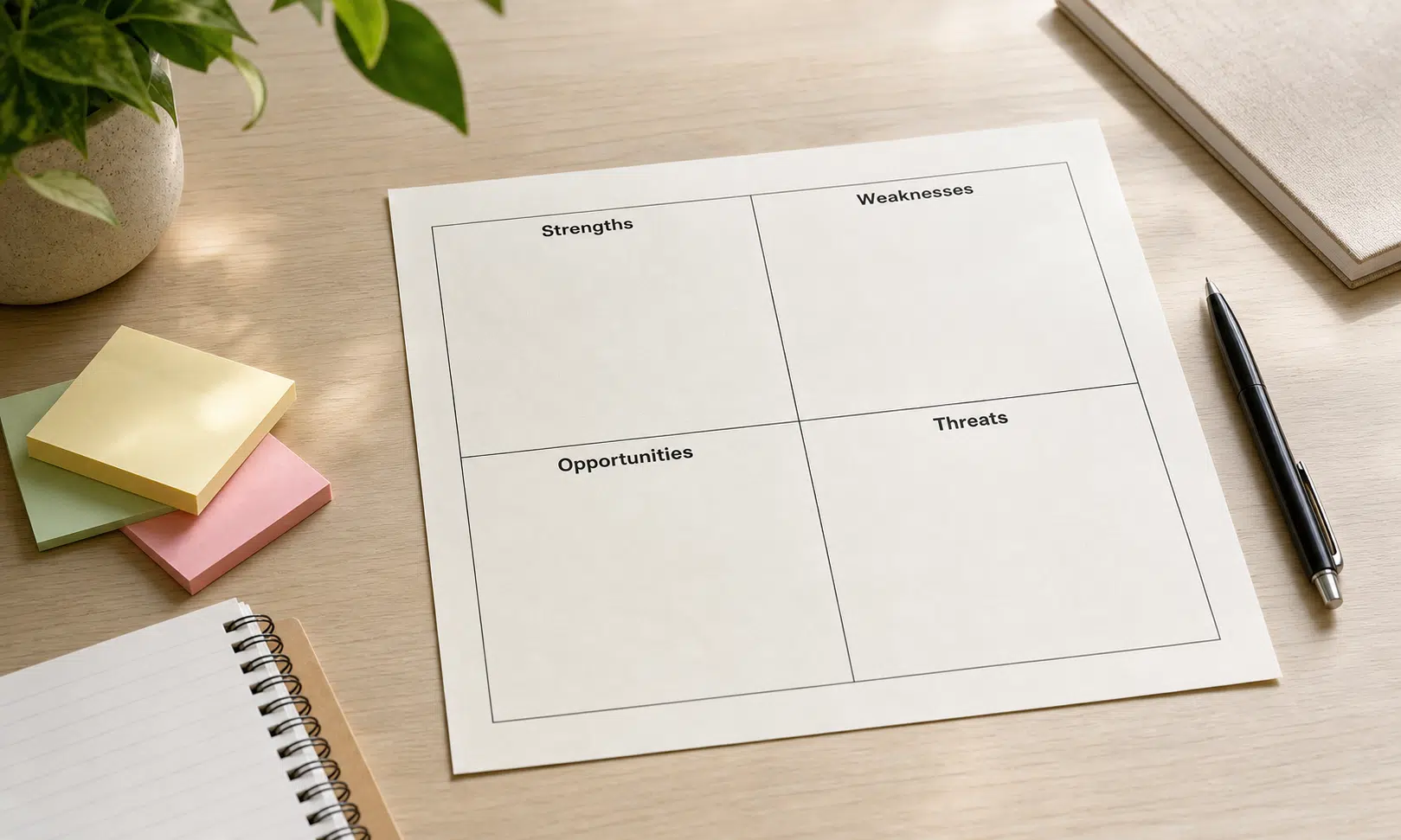

SWOT analysis is a familiar strategy framework built around four questions: strengths, weaknesses, opportunities, and threats. The source article frames it as a practical system for thinking through business, career, and personal decisions, rather than as a tool reserved for formal planning sessions.
That framing is useful. SWOT works best when it slows down a decision that might otherwise be made from habit, pressure, or vague optimism. It does not make the decision for you, and it should not be treated as proof that a plan will work. Its value is in making the tradeoffs visible.
Verdict: Best for Decisions That Need More Structure
As a personal strategy tool, SWOT is strongest when you are choosing between a few meaningful options: a career move, a business idea, a skill to build, or a change in how you spend time and attention. It gives you a simple way to separate what is inside your control from what sits in the environment around you.
How to Use SWOT Without Overcomplicating It
The basic setup is low-friction: use a notebook, document, or one-page worksheet and divide the page into four sections.

Rocketbook Core Reusable Notebook
A reusable notebook can work well for SWOT sessions you plan to revisit quarterly. Dot-grid or lined pages give enough structure for four-quadrant notes without locking you into a fixed template.
As an Amazon Associate I earn from qualifying purchases.
- Strengths: internal advantages that may support the outcome you want.
- Weaknesses: internal limits or gaps that could make progress harder.
- Opportunities: outside conditions you may be able to use constructively.
- Threats: outside risks or pressures that could interfere with the plan.
For a career decision, a strength might be strong written communication, while a weakness might be discomfort speaking in groups. An opportunity could be a course, mentor, or project that builds that skill. For personal planning, a weakness might be difficulty focusing, while a threat could be the pull of social media or other recurring distractions.
The Main Tradeoff
SWOT is simple, which is both the appeal and the limitation. It can clarify what deserves attention, but it depends on the quality of the input. If the answers are vague, flattering, or rushed, the output will be weak.
It is also not a one-time exercise. The source recommends revisiting the analysis on a regular cadence, such as quarterly. That is reasonable: goals change, constraints change, and a strategy that made sense six months ago may need to be adjusted.
Who It Is For
SWOT is a good fit for readers who want a lightweight decision tool before committing time, energy, or money to a major move. It is less useful for anyone looking for a detailed execution plan, financial model, or guaranteed answer.
Used well, it is a pause button: a way to ask whether the next move fits your strengths, addresses your weak spots, uses real opportunities, and accounts for threats before you spend resources on the wrong problem.