

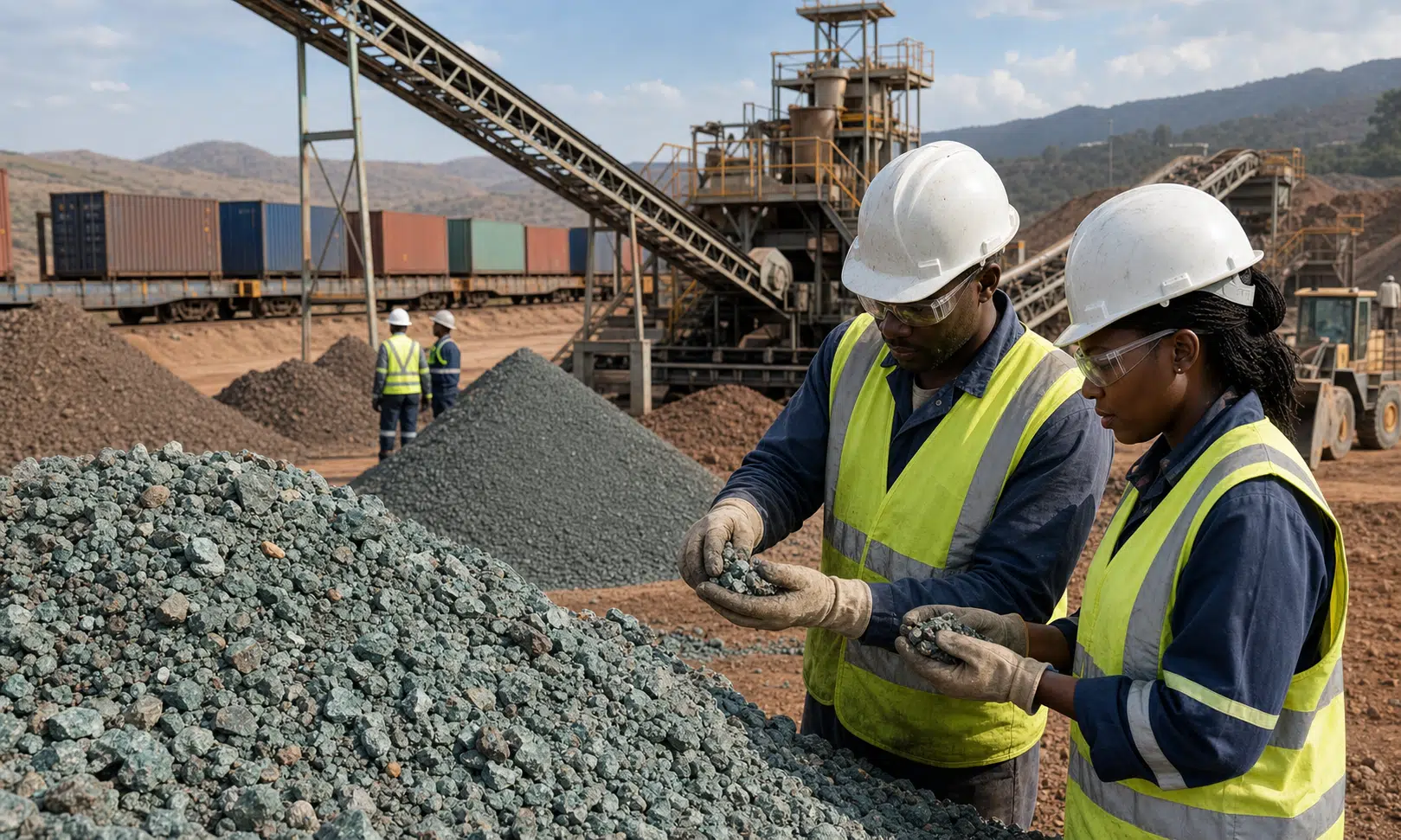

The G7’s critical minerals push is landing at a moment when African governments are trying to change the terms of the mining business: less raw-material export, more local processing, and more bargaining power in supply chains that increasingly matter to batteries, clean energy, defense, electronics, and industrial manufacturing.
At a meeting in Evian, France, on June 17, 2026, G7 leaders agreed to coordinate work on investment, processing, stockpiling, recycling, and supply-chain data for critical minerals including rare earths, lithium, and nickel. The bloc said 195 critical minerals projects announced since the start of 2026 had reached EUR64 billion in investment, including equity participation and offtake agreements.
For Africa, the number is less important than the direction of travel. The continent has major deposits of cobalt, copper, lithium, graphite, manganese, rare earths, and other strategic minerals, but much of the higher-value refining and manufacturing still happens elsewhere. That mismatch is what governments from Nairobi to Kinshasa are trying to fix.
The opportunity is clear enough: if outside capital flows into processing plants, power, transport, and industrial capacity, mineral-rich African economies could move further up the value chain. The harder question is whether that capital arrives on terms that build lasting local capacity rather than simply rerouting supply chains for buyers in richer markets.
Why the G7 push matters for African producers
Critical minerals have become a strategic priority because the countries that control refining and processing can shape the pace and cost of whole industries. Rare earths are used in magnets and electronics. Lithium, nickel, cobalt, and graphite are tied to battery production. Manganese and platinum group metals sit across industrial and clean-energy supply chains.
The G7 language points toward diversification, but African producers are reading the moment through a more practical lens. Diversification only helps them if it brings factories, technical training, infrastructure, and better commercial terms. Exporting ore while someone else captures the value from refining is the model many governments are trying to leave behind.
That is why local beneficiation has become the key phrase around the continent’s mining negotiations. It means processing minerals closer to where they are extracted, creating more domestic jobs and giving governments a stronger argument for industrial policy. It is also expensive, technically demanding, and dependent on reliable power, roads, ports, water, and long-term customers.
G7 development finance institutions and export credit agencies are expected to coordinate more closely around critical minerals and related infrastructure. That could matter for African projects because many are not blocked by geology; they are blocked by financing costs, political risk premiums, weak infrastructure, and uncertainty over offtake agreements.
Kenya is pushing for processing at home
Kenya’s role at the summit gave President William Ruto a platform to argue that African minerals should be processed locally rather than shipped abroad as raw materials. Ruto said Kenya had discussed a critical minerals arrangement with the United States covering rare earths and other strategic minerals, and framed local processing as a central condition.
“We have agreed that the minerals will be processed in Kenya,” Ruto said after talks at the G7 summit. He described the proposed arrangement as mutually beneficial for Kenya and the United States, while also tying it to jobs and industrialisation.
That framing fits the broader shift in African mining policy. Governments are pressing for better offtake terms, more local value retention, and processing commitments in deals with foreign partners. Ruto put the argument bluntly: “These natural resources can no longer be exported and processed elsewhere. They have to be processed in-country and in-continent.”
The political message is that Africa is not trying to choose one bloc over another. Kenya has deep economic links with China, but Ruto used the G7 stage to argue for wider partnerships with Western governments and companies. His position was that Africa wants deals that support manufacturing and employment, not just extraction.
For companies watching the sector, that makes the next wave of mineral deals more complicated. Access to deposits may increasingly come with expectations around processing, workforce development, infrastructure, and local industrial participation.
Nigeria’s rare earth project shows the local-processing push
Nigeria is also trying to position itself in critical minerals processing. A government delegation inspected the site of a planned rare earth processing facility in the country’s North Central region, a project described as a $400 million investment by an indigenous mining company.
The facility is expected to add 12,000 tonnes of annual processing capacity to existing operations, lifting total output to 18,000 tonnes a year if the project proceeds as planned. The project has been described as moving through a transition period since June 2025, with further political backing in November and fresh attention after the delegation’s June 2026 visit.
The project sits outside direct G7 financing, but it reflects the same pressure reshaping the market. African governments do not want to be treated only as upstream suppliers. They want plants, processing capacity, and domestic industrial ecosystems that can capture more of the value created by strategic minerals.
That ambition still needs careful handling. Rare earth processing is capital intensive and can bring environmental and technical challenges. A plant announcement is not the same as reliable production at scale. Buyers, lenders, and governments will be watching whether projects can secure power, permitting, skilled labor, and stable long-term demand.
DRC, South Africa, and Egypt remain part of the bigger map
The Democratic Republic of Congo remains central to battery supply chains because of its cobalt reserves, and its role in critical minerals is not limited to existing production. Congo has been seeking access to colonial-era geological records held in Belgium as it looks to map underexplored mineral deposits. U.S. mining company KoBold Metals has been linked to efforts to digitise those records and support the search for new deposits.
South Africa was not represented at the Evian meeting, even though President Cyril Ramaphosa had earlier been expected to attend. France said Kenya had been invited and denied reports that South Africa was excluded under pressure from Washington.
Even without a seat at that meeting, South Africa remains relevant to the minerals conversation because of its manganese, platinum group metals, rare earths, and other resources used across clean-energy and industrial supply chains. It also has a more developed industrial base than many African peers, which gives it potential advantages in processing and supporting infrastructure.
Egypt’s presence at the summit pointed to another side of the supply-chain discussion. President Abdel Fattah el-Sisi attended as one of the invited leaders, making Egypt the only North African country represented. Egypt does not hold the same mineral profile as some other African countries, but its ports, industrial base, and access to the Suez Canal make it relevant to logistics and manufacturing conversations around global supply chains.
The financing problem is still the real test
The central question for Africa is not whether demand for critical minerals exists. It does. The question is whether countries can convert that demand into processing capacity, infrastructure, and durable industrial jobs.
Ruto told G7 leaders that Africa’s problem was not a lack of capital in the abstract, but the absence of frameworks that make it easier to mobilise. He called for guarantees and risk-sharing mechanisms that could help draw in African pension funds, insurance assets, and reserves.
That matters because critical minerals projects often sit between competing risks. Processing facilities need huge upfront spending before they generate returns. Infrastructure gaps can delay projects or push costs higher. Political uncertainty can make lenders more cautious. Without credible risk-sharing, even commercially promising projects can struggle to close financing.
The G7’s EUR64 billion figure shows that money is moving into the sector, but Africa’s share will depend on execution. Countries that can pair mineral resources with stable policy, credible environmental oversight, power supply, and bankable processing plans are more likely to attract serious capital.
What this means for buyers and investors
For battery makers, electronics companies, automakers, and industrial buyers, Africa’s processing push could eventually mean more diversified supply options. But it also means procurement strategies may need to account for local-processing requirements, government participation, and longer project timelines.
The most useful way to read the G7 move is not as a finished solution. It is a signal that wealthy economies want more resilient critical minerals supply chains, and African governments want a larger share of the value those supply chains create.
Those goals can overlap, but they are not automatically aligned. G7 countries are looking for secure supply. African governments are looking for industrialisation, jobs, and stronger negotiating power. The projects that work will be the ones that satisfy both sides: reliable minerals for global buyers, and real processing capacity for the countries where those minerals are found.