

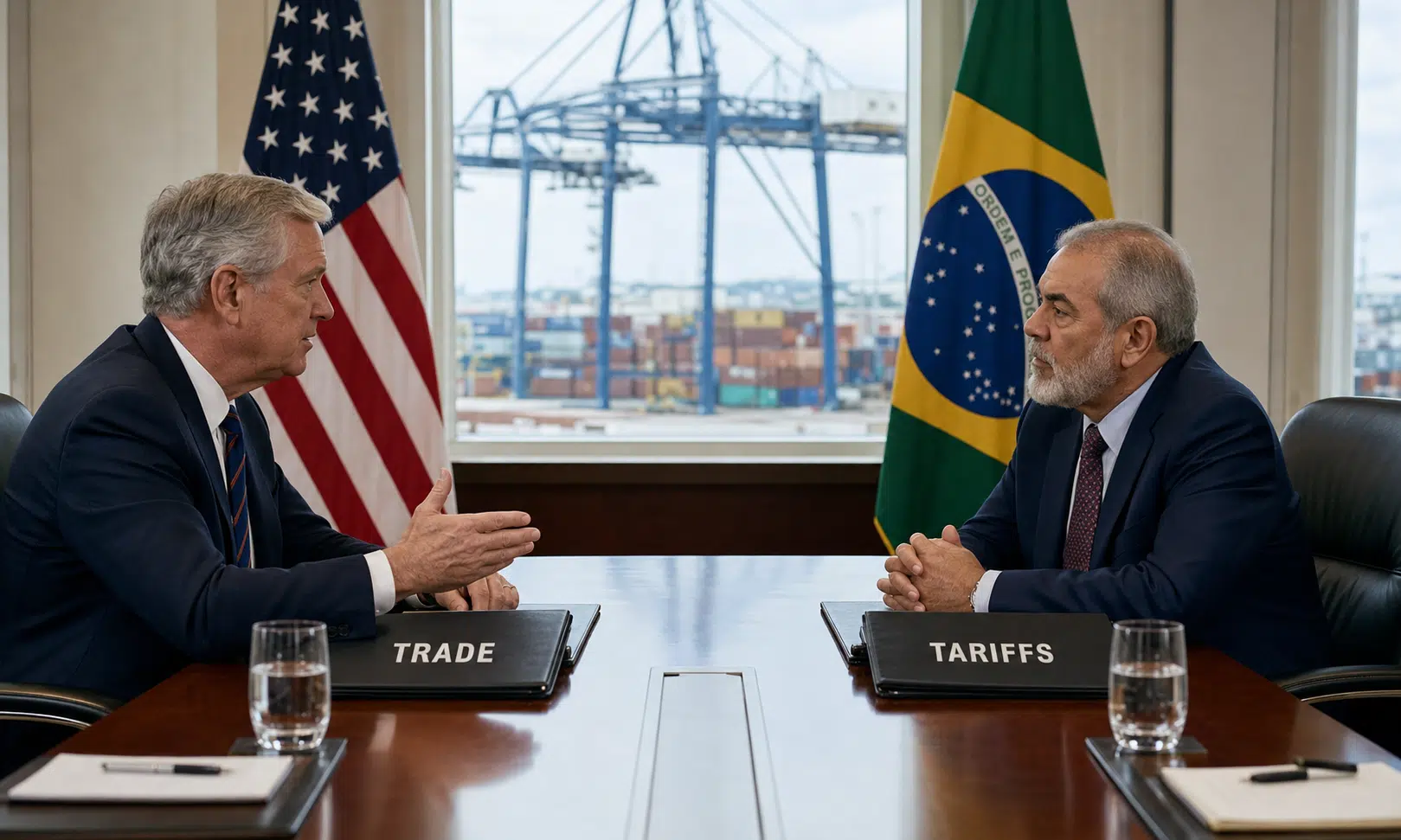

Brazilian President Luiz Inacio Lula da Silva met US President Donald Trump at the White House on Thursday for talks expected to center on trade, security and critical minerals, as Brazil tries to reduce the risk of another round of US tariff pressure.
The meeting brought together two leaders with large populist followings but sharply different political instincts. Lula has positioned himself as a left-wing defender of labor, social spending and South-South diplomacy. Trump has built his political brand around protectionism, border control and a confrontational approach to trade.
For Brazil, the immediate concern is practical: avoiding new duties on exports and keeping access to the US market steady at a time when its domestic politics are already unsettled. For the United States, the talks touched on a wider set of commercial and strategic questions, including supply chains, digital trade and access to minerals considered important for advanced manufacturing and energy technology.
The two presidents had been expected to take questions from reporters together in the Oval Office, but they did not appear for a joint press availability. That absence fed speculation about whether the discussion had been more difficult than either side wanted to acknowledge publicly.
Trump later described the meeting in positive terms on social media, saying the leaders discussed several issues, including trade and tariffs, and that more meetings were expected in the coming months. Lula also gave an upbeat account afterward, saying he left the three-hour meeting in Washington “very, very satisfied.” His remarks about the meeting’s importance for both countries were presented as his own assessment rather than an independently verified outcome.
Why tariffs dominated the agenda
Tariffs have been the main source of strain in the recent US-Brazil trade relationship. Brazilian officials entered the meeting looking for signs that Washington would avoid new restrictions on Brazilian goods or at least narrow the scope of any future action.
The source of concern is a possible US trade investigation tied to allegations of unfair practices. Brazil has also faced scrutiny over digital trade, timber exports and its own import barriers on some goods. Those issues give the White House several potential points of pressure if it chooses to take a harder line.
A previous round of US tariff action against Brazilian products, including a reported 50 percent duty on some goods, remains politically sensitive. The stated rationale at the time included Trump’s criticism of Brazil’s handling of former President Jair Bolsonaro, who was later convicted in connection with an attempt to overturn democracy. Because parts of that tariff history remain contested or difficult to independently confirm from the available material, the clearest takeaway is that the dispute left both governments wary of another escalation.
Some levies were later withdrawn, including on Brazilian beef and coffee, as US officials faced pressure over grocery prices. Other duties were affected after the US Supreme Court struck down global tariffs imposed under a national emergencies law. Brazilian products are still described as facing an additional 10 percent tariff scheduled to expire in July, making the next few months important for exporters watching the US market.
For companies that buy, sell or ship goods between the two countries, the timing matters. A tariff increase can change margins quickly, especially for importers that already have contracts priced months in advance. It can also force buyers to reconsider sourcing plans, even before a formal policy change takes effect.
| Issue | Why it matters |
|---|---|
| Tariffs on Brazilian exports | Could raise costs for US buyers and reduce Brazil’s competitiveness in key product categories. |
| Digital trade disputes | Brazil’s position on e-commerce tariff rules has frustrated US-backed trade priorities. |
| Timber export allegations | US officials have questioned the legality of a large share of Brazil’s timber exports, which Brazil denies. |
| Critical minerals | Both countries have an interest in supply chains tied to energy, defense and advanced manufacturing. |
A reset with limits
Both governments had reasons to present the meeting as constructive. Lula wants to show that he can manage a difficult relationship with Washington without appearing subordinate to Trump. Trump, for his part, can use the talks to signal that his tariff threats are part of a negotiation strategy rather than a permanent rupture with a major regional economy.
Still, a warmer public tone does not settle the disputes behind the meeting. Brazil has resisted parts of the US-backed approach to global digital trade rules, including the renewal of a World Trade Organization moratorium on e-commerce tariffs. Washington has also criticized Brazilian tariff barriers on some imported goods, including ethanol.
The timber dispute adds another layer. The Office of the US Trade Representative has alleged that nearly half of Brazil’s timber exports come from illegal sources. Lula’s administration rejects that claim and points to its record on lowering deforestation. That disagreement is not simply environmental; it could become a trade enforcement issue if US officials decide to attach penalties or restrictions to the allegation.
Critical minerals may offer a more cooperative path. Brazil has resources that are valuable to supply chains the United States wants to secure, particularly as competition with China shapes industrial policy. A deal or framework around minerals could give both sides a positive agenda while they continue arguing over tariffs and market access.
Lula’s domestic pressure
The Washington visit came at a difficult moment for Lula at home. His government recently faced setbacks in Congress, including a lower house vote overriding one of his vetoes on a law related to Bolsonaro’s prison time. The Senate also rejected his nominee to the Supreme Court, described in the source material as the first such rejection in more than a century.
Those defeats matter because trade diplomacy is not happening in isolation. Lula needs to show that he can still deliver results abroad while facing resistance from lawmakers at home. A tariff reprieve or a clearer channel with Washington would be useful politically, particularly for industries and exporters that want predictability.
The source material says Lula, now 80, is expected to seek another non-consecutive term in October elections, but a firm timeline is not independently confirmed here. What is clear is that Brazilian politics remain closely tied to the Bolsonaro era, and Trump’s public sympathy for Bolsonaro has complicated the relationship between Brasilia and Washington.
For Lula, the challenge is to keep the US relationship functional without allowing it to become a domestic liability. For Trump, Brazil offers both an economic target and a strategic partner, depending on which issue is in focus.
What comes next
The immediate test will be whether the meeting leads to concrete follow-up before the remaining tariff deadline in July. Trump said additional meetings would be scheduled, but the value of that process will depend on whether officials can narrow disputes over exports, digital trade and enforcement.
Brazilian exporters will be watching for signals from US trade agencies, not just statements from the White House. Importers in the United States will also be looking for clarity, especially in product categories where Brazil is a major supplier or where price increases would be passed on quickly to consumers.
A limited agreement is possible if both sides decide that stability is more useful than confrontation. But the unresolved issues remain substantial. Tariffs, digital commerce rules, timber enforcement and agricultural market access all carry political weight.
The meeting appears to have lowered the temperature for now. Whether it prevents new tariff action is the harder question, and one that will be answered less by diplomatic language than by the next set of US trade decisions.