

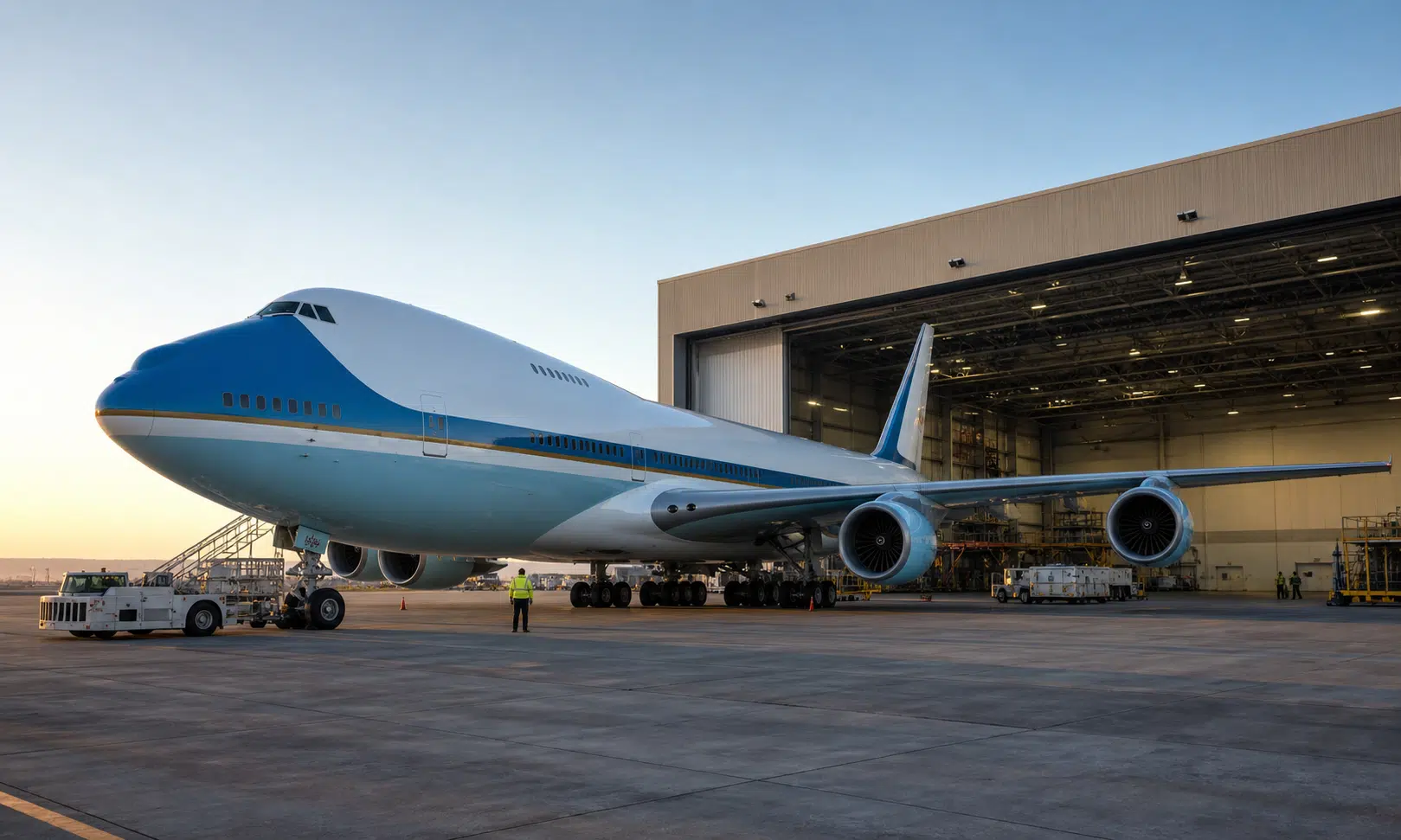

L3Harris is beginning to explain how it handled one of the strangest aircraft conversion jobs in recent presidential transport history: turning a Qatar-sourced Boeing 747-8I into a temporary Air Force One-style aircraft on a compressed schedule.
The aircraft, known as the VC-25B Bridge, is meant to help cover the gap while Boeing continues work on two longer-planned VC-25B presidential aircraft. Those jets have been delayed for years, leaving the US government with aging VC-25A aircraft based on the 747-200 platform.
L3Harris says its role centered on taking an existing 747-8I, inspecting and securing it, changing the interior, installing secure communications equipment, replacing engines, and moving the aircraft through a certification path built around modifications rather than a clean-sheet build. The company describes the effort as a 10-month sprint involving hundreds of technicians and round-the-clock shifts, though many details of the work remain undisclosed because of the aircraft’s mission and security requirements.
That makes the VC-25B Bridge less a normal aircraft delivery than a case study in what happens when politics, defense procurement, aviation certification, and presidential logistics collide.
A bridge aircraft with unusual origins
The VC-25B Bridge stands apart from the traditional Air Force One replacement program because it was not ordered from the start as a US-built presidential transport. The aircraft began as a customized Boeing 747-8I associated with Qatar and was later offered to the US government as an interim option while the Boeing-built VC-25B aircraft remained behind schedule.
That origin immediately made the aircraft controversial. A foreign-sourced jet intended for presidential use raises two obvious questions: whether the arrangement creates ethical problems, and whether the aircraft can be trusted for one of the most sensitive transport missions in the world.
The White House has dismissed the ethics concerns around accepting the aircraft, while the Air Force and L3Harris have emphasized the security process. L3Harris executive Jason Lambert has said the initial phase involved taking the aircraft apart piece by piece and checking that it was scrubbed and secure. He has not described the inspection methods in detail.
The Air Force has also said that interagency experts developed protocols to detect and, if necessary, neutralize technical hazards on the previously owned jet. The Pentagon has not said whether any such hazards were found.
That lack of detail is not surprising for a presidential aircraft. The useful takeaway is narrower: L3Harris is presenting the bridge jet as a secured and modified aircraft, not simply a luxury 747 repainted for government use.
Why the conversion could move faster than Boeing’s VC-25B program
The most important difference between the bridge aircraft and Boeing’s two planned VC-25Bs is the starting point.
Boeing is converting two 747-8I aircraft originally built for Transaero, the Russian carrier that collapsed before taking delivery. The US government agreed in 2018 to buy those aircraft under a roughly $4 billion fixed-price program. The work has since been slowed by supply chain disruption, pandemic-era complications, and the difficulty of staffing a highly secure aerospace program.
The bridge aircraft followed a different model. L3Harris says it approached the jet as a modification and supplemental certification effort on an aircraft that already existed, rather than as an original equipment manufacturer building a presidential transport from the ground up.
Lambert has framed that as one of the central reasons the company could move quickly. Keeping the aircraft close to its existing configuration meant each certification item could be treated as a change to an established baseline instead of a full redesign.
That mattered especially inside the cabin. Presidential aircraft need space for the president, staff, security personnel, communications teams, press, and support operations. But major structural changes, such as moving bulkheads or reworking rooms, would have added time and certification complexity.
L3Harris says it largely avoided those kinds of structural changes. The company did make interior changes to make the aircraft more suitable for the presidential mission, but it has not disclosed the full design details.
The work was not just cosmetic
The visible change is the livery. The VC-25B Bridge uses a darker navy, red, white, and gold scheme rather than the long-running blue-and-white look associated with presidential aircraft since the Kennedy era. The paint decision carries political baggage: Donald Trump supported a darker redesign during his first term, while Joe Biden later favored retaining a look closer to the current VC-25A aircraft.
L3Harris says White House representatives were involved in final paint approval for the bridge aircraft.
But the more consequential changes are technical. The conversion included secure communications equipment, engine work, and passenger access changes designed to make the aircraft function more like a government executive transport.
L3Harris already works on secure communications for US government aircraft, including systems used on executive transport fleets. The company says the bridge aircraft received the Senior Leader Command, Control, and Communications System-Airborne, known as SLC3S-A, the same general secure communications capability planned for the Boeing VC-25B aircraft.
For a presidential aircraft, that kind of system is not a convenience feature. It is part of what turns a jet into a flying command post. The president and senior officials need access to secure communications while airborne, including during crises when normal infrastructure may be unavailable or unreliable.
The aircraft also received a self-contained airstair system and exterior door changes so passengers can board and leave without relying on airport stairs. That is a practical detail, but an important one for a presidential aircraft that may need to operate across a wide range of locations and security conditions.
Why L3Harris replaced the engines
One of the more expensive-sounding changes was also one of the more technical: L3Harris says the 747-8I received a new set of GE Aerospace engines.
Lambert has said the aircraft’s existing engines were in good mechanical shape, but carried an altitude restriction. The company says the replacement engines provided a performance upgrade and removed that limitation. L3Harris worked with Boeing on the engine swap.
The distinction matters because the engine work was not presented as a repair job. It was a mission-readiness decision. Presidential aircraft are expected to offer range, reliability, and operating flexibility, and an altitude restriction would be a poor fit for that role.
A cleared workforce became a scheduling advantage
L3Harris is also arguing that the company’s workforce structure gave it an edge. The company’s ISR business regularly modifies existing aircraft for military missions, and it maintains a large pool of employees with active security clearances.
Lambert has said the division includes thousands of cleared workers, including engineers, which allowed the company to put labor on the program quickly. L3Harris also says the conversion relied on three-shift, seven-day work across a large technician base.
That is a meaningful difference from a normal commercial aircraft conversion. Sensitive presidential aircraft work cannot simply be accelerated by hiring any available mechanic or engineer. Workers need the right skills, but they also need access to the program. Clearance bottlenecks can become schedule bottlenecks.
This is one area where L3Harris’ broader defense business appears to have helped. The company is not primarily known for mass-producing commercial airliners. It is better known for integrating mission systems, communications gear, sensors, and military modifications into existing platforms. For this job, that specialization was the point.
The bridge jet does not erase the Boeing problem
The VC-25B Bridge may reduce near-term pressure on the presidential airlift fleet, but it does not replace the larger Air Force One modernization program.
Boeing’s two planned VC-25B aircraft remain the permanent successors to the VC-25A fleet. Those aircraft have been difficult and costly for Boeing under a fixed-price contract, with the program generating more than $1 billion in charges tied to schedule and cost problems.
The bridge aircraft exists because that program has taken longer than expected. It also shows the tradeoff between speed and standardization. L3Harris could move quickly because it modified an available aircraft and tried to avoid the most disruptive structural changes. Boeing’s task is broader: delivering the planned replacement fleet under a heavily customized, security-sensitive program.
For the Air Force, the practical question is whether the bridge aircraft can reliably fill the gap without becoming another costly one-off complication. For L3Harris, the project is a high-profile demonstration of the company’s pitch: when the government needs an existing aircraft turned into a specialized mission platform quickly, it has the workforce and integration experience to do it.
The public may see the paint first. The more important story is the compressed chain of inspection, security work, certification choices, communications integration, engine replacement, and workforce mobilization behind it.