

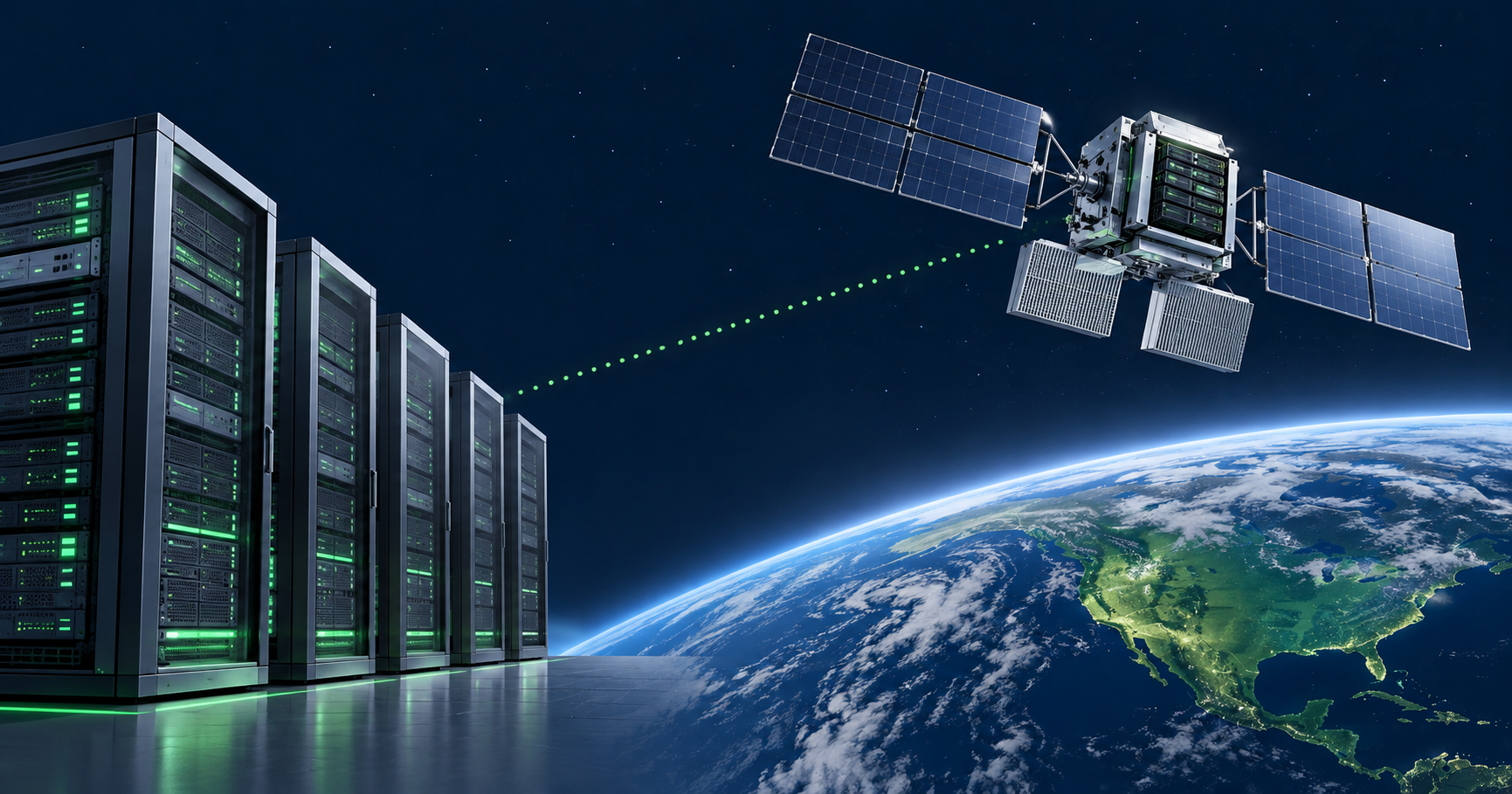

SpaceX could be lining up around $40 billion in financing to buy Nvidia AI chips, with Apollo Global Management potentially helping arrange the deal. The proposed purchase would sit alongside two ambitions: expanding AI infrastructure on Earth and developing computing systems that can operate in orbit.
The financing remains a proposal, with its final terms and completion uncertain. Even if it goes ahead, securing chips would be only one step toward an orbital data center. Power, cooling, radiation tolerance and maintenance would still determine how much useful computing those chips could deliver.
That is the tension behind the headline number. Nvidia hardware could give SpaceX a common computing foundation across its terrestrial and space projects. Making the economics work in both environments is a separate challenge.
A potential chip deal with a longer-term space ambition
The proposed financing centers on buying AI processors. It should not be read as a confirmed $40 billion budget devoted entirely to satellites, or as evidence that commercial orbital computing is ready to deploy.
For Nvidia, a purchase on that scale could deepen its role in SpaceX’s AI infrastructure. For SpaceX, the practical question would be how to turn the hardware into usable capacity, whether it is installed in a ground-based facility or integrated into a spacecraft.
Those destinations have different requirements. A data center on Earth needs power, cooling and serviceable equipment. An orbital system adds the demands of launch and operation in an environment where repairs become much harder. Buying the processors does not settle those engineering questions.
The potential financing therefore matters as a measure of ambition. Its significance for space computing would depend on the systems SpaceX actually builds and operates.
Where Nvidia’s Vera Rubin platform fits
Nvidia describes plans for SpaceXAI to use Vera CPUs and its Vera Rubin platform as it expands the infrastructure behind Grok. The intended role of the CPU is to handle work around AI models, including coordinating tasks, executing code and processing data, while keeping GPUs supplied with useful work.
Nvidia lists Vera with 88 Olympus cores and up to 1.2 terabytes per second of memory bandwidth. It also claims up to 1.8 times faster completion of certain tasks than x86 processors. That is a vendor performance claim tied to particular workloads, rather than a guaranteed improvement for every application.
The planned connection to orbit is Starmind. Nvidia describes the first-generation satellite design as using an optimized Vera Rubin NVL72 system. That points to an effort to adapt a shared computing architecture for space, with changes needed for the satellite’s power, thermal and physical constraints.
A common platform could simplify parts of the computing stack. It would still need to operate reliably inside a very different machine.
Starmind’s power target is not a performance benchmark
SpaceX describes Starmind as a solar-powered satellite concept intended to run AI computing in sun-synchronous orbit and radiate waste heat into space. The attraction is access to solar energy without relying on a terrestrial electricity connection.
For the planned AI1 design, SpaceX lists a compute payload of up to 250 kilowatts at peak. That figure describes power, not processing speed. It cannot, by itself, establish how many AI requests the satellite would handle or how its performance would compare with a data center on Earth.
Keeping that distinction clear matters. A large power budget may support powerful hardware, but useful output also depends on the chips, the workload and the system’s ability to keep operating within its limits.
The orbital design would need to make those pieces work together. Solar power addresses the energy supply; it does not eliminate the need to move heat away from densely packed processors.
Google and Starcloud describe early orbital experiments
Google describes Project Suncatcher as a research effort to explore whether space could support scalable machine learning infrastructure. The company says its prototype satellite has reached orbit, with testing intended to examine how its Tensor Processing Units handle spaceflight, radiation and thermal conditions.
Starcloud also says it has launched an Nvidia H100 GPU into orbit. These company-described milestones suggest that testing AI hardware beyond Earth is becoming a practical engineering activity.
Their significance still needs to be kept in proportion. A prototype can help establish whether hardware survives and operates in space. It does not, on its own, demonstrate that a much larger orbital facility can deliver dependable computing at an attractive price.
The useful comparison is therefore between what each experiment is designed to test and what a commercial service would eventually need to provide. Flight experience can inform that next step without guaranteeing it.
Cooling and maintenance shape the business case
Space does not provide effortless cooling. In a vacuum, there is no surrounding air to carry heat away through convection. Heat must travel from the electronics to surfaces that can radiate it away. The radiator system becomes part of the spacecraft’s size, mass and operating limits.
Radiation exposure also needs to be accounted for, alongside temperature control and the difficulty of servicing failed equipment. These are reasons to treat orbital computing as a complete spacecraft engineering problem, even when the processors have familiar names.
Energetic particles can disrupt electronics or damage them over time. That makes radiation tolerance a design requirement for space hardware, alongside the speed and efficiency that usually dominate discussions of AI processors.
For an eventual customer, the relevant measure would be reliable computing delivered at a workable cost. Chip specifications and access to sunlight are only parts of that calculation.
A financing agreement could help SpaceX acquire hardware. The stronger test of its orbital ambitions would come from sustained operation: keeping that hardware powered, cooled and productive long enough to justify sending it into space.