

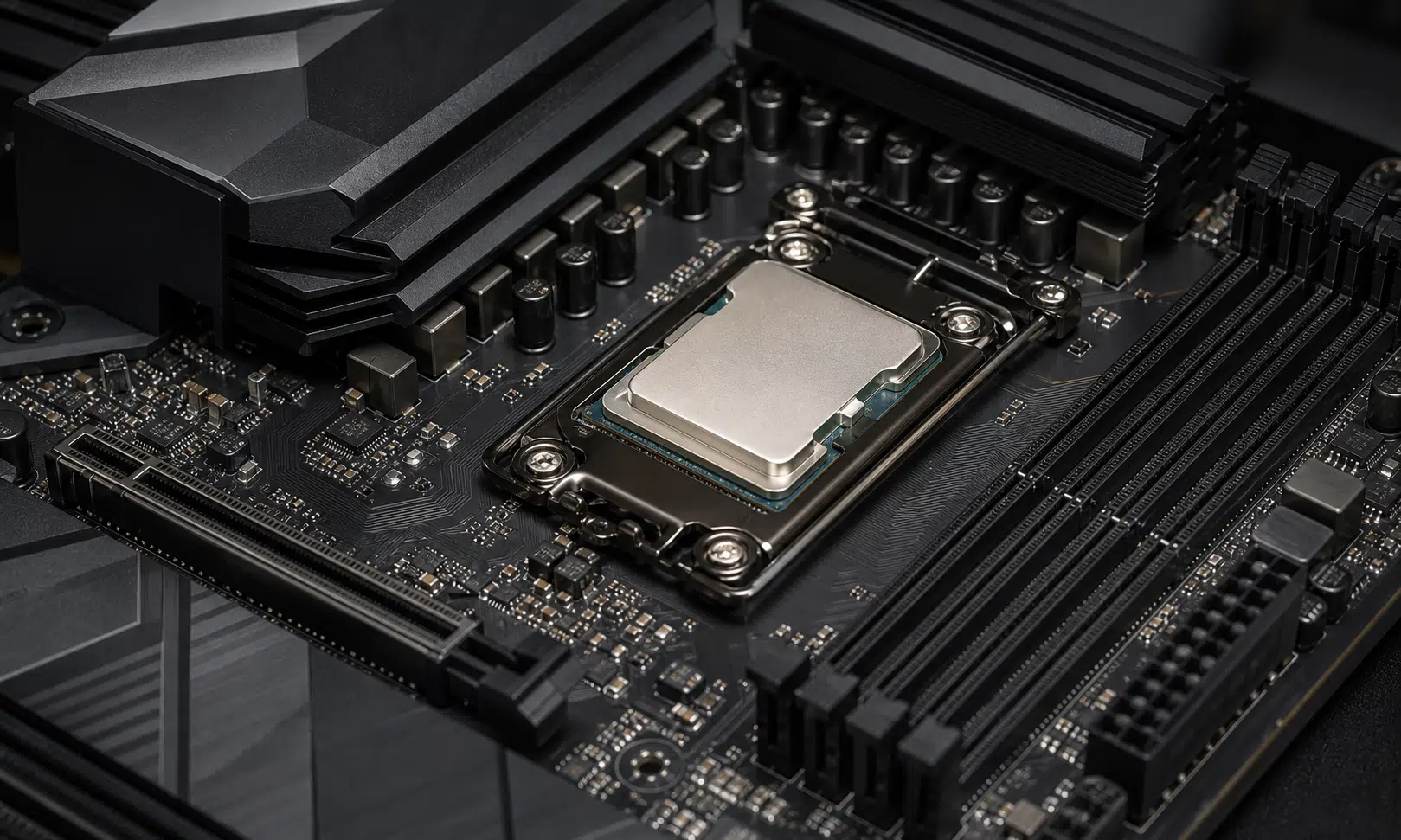

AMD is continuing to frame AM5 as a long-lived desktop platform, while leaving the exact timing of its next consumer socket tied to bigger industry shifts such as DDR6 memory and PCIe 6.0.
The source article attributes those comments to David McAfee, AMD’s VP and general manager for Ryzen CPU and Radeon graphics, during a Computex roundtable. Because AMD has not published a detailed public roadmap for every future AM5 processor family, the most careful reading is narrower than a hard product guarantee: AMD is signaling confidence in more AM5 products and architectures over a longer window, while holding back from naming every chip, chipset, or launch date.
That distinction matters for PC builders. A socket promise is useful only if it translates into real upgrade paths, BIOS support, and boards that remain practical to buy. AMD’s broader message is that it does not want to force a new desktop platform until the supporting standards and user benefits are strong enough to justify the disruption.
AM5 Longevity Remains the Main Message
AM5 launched as AMD’s DDR5-era desktop platform, replacing the long-running AM4 socket for mainstream Ryzen builds. The article says AMD sees the AM5 window extending further than earlier expectations, with future products and architectures still planned around the platform. A firm, fully itemized public timeline for those products has not been confirmed, so it is better to treat the 2029 framing as AMD’s stated direction rather than a complete release schedule.
That is still meaningful. AM4 built much of its reputation on longevity, with several CPU generations and later refreshes giving owners upgrade options without replacing the entire motherboard. AM5 is being positioned in a similar way: not as a short-lived stop between memory generations, but as a platform AMD wants buyers and motherboard partners to live with for several years.
The practical appeal is clear. A buyer choosing an AM5 motherboard today is not only buying for the processor installed on day one. They are also betting that future Ryzen options, BIOS updates, and board support will make the platform worth keeping. That does not mean every AM5 board will support every future chip in the same way, and it does not remove the need to check motherboard vendor support lists. It does explain why AMD is still talking about platform life as a selling point.
The source also suggests AMD does not view a socket transition as a cosmetic change. A new desktop socket can affect memory routing, PCIe layout, power delivery, signal integrity, board validation, firmware support, and the cost structure of the motherboard ecosystem. For motherboard makers, retailers, system builders, and buyers, those changes can add complexity before they add obvious value.
Why AMD Is Cautious About a New Socket
The article’s central argument is not simply that AM5 will last longer. It is that AMD believes a new platform has to clear a high bar.
McAfee is quoted as describing a socket change as disruptive because the motherboard has to be redesigned around core electrical and layout requirements. In practical terms, that means a new socket is not just a different CPU shape. It can require different trace routing, new validation work, new memory design rules, and additional components needed to maintain high-speed signaling.
That helps explain why AMD is watching DDR6 and PCIe 6.0 as possible trigger points. Those standards may eventually justify a new platform, but the source article presents AMD’s view as more conditional than automatic. A newer standard has to be available, but it also has to provide enough real benefit to users to justify higher motherboard cost and a break from existing infrastructure.
The article uses PCIe generation changes as an example. PCIe 5.0 raised theoretical bandwidth and enabled faster storage devices, but the real-world gains are not always obvious in everyday gaming. A high-end Gen 5 SSD may look impressive in sequential throughput numbers, yet game load times and desktop responsiveness often depend on more than headline bandwidth. If a new standard mostly increases board cost without changing the experience a buyer can feel, the case for moving platforms becomes weaker.
That is the tension AMD appears to be describing. Enthusiasts like new standards, but platform changes have to work for the wider market. A new socket can bring technical headroom, but it can also raise motherboard prices, complicate upgrades, and shorten the useful life of existing systems.
DDR6 and PCIe 6.0 Are the Likely Inflection Points
According to the source, AMD is looking at three broad questions before moving beyond AM5.
- Which industry standards are arriving, especially around memory and PCIe connectivity?
- Whether those standards create a user-visible improvement rather than a benchmark-only gain.
- Whether gamers, enthusiasts, and DIY builders need different platform capabilities, such as more high-speed storage, more PCIe lanes, different I/O, or new power delivery requirements.
DDR6 and PCIe 6.0 are the clearest candidates for a future desktop transition. Both could require platform-level changes, and both could eventually make an AM5 successor more compelling. But the article presents AMD as wanting those standards to make sense in cost and timing before asking buyers to change motherboards.
That is a more conservative position than launching a new socket on a strict cadence. It also reflects lessons from AM4. Before AM4, AMD moved through desktop platforms more frequently. The source says AMD views the shift to multi-year socket support as better for users and partners, because it gives the ecosystem time to mature and gives buyers more confidence that a motherboard purchase will not become obsolete too quickly.
The lesson is especially relevant when platform costs are high. New memory standards and faster I/O can raise motherboard complexity. Signal integrity requirements can require better materials, re-drivers, re-timers, and more careful board layout. Those costs are easier to defend when the performance benefit is obvious. They are harder to defend when most users see only a spec-sheet improvement.
Memory Prices Make the Upgrade Question More Complicated
The article discusses memory pricing as part of the reason platform timing matters. Broad claims about memory and component prices being at absolute highs should be treated cautiously without independent market data, but the underlying buyer problem is real enough: memory cost can change the appeal of a full platform upgrade.
AM5 requires DDR5, while AM4 remains tied to DDR4. When DDR5 pricing is favorable, the transition to AM5 is easier to justify. When memory is expensive, an older DDR4 platform can remain attractive for budget-conscious gaming systems, especially if the user already owns compatible memory or can find discounted parts.
That context also explains why AMD’s AM4 refresh strategy continues to matter. The source article describes AM4 as still having market traction, particularly because some buyers are sensitive to total platform cost. A CPU upgrade on an existing board can be much cheaper than replacing the processor, motherboard, and memory at the same time.
For AM5, AMD’s pitch is different. The company wants the platform to be the forward-looking choice, but not one that forces a second platform jump too soon. If AM5 continues receiving meaningful processor options, the up-front cost of moving to DDR5 becomes easier to spread over a longer ownership period.
X3D Chips Are Part of AMD’s Value Argument
The source article also connects AM5 longevity to AMD’s Ryzen X3D processors with 3D V-Cache. AMD is said to be emphasizing that these gaming-focused CPUs can reduce the need for more expensive memory configurations in some builds.
The specific claim attributed to AMD is that, across a 30-game test suite, a single-DIMM X3D setup was only about 0.5 percent different from dual-DIMM performance on average. Because the full test data is not included in the source material here, that figure should be understood as AMD’s stated result rather than an independently verified benchmark conclusion.
Still, the reasoning is clear. 3D V-Cache can reduce sensitivity to memory bandwidth in many games because more game-relevant data can be served from the CPU’s enlarged cache. That does not make memory configuration irrelevant for every workload. AMD’s own framing, as described in the source, separates gaming from heavier creator and development tasks where memory capacity and bandwidth can matter more.
For a gaming-first build, AMD is arguing that an X3D processor may let some users start with less memory and upgrade later. For a workstation, creator system, or software development machine, that same advice may not apply. The useful takeaway is not that single-channel memory is universally fine. It is that the right memory spend depends heavily on the workload and the CPU architecture.
Overclocking and Undervolting Remain Part of the Enthusiast Pitch
The source article closes with AMD’s comments on overclocking. McAfee is quoted as saying that AMD understands overclockability matters to many CPU and GPU buyers, especially gamers and enthusiasts.
The article describes a shift in philosophy: instead of using all available headroom in stock product definitions, AMD wants future products to leave more room for experimentation. That should be read as a general direction rather than a promise that every upcoming Ryzen chip will offer large manual overclocking gains. Modern CPUs already manage boost behavior aggressively, and thermal limits, motherboard power delivery, silicon quality, and firmware settings all affect what users can achieve.
Undervolting is also part of the discussion. Ryzen users have often used tuning tools to reduce voltage, control temperatures, or improve sustained boost behavior. For many modern systems, efficiency tuning can be just as useful as traditional frequency overclocking. AMD appears to be acknowledging both sides: buyers who want higher performance ceilings and buyers who want better performance per watt.
That fits the larger AM5 message. A long-lived enthusiast platform has to support more than stock operation. It needs firmware maturity, motherboard stability, memory compatibility, and tuning features that improve over time. Those qualities are difficult to deliver if the platform changes too often.
The Next AMD Socket Still Depends on Timing
The clearest conclusion from the source is that AMD is not treating a new socket as inevitable on a short schedule. The company is presenting AM5 as a platform with more life ahead, while suggesting that DDR6, PCIe 6.0, changing I/O needs, and power delivery requirements will shape whatever comes next.
For buyers, that means AM5 remains the platform AMD wants associated with forward-looking Ryzen desktop builds. It does not mean every unanswered roadmap question has been settled. Exact product names, chipset support, BIOS compatibility, and launch timing still need to be confirmed through future AMD announcements and motherboard vendor support documentation.
The more important signal is strategic. AMD appears to be prioritizing platform stability until a new socket can offer enough practical value to outweigh the cost and disruption of moving on. If DDR6 and PCIe 6.0 become compelling for mainstream desktop users, the case for a successor platform gets stronger. Until then, AM5 is still being positioned as the center of AMD’s desktop CPU plans.