


Apple’s iPad lineup remains the reference point many tablet shoppers use when comparing performance, software support, accessories, and price. The source article argues that several Chinese tablets deserve a closer look beside Apple’s models, especially for readers weighing screen quality, storage, charging speed, and overall value.
That comparison needs a careful frame. Several of the tablets discussed are not described as officially sold in the U.S., and some pricing appears to be based on overseas listings or currency conversions. Availability, warranty coverage, software services, and import pricing can therefore matter as much as the headline specifications.
Still, the models named in the source show why the iPad is not the only tablet worth considering. Nubia, Huawei, Xiaomi, and Honor all have tablets positioned around familiar iPad price bands, with reported advantages in areas such as refresh rate, battery capacity, storage, or bundled accessories.
Nubia Pad Pro
The Nubia Pad Pro is presented as a lower-cost alternative to Apple’s standard iPad, though the comparison depends heavily on the configuration being considered. The source describes the Nubia tablet as starting around $420 for a version with 8 GB of memory and 256 GB of storage. It also lists higher configurations at about $490 for 12 GB of memory and 256 GB of storage, and about $600 for 16 GB of memory and 512 GB of storage.
Those figures should not be read as universal street prices, especially for U.S. buyers. The stronger point is that the Nubia model is framed around a richer base storage configuration than Apple’s entry iPad, while staying in the same broad price discussion.
The listed hardware centers on a 10.9-inch IPS display with a 144 Hz refresh rate and 1,800-by-2,880 resolution. The source also names Qualcomm’s Snapdragon 8 Gen 3 chip, a 10,100 mAh battery, and 66 W wired charging. If those specifications match the retail unit a buyer can actually purchase, the display and charging figures are the main reasons it stands out against Apple’s standard iPad.
By comparison, the source positions Apple’s 11th-generation iPad as the lower starting-price option, with an 11-inch 60 Hz IPS display, Apple’s A16 chip, and storage choices beginning below the Nubia’s cited 256 GB base model. That makes the Nubia Pad Pro less of a simple cheaper-iPad story and more of a storage-and-display tradeoff for buyers who are comfortable looking beyond Apple’s ecosystem.
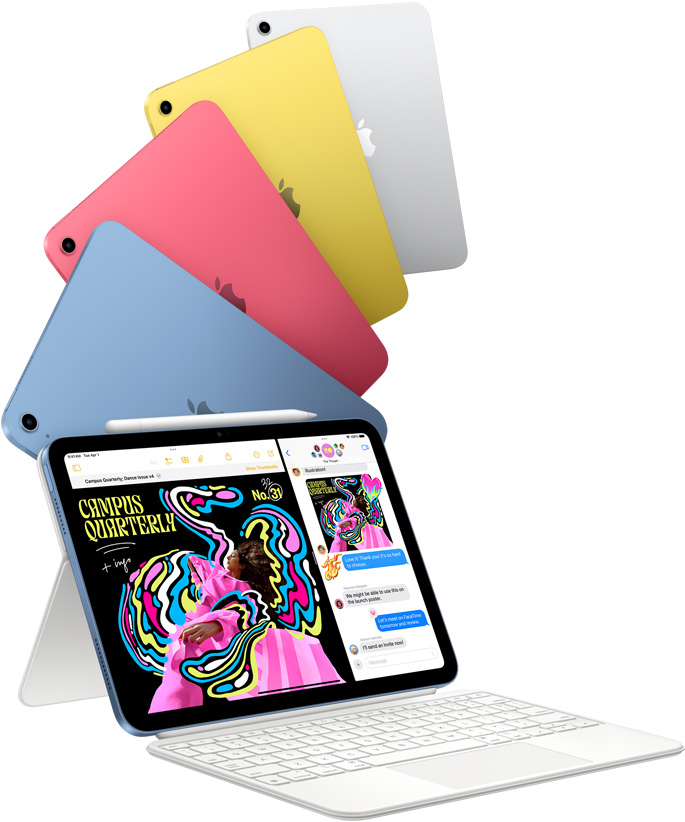
Apple iPad 11-inch with A16 chip
Apple’s 11-inch iPad with the A16 chip is the familiar baseline for this comparison, with iPadOS, broad accessory support, and 128 GB of starting storage. It is worth checking alongside the Nubia Pad Pro if software support and U.S. availability matter as much as refresh rate or charging speed.
As an Amazon Associate I earn from qualifying purchases.
Huawei MatePad Pro 12.2
Huawei’s MatePad Pro 12.2 is presented as the most premium tablet in the group, aimed closer to the iPad Pro than the entry iPad or iPad Air. The source lists a 12.2-inch OLED display with a 144 Hz refresh rate and peak brightness up to 2,000 nits, along with Huawei’s Kirin T92A processor.
Reported configurations include 12 GB or 16 GB of memory and storage options of 256 GB, 512 GB, or 1 TB. The source also lists a 10,100 mAh battery and up to 100 W wired charging over USB-C. Those specifications, if reflected in the model being sold in a buyer’s region, would make the Huawei tablet a display-first and charging-first rival to Apple’s Pro line.
The pricing comparison is more complicated. The source cites a U.K. price of £799.99 for a 12 GB and 512 GB model, converting that to roughly $1,077 at the exchange rate it used. That puts the MatePad Pro 12.2 in the same general conversation as Apple’s 11-inch iPad Pro, which the source lists as starting at $999.
The source also says the Huawei package includes an external keyboard and protective case, an important detail because Apple’s Magic Keyboard is normally a separate purchase. That bundled-accessory angle may be one of the MatePad Pro’s clearest value arguments, though buyers should still account for regional availability, app compatibility, and warranty support before treating the price comparison as one-to-one.
Xiaomi Pad 8 Pro
The Xiaomi Pad 8 Pro is framed as a direct challenger to the 11-inch iPad Air. The source describes it as an Android tablet using Qualcomm’s Snapdragon 8 Elite chipset, paired with 8 GB, 12 GB, or 16 GB of memory and 128 GB, 256 GB, or 512 GB of storage.
Its display is listed as an 11.2-inch IPS LCD panel with a 144 Hz refresh rate, HDR support, 2,136-by-3,200 resolution, and up to 800 nits of brightness. The source also cites a 9,200 mAh battery with 67 W wired charging.
The comparison to the iPad Air rests on price and display behavior. The Xiaomi tablet is listed at a starting price of $645, while the 11-inch iPad Air is described as starting at $599. The iPad Air comparison model in the source uses Apple’s M4 chip, 12 GB of memory, storage beginning at 128 GB, and an 11-inch IPS LCD display with a 60 Hz refresh rate.
On paper, that gives Xiaomi the stronger refresh-rate and charging story. Apple, however, still brings the iPadOS app catalog, long accessory support, and deeper integration with other Apple devices. For a buyer already tied to Apple services, the Xiaomi’s hardware advantages may not settle the decision by themselves.
Xiaomi Pad Mini
The Xiaomi Pad Mini is the compact-tablet entry in the source’s list, and it is compared most naturally with Apple’s iPad mini. The source lists an 8.8-inch IPS LCD display with a 165 Hz refresh rate, Dolby Vision and HDR10 support, and up to 700 nits in high brightness mode.
It also reports a MediaTek Dimensity 9400+ chipset, a 7,500 mAh battery, and 67 W wired charging. The listed configurations are 8 GB of memory with 256 GB of storage or 12 GB of memory with 512 GB of storage.
Against the iPad mini, the Xiaomi model is presented as the more aggressive display-and-battery option. The source describes Apple’s iPad mini as having an 8.3-inch 60 Hz IPS LCD display, 1,488-by-2,266 resolution, Apple’s A17 Pro chip, and a smaller battery. It also lists the Xiaomi Pad Mini at $429 and the iPad mini as starting at $499.
As with the other models, that pricing needs context. The Xiaomi Pad Mini is described as not officially available in the U.S., so import costs, retailer reliability, and after-sales support could narrow or erase the apparent price advantage. For buyers who mainly want a small tablet for reading, travel, gaming, or media, the hardware comparison is still the reason it belongs in the discussion.
Honor MagicPad 3 Pro 12.3
Honor’s MagicPad 3 Pro 12.3 is another large-screen Android tablet positioned near iPad Air pricing. The source lists Qualcomm’s Snapdragon 8 Gen 5, described there as a powerful mid-range chipset, with 8 GB, 12 GB, or 16 GB of memory and either 256 GB or 512 GB of storage.
The display is the headline specification: a 12.3-inch OLED panel with a 165 Hz refresh rate, 3,000 nits peak brightness, and 1,920-by-3,000 resolution. The source also cites stylus support, a 10,100 mAh battery, 66 W fast charging, and MagicOS 10 based on Android 16.
The entry-level price is listed at roughly $591 in China for the 8 GB and 256 GB model. That places it close to the source’s $599 starting point for the M4 iPad Air. The Honor tablet is therefore presented as a larger, brighter OLED alternative to Apple’s LCD-equipped Air, at least when judged by the listed hardware and China-market pricing.
The more cautious reading is that the Honor tablet may appeal most to buyers who value display size and refresh rate over Apple’s app ecosystem. As with Huawei and Xiaomi, the practical question is not only whether the specs look stronger, but whether the exact model is easy to buy, service, and use in the buyer’s region.
Reported Specs At A Glance
| Tablet | Closest iPad comparison in source | Reported display | Reported battery and charging | Pricing context in source |
|---|---|---|---|---|
| Nubia Pad Pro | 11th-generation iPad | 10.9-inch IPS, 144 Hz | 10,100 mAh, 66 W | Starts around $420 |
| Huawei MatePad Pro 12.2 | 11-inch iPad Pro | 12.2-inch OLED, 144 Hz | 10,100 mAh, up to 100 W | £799.99 for a 12 GB/512 GB model in the U.K. |
| Xiaomi Pad 8 Pro | 11-inch iPad Air | 11.2-inch IPS, 144 Hz | 9,200 mAh, 67 W | Listed from $645 |
| Xiaomi Pad Mini | iPad mini | 8.8-inch IPS, 165 Hz | 7,500 mAh, 67 W | Listed from $429 |
| Honor MagicPad 3 Pro 12.3 | M4 iPad Air | 12.3-inch OLED, 165 Hz | 10,100 mAh, 66 W | About $591 in China |
How The Comparison Was Framed
The source limited its selection to tablets made by Chinese technology companies and compared each one with an iPad model in a similar broad price range. The emphasis was not that every tablet is better than the iPad it is compared with, but that each one has at least one hardware or value argument that could make it competitive for certain buyers.
The strongest recurring themes are faster display refresh rates, larger listed batteries, faster charging, and higher storage at comparable prices. Those are meaningful tablet features, especially for media use, gaming, multitasking, or people who keep large files on-device.
The limits are just as important. A spec sheet does not settle software quality, update policy, app availability, accessory support, warranty coverage, or regional service. Those are areas where iPads often remain difficult to displace, particularly for users who already own an iPhone or Mac.
Read carefully, the comparison is less about declaring an iPad replacement for everyone and more about showing how competitive the non-Apple tablet market has become. For buyers willing to consider imports or region-specific models, these Chinese tablets offer several hardware-focused reasons to look beyond Apple’s lineup.