

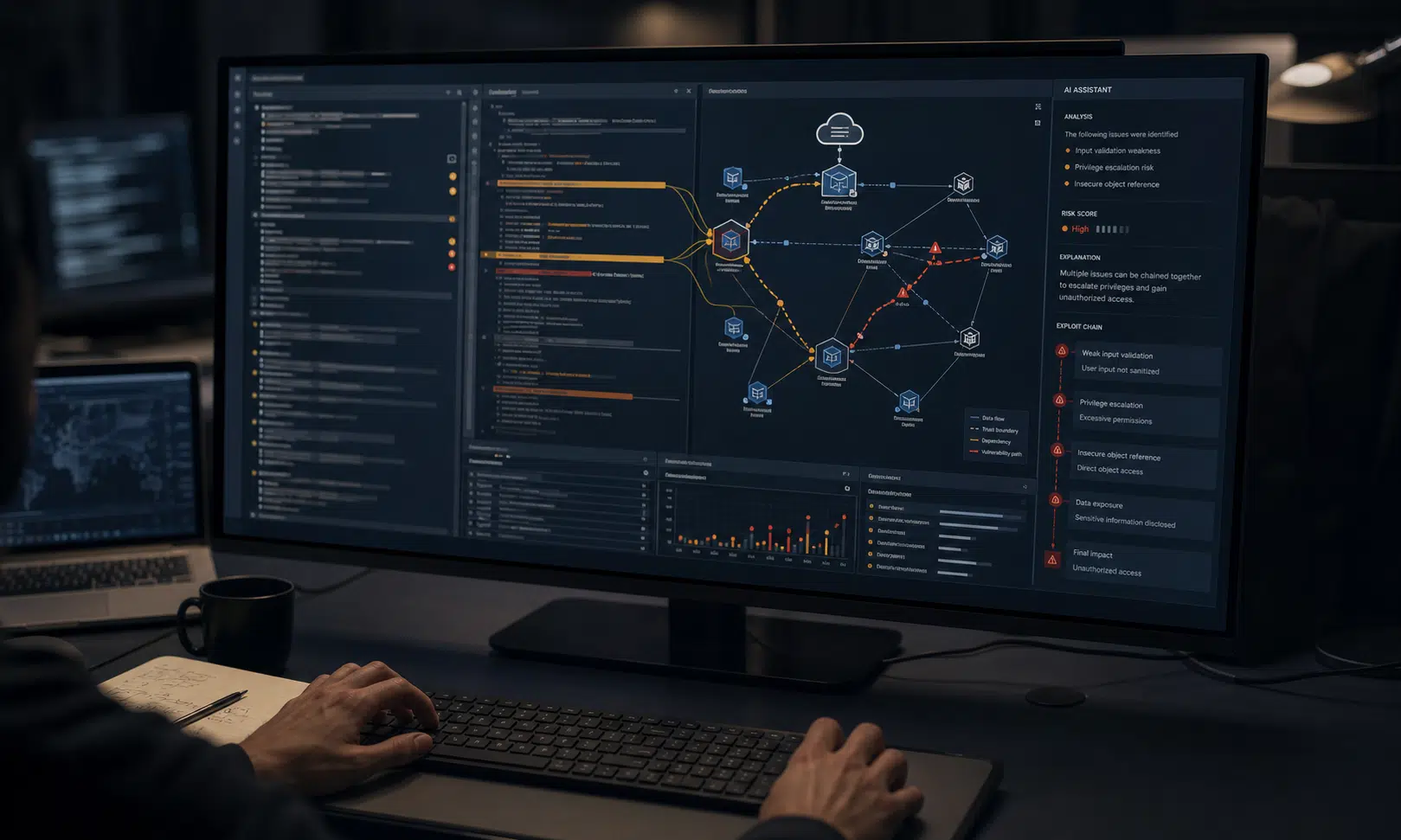

Cloudflare’s early work with Anthropic’s Claude Mythos Preview gives security teams a more practical way to think about the model: not as a magic vulnerability scanner, and not as a replacement for human researchers, but as a powerful research component that needs careful orchestration.
The company says Mythos Preview can reason through vulnerability chains in a way that resembles senior security work. That is a notable claim, but it should be read as Cloudflare’s assessment from controlled defensive testing, not as an independently proven industry benchmark.
For buyers and security leaders, the more useful takeaway is not simply that a frontier AI model can find bugs. It is that the model appears most valuable when it is used inside a structured workflow, with narrow tasks, validation steps, and architecture decisions that reduce the blast radius of future vulnerabilities.
What Cloudflare Says Mythos Did Well
Cloudflare participated in Anthropic’s Project Glasswing, a defensive security program built around Claude Mythos Preview. Anthropic has described Mythos Preview as an unreleased frontier model intended to help selected organizations scan and secure first-party and open-source systems.
The program includes major technology and infrastructure companies, and Anthropic has committed up to $100 million in model usage credits for the initiative. Cloudflare’s role was to test Mythos in a controlled environment against its own code and evaluate where the model actually helped.
Cloudflare’s most interesting finding is that Mythos was not only spotting isolated low-severity bugs. The company said the model was able to connect smaller weaknesses into a more serious exploit path. In security terms, that matters because real attacks often do not depend on one obvious flaw. They combine assumptions, edge cases, permissions, parsing behavior, and deployment details until a practical route appears.
That is where Cloudflare says Mythos stood out: exploit chain construction and proof generation.
| Capability Cloudflare Highlighted | Why It Matters | Buyer Takeaway |
|---|---|---|
| Exploit chain construction | The model can connect multiple lower-severity issues into a more serious attack path. | Useful for teams trying to understand real-world risk, not just count findings. |
| Proof generation | The model can help show whether a suspected issue can actually be exploited. | Can reduce some triage guesswork, but still needs human validation. |
| Directed investigation | The model performed better when given narrower, more specific tasks. | Works best as part of a harnessed workflow, not as a hands-off codebase auditor. |
That distinction is important for any organization considering AI-assisted security tooling. A long list of possible bugs is not the same as a prioritized understanding of which weaknesses can be chained, proven, and fixed in the right order.
Where the Model Still Needs Guardrails
Cloudflare’s testing also makes clear that Mythos Preview is not a clean substitute for a mature security program. The model is powerful, but it still needs structure around it.
One limitation Cloudflare noted was that guardrails could sometimes interfere with legitimate security research. That is a familiar tension for defensive AI tools: the same capabilities that make them useful for finding exploit paths also make them sensitive to misuse. If safeguards are too loose, the model becomes dangerous. If they are too blunt, they get in the way of authorized work.
Cloudflare also found that using the model directly inside a coding agent was not the right approach for broad coverage. A researcher with a lead could use it as a strong second set of eyes. But asking one agent to roam across a large codebase and maintain all relevant context was less effective.
That is a useful warning for buyers. The sales pitch around AI security often implies scale: point the model at everything, wait for findings, patch faster. Cloudflare’s experience suggests the better pattern is more deliberate.
A practical Mythos-style workflow looks closer to this:
- Break the target into smaller review areas.
- Give each agent a narrow objective and enough context to reason well.
- Use separate validation steps to filter noise from real signal.
- Have human researchers review exploitability and impact.
- Feed confirmed findings into normal remediation and architecture planning.
That is less dramatic than the idea of a single super-agent auditing an entire estate. It is also more believable. Security work depends heavily on scope, assumptions, environment, and context. A model can accelerate parts of that work, but a careless workflow can still create noise, missed coverage, or false confidence.
Verdict for Security Teams
For security leaders, Cloudflare’s Mythos testing points to a clear verdict: AI vulnerability research tools are becoming serious enough to evaluate, but they should be bought and deployed as workflow components, not as standalone answers.
Mythos appears most relevant for organizations with mature security teams, large codebases, and enough process discipline to validate findings. It is less useful for teams hoping to replace fundamentals such as threat modeling, patch management, isolation, logging, and secure deployment pipelines.
The strongest case for a Mythos-like system is not simply faster bug discovery. It is better risk analysis around how bugs combine. If a model can show how a small input validation issue, a permission boundary weakness, and a deployment assumption interact, that can help teams prioritize fixes more intelligently.
The weaker case is high-volume scanning without a plan. More findings do not automatically mean better security. In many organizations, the bottleneck is not discovering that code has flaws. It is deciding which flaws matter, proving impact, assigning ownership, and shipping fixes consistently.
The Bigger Lesson: Architecture Still Wins
Cloudflare’s most practical conclusion is that the industry should not focus only on patching faster. Faster patching matters, but the larger question is what the surrounding architecture looks like when a vulnerability exists.
That means designing systems so one flaw does not automatically expose everything behind it. It means placing defenses in front of applications, limiting lateral movement, isolating sensitive components, and making it possible to roll out fixes everywhere a vulnerable component is running.
This is where the buyer decision becomes more strategic. If AI models make vulnerability discovery faster for defenders, they may also make it faster for attackers. The sensible response is not panic. It is reducing the value of any single bug.
Security teams evaluating AI-assisted research should ask sharper questions than “How many vulnerabilities can it find?” Better questions include:
- Can it explain how separate weaknesses combine into a practical exploit?
- Can it produce evidence that a finding is real without overwhelming the team with noise?
- Can the workflow split work across agents without losing context?
- Can findings be routed into existing triage, remediation, and deployment systems?
- Does the tool help improve architecture, or only generate tickets?
Cloudflare has not fully detailed how it plans to turn the Mythos work into customer-facing products or controls. The company has said it expects to share more later, so any specific product implication should be treated as pending rather than confirmed.
For now, the lesson is already useful. Mythos may represent a meaningful step forward in AI-assisted vulnerability research, based on Cloudflare’s account, but the model’s value depends on the system around it. The best teams will not treat it as an oracle. They will treat it as a powerful research engine that needs scope, validation, human judgment, and resilient architecture to matter.