


European manufacturers are not leaving China at the pace political language might suggest. In many cases, they are doing the opposite.
A survey from the European Union Chamber of Commerce in China found that European firms are largely maintaining or expanding their mainland China supply chains, even as Brussels pushes companies to reduce strategic dependence on the country. The pattern points to a difficult buyer decision for manufacturers: resilience matters, but so do cost, speed, supplier depth and factory efficiency.
Nearly one-third of surveyed companies said they were moving more of their supply chain activity into China. Another 37% said their strategy had not changed over the past two years. Together, that means 68% were either staying put or expanding in China, while only 7% said they were moving factory sourcing out of the country or building alternative manufacturing bases elsewhere.
The survey was based on responses from nearly 300 chamber members collected in January and February from people familiar with their companies’ mainland China supply chain strategies.
The de-risking gap: policy pressure versus operating reality
The EU’s de-risking language has become a major part of the trade debate, especially around critical components, green technology, electric vehicles, batteries and advanced manufacturing. But the chamber’s findings suggest that the boardroom calculation remains more practical than political.
For buyers, the issue is not simply whether China exposure creates risk. It does. The harder question is what replacing that exposure would cost, how long it would take, and whether alternative suppliers can match the same mix of price, technical capability and delivery speed.
That is why many companies appear to be choosing a dual approach rather than a clean break. About 24% of respondents to the supply chain question said they were diversifying by both expanding in China and developing alternative suppliers elsewhere.
That distinction matters. Diversification does not always mean less China. For some European companies, it means keeping China as the main production engine while adding backup capacity in other markets.
| Supply chain approach | Share of surveyed companies | What it means for buyers |
|---|---|---|
| Onshoring further in China | Nearly one-third | Companies are putting more production or sourcing inside China to stay competitive. |
| No major strategy change | 37% | Existing China supply chains remain central enough that companies are holding course. |
| Staying or expanding overall | 68% | Most respondents are not acting as if exit is the main priority. |
| Moving sourcing or factory bases outside China | 7% | A small minority are pursuing a more direct relocation strategy. |
| Expanding in China while adding alternatives | 24% | Some companies are trying to balance cost competitiveness with resilience. |
Why China is still hard to replace
China’s manufacturing pull is no longer just about low wages. Labor costs remain part of the story, but the stronger argument is now the full industrial system around the factory: automation, supplier density, industrial energy costs, raw material access, logistics know-how and the ability to move from design changes to mass production quickly.
China accounts for about 28% of goods manufactured globally, giving it a scale advantage that is difficult for any single alternative market to match. That scale feeds on itself. The more supplier networks, engineers, logistics providers and component makers cluster in one place, the easier it becomes for manufacturers to solve problems quickly and negotiate aggressively.
Roland Berger, which helped assemble the chamber survey, has argued that China’s cost and speed advantages are becoming a serious competitive challenge for Western companies. The report pointed to factors such as lower industrial energy prices, raw material costs, frequent supplier price negotiations and selective state support as reasons Chinese-made products can reach global markets faster and at lower cost.
For procurement teams, the implication is uncomfortable: leaving China may reduce one type of exposure while increasing cost, complexity or time-to-market risk.

Supply Chain Risk Management
A risk management reference can help procurement teams evaluate supplier concentration, disruption exposure, and resilience tradeoffs before changing sourcing footprints.
As an Amazon Associate I earn from qualifying purchases.
Automation is changing the cost equation
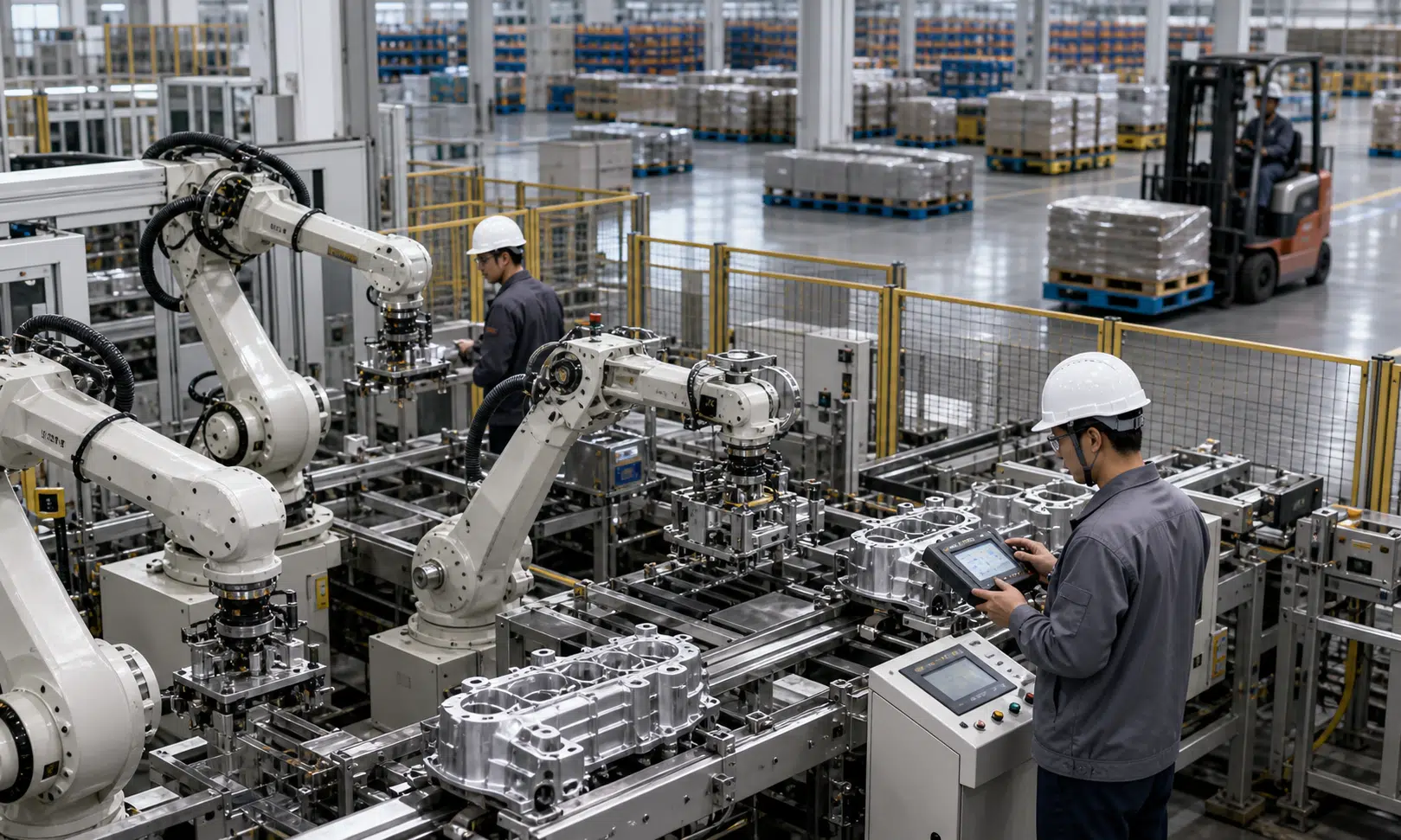
Automation is one of the biggest reasons China remains competitive even as wages rise and factories face labor shortages. The old assumption was that China’s advantage rested mainly on lower-cost workers. The newer reality is that many factories are using automation to make labor a smaller share of the final cost.
Denis Depoux of Roland Berger said the level of automation in some Chinese factories has changed sharply in just two years. He described visiting a privately owned copper manufacturing company where the production floor showed how quickly human labor can be reduced in high-throughput industrial settings.
Automation can require higher upfront investment, but it can also raise output, reduce error rates and support round-the-clock production. That tradeoff is especially important in sectors where speed, precision and volume determine competitiveness.
Chinese electric vehicle maker Nio, which has expanded into Europe, has said one of its factories in China uses 941 robots capable of operating autonomously across multiple vehicle models without workers on the production floor. That specific setup should be treated as company-reported rather than independently verified, but it illustrates the kind of automation claims now shaping manufacturing competition.
About three-fourths of EU companies in China said their Chinese production facilities were more efficient than their operations elsewhere, according to the chamber survey.
Logistics control is also shifting
The supply chain decision is not limited to factories. Logistics companies are also seeing Chinese companies take more control over overseas supply chains as they expand globally.
Michael Aldwell, executive vice president for sea logistics at Swiss shipping company Kuehne+Nagel, said more business in the logistics industry is being controlled, decided, shipped and paid for from China. He pointed to sectors including electric vehicles, batteries and consumer electronics.
That shift matters for European buyers because control over logistics can influence pricing, delivery reliability and supplier relationships. If a China-based supply chain team is more mature than the destination market’s organization, or if an industry is changing quickly, companies may prefer to keep decision-making close to the Chinese production base.
How buyers should read the China manufacturing tradeoff
For manufacturers and sourcing teams, the survey does not make China an easy answer. It makes the decision more specific.
Companies with high-volume production, tight cost targets or fast product cycles may find China difficult to replace without damaging competitiveness. Companies exposed to export controls, political pressure, tariff risk or single-country dependency may still need alternatives, even if those alternatives cost more.
The practical question is not whether to stay or leave. For many firms, it is how much production should remain in China, which parts of the supply chain need redundancy, and which suppliers are too important to depend on without a backup.
Useful decision criteria include:
- Whether Chinese facilities are materially more efficient than other sites.
- Whether alternative suppliers can match quality, volume and delivery windows.
- How exposed the company is to tariffs, export controls or political restrictions.
- Whether automation in China is widening the cost gap.
- How much disruption the company could absorb during a forced supplier change.
- Whether a China-plus-one strategy provides enough resilience without giving up competitiveness.

The Procurement and Supply Manager’s Desk Reference
This desk reference is a useful fit for teams comparing supplier capability, sourcing terms, landed costs, and procurement process controls across markets.
As an Amazon Associate I earn from qualifying purchases.
The bottom line
The EU’s de-risking push is real, but the chamber survey shows that many European companies still see China as essential to global competitiveness. Cost is part of the reason. So are automation, supplier density, production speed and logistics control.
For buyers, the message is not that China risk should be ignored. It is that replacing China is not a simple procurement exercise. In many industries, the strongest near-term strategy may be selective diversification: keep the China manufacturing base where it delivers a clear advantage, while building credible alternatives for the components, suppliers and routes where concentration risk is too high.

Strategic Sourcing and Category Management
A category management guide can help sourcing teams structure supplier comparisons, evaluate alternatives, and decide where redundancy is worth the added cost.
As an Amazon Associate I earn from qualifying purchases.