

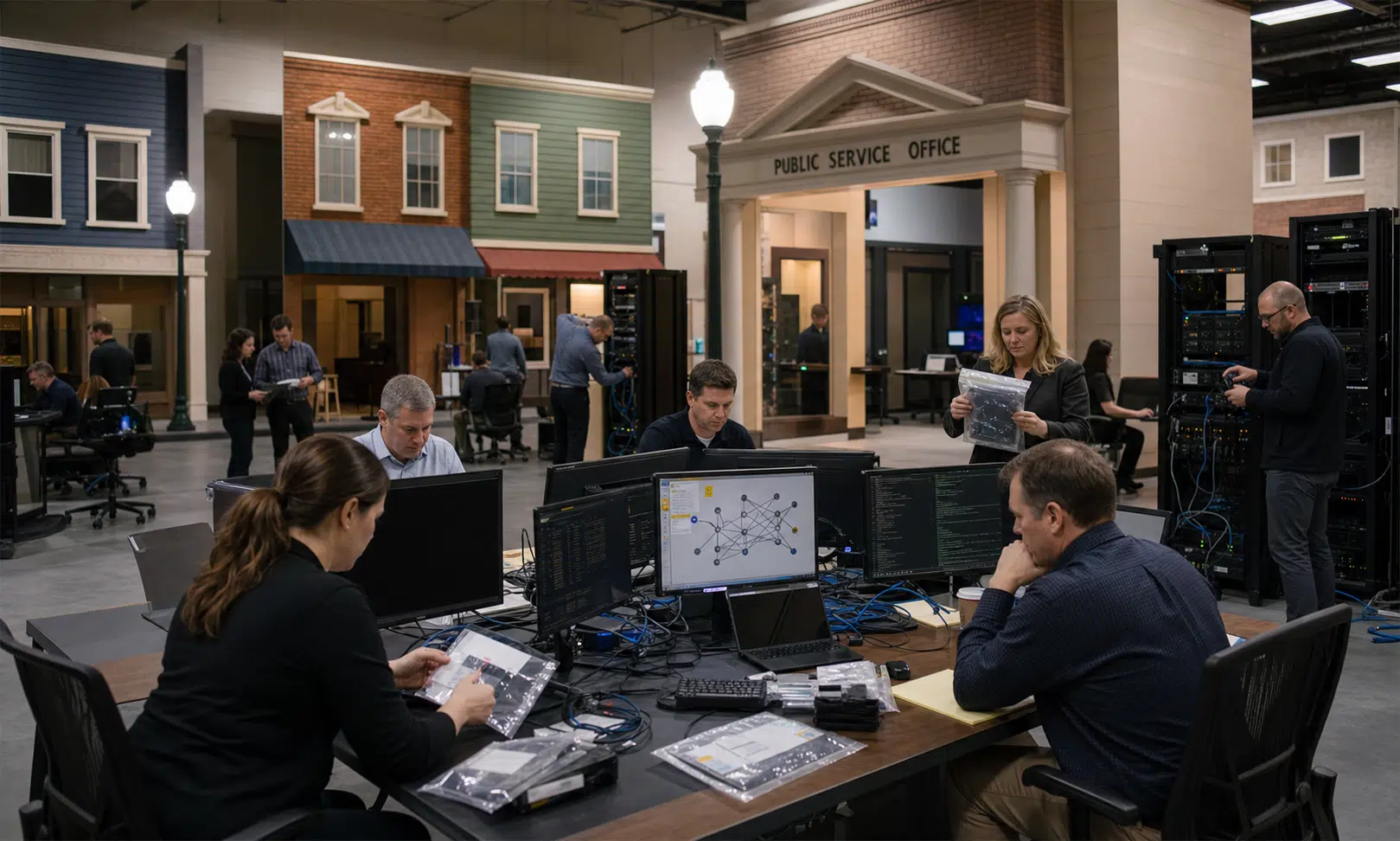

The FBI has built a small-town training environment in Huntsville, Alabama, to give cyber investigators something more concrete than a classroom exercise. The facility, called the Kinetic Cyber Range, is designed to look and behave like a working community, with homes, businesses, public services, roads, traffic lights, connected devices, and back-end systems that can be used in simulated cyber incidents.
The agency describes the range as a place where investigators, analysts, and forensic specialists can practice the kinds of decisions they may face during a real breach, ransomware case, search warrant, or digital evidence collection effort. Those details come from the FBI’s own description of the facility and should be read as the agency’s account of how the training environment works, not as an independently audited assessment of its performance.
For law enforcement and security leaders, the notable point is not just that the FBI has built a realistic-looking set. It is that the bureau is treating cyber investigations as physical, operational events. A compromised hospital system, a searched business, or a seized vehicle is not just a screen full of logs. It involves people, rooms, hardware, networks, legal constraints, and time pressure.
What the FBI Says It Built in Alabama
The Kinetic Cyber Range is described as a 22,000-square-foot replica town on the FBI’s Huntsville campus. According to the agency, it opened in February 2025 and includes fully furnished houses, a hotel, a gas station and grocery mart, a courthouse, a hospital, and a power company. The setting is meant to resemble an ordinary U.S. community closely enough that trainees have to work through realistic scenes rather than isolated lab tasks.
The FBI says each part of the town is wired with working devices, systems, and networks that behave like the equipment investigators might encounter in homes, offices, and public-service environments. The agency also says the range is isolated so simulated attacks stay inside the facility.
That containment matters. A training range only works if students can make mistakes, trigger failures, and follow bad leads without creating risk for real networks. In the FBI’s telling, the point is to let trainees experience the messiness of cyber work before they are standing inside an actual business, hospital, or data center during an active case.
The facility has reportedly trained more than 1,400 students since opening, including FBI personnel and partners from other federal and local agencies. Because that figure comes from the agency, it is best understood as the FBI’s reported count.
Why a Replica Town Changes the Training Problem
Traditional cyber training can become too tidy. A student may receive a device, a disk image, a log file, or a known scenario. Real investigations rarely arrive that neatly. Investigators may need to decide which devices are relevant, how to preserve evidence, how to keep a business operating, and how to explain technical steps to nontechnical people while the incident is still unfolding.
The replica town is built around that gap. Instead of treating cybercrime as something that happens only inside a terminal window, the range puts digital systems into physical spaces. A home can contain connected consumer devices. A business can have servers, firewalls, email systems, and user accounts. A hospital scenario can add urgency because outages may affect care delivery.
For buyers and decision-makers evaluating their own cyber training programs, that is the useful takeaway: realism is not only about using current tools. It is also about recreating context. A ransomware drill that includes executives, legal staff, system administrators, affected users, and operational pressure teaches a different set of habits than a clean technical exercise.
The Systems Inside the Range
The range also includes a data center with more than 200 physical servers, according to the FBI’s description. Some run Windows and some run Linux, reflecting the mixed environments investigators are likely to see when responding to a breach or executing a search warrant.
Dave Beachboard, identified in the FBI’s write-up as the range’s program manager, described the data center conditions as cold, cramped, noisy, dark, and uncomfortable. The point of recreating that environment is practical. Collecting evidence from a server room is not the same as reviewing a prepackaged lab file from a desk.
The range’s value, as presented by the FBI, is that trainees have to work through the physical and technical friction together. They may need to identify the right systems, interact with administrators, locate data, preserve evidence, and understand how a networked environment is actually put together.
| Training area | What it is meant to simulate | Why it matters |
|---|---|---|
| Homes and community spaces | Consumer devices and everyday connected systems | Investigators practice deciding what may contain useful evidence. |
| Business and public-service settings | Networks, accounts, and operational systems | Students work through incidents in environments that resemble real organizations. |
| Hospital scenario | Ransomware and service disruption pressure | Trainees must handle technical and human consequences at the same time. |
| Data center | Physical servers running mixed operating systems | Students experience the practical difficulty of collecting evidence in live infrastructure. |
Ransomware Training Is the Clearest Use Case
The FBI’s description of the range emphasizes ransomware because ransomware incidents are rarely cleanly technical. They can force fast decisions about containment, evidence preservation, communications, recovery, and risk to people who depend on affected systems.
In a hospital-style scenario, for example, the training problem is not only whether students can identify malware activity. It is whether they can operate under pressure while systems are unavailable and role players are reacting as if patient care could be affected. That kind of simulation can expose weak communication habits that a purely technical lab would never test.
The source article also pointed to the FBI’s Internet Crime Report as context for why the bureau is investing in this kind of training. Reported cybercrime losses and ransomware threats are often cited by the FBI as reasons for expanding cyber capacity. The specific figures in the source should not be treated here as independently verified, but the broader editorial point remains: the FBI is presenting the range as a response to the scale and seriousness of modern cyber investigations.
Digital Forensics Is Part of the Picture
The Kinetic Cyber Range is also described as a place for digital forensics training. In criminal investigations, digital forensics can involve extracting, preserving, and analyzing data from phones, computers, servers, vehicles, and other connected systems.
The source article noted that this work can be controversial when investigators rely on tools or methods that defeat device protections. That concern should be handled carefully. The existence of digital forensics training at the range does not, by itself, prove which tools are used in every class or how particular vulnerabilities are handled. What can be said safely is that modern device forensics often sits at the center of a broader debate about lawful access, user privacy, platform security, and undisclosed vulnerabilities.
For agencies and security teams, the practical lesson is that cyber training is increasingly interdisciplinary. A single case can involve network logs, encrypted devices, cloud accounts, vehicle data, business records, and legal process. The replica-town format appears designed to make trainees practice across those boundaries instead of treating each evidence source as a separate classroom topic.
What Security Teams Can Take From the FBI’s Approach
Most organizations will not build a 22,000-square-foot cyber town. That does not make the model irrelevant. The useful idea is to make training closer to the real operating environment.
A mature exercise should ask more than whether analysts can find an indicator of compromise. It should test who gets called, who makes decisions, what systems are prioritized, how evidence is preserved, how communications are handled, and what happens when business pressure conflicts with investigative needs.
For a company, hospital, utility, school district, or local agency, the FBI’s range points toward several buyer-relevant criteria for evaluating cyber training and incident-response preparation:
- Does the exercise include realistic systems, not just slide-based scenarios?
- Are technical responders required to work with legal, executive, operational, and communications roles?
- Can trainees make mistakes without affecting production systems?
- Does the drill include evidence preservation and post-incident investigation, not only containment?
- Are scenarios updated as devices, networks, and attack patterns change?
Verdict: A Useful Signal About Where Cyber Training Is Going
The FBI’s Kinetic Cyber Range is not a product review in the usual sense, and the source does not provide enough independent evidence to judge whether the facility outperforms other training models. The safer verdict is narrower: the range is a revealing example of how cyber investigation training is moving toward immersive, operational simulations.
For law enforcement, that means practicing before a real warrant, breach, or ransomware call puts every decision under pressure. For private-sector security leaders, it is a reminder that cyber readiness cannot be measured only by tools purchased or policies written. Teams need to rehearse in environments that include people, systems, constraints, confusion, and consequences.
The replica town may be unusual in scale, but the underlying standard is practical: cyber training should look less like a lecture and more like the incident the team will actually have to handle.