

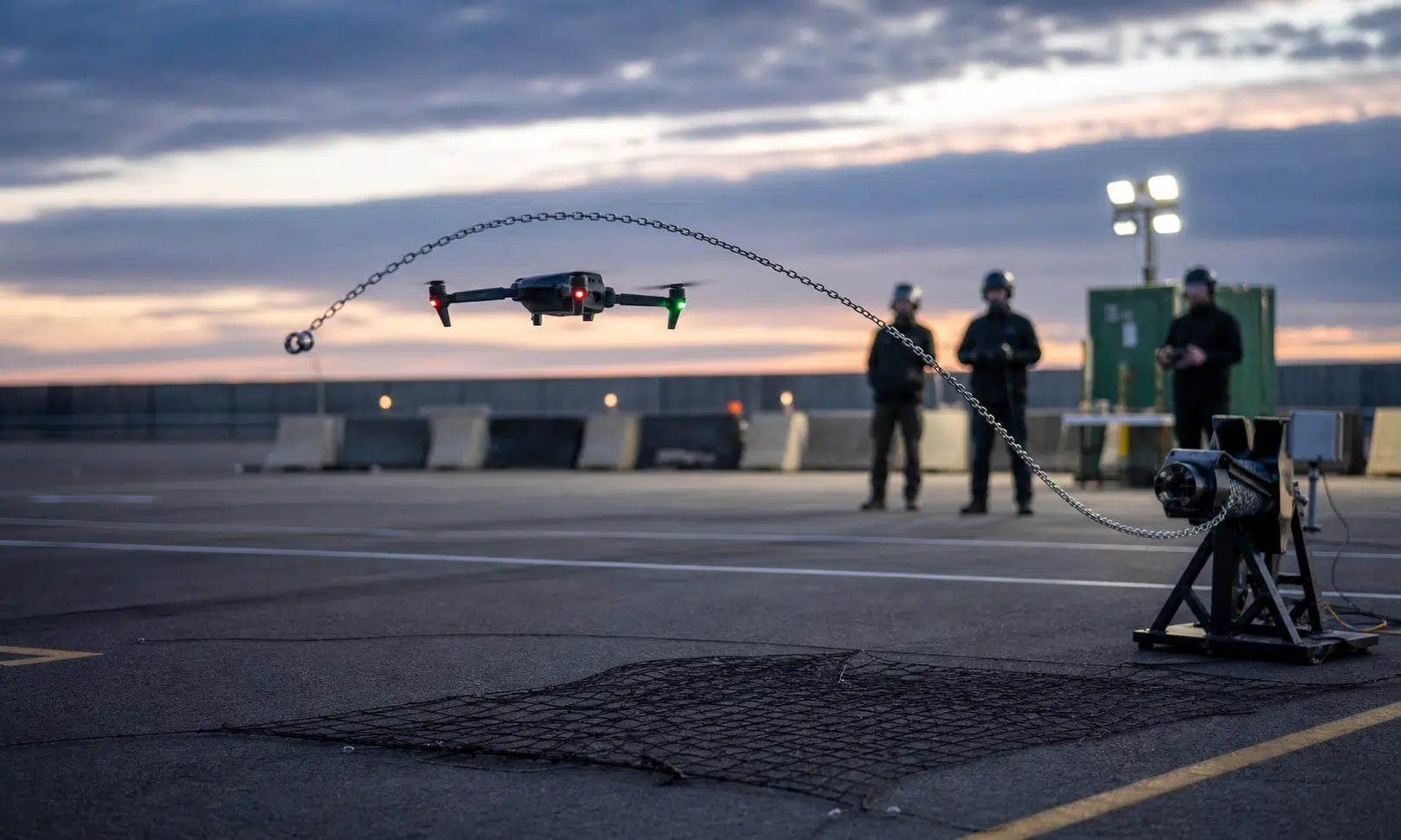

German researchers are testing a bluntly mechanical answer to small drones: fire a thin steel chain at the aircraft and let the rotors do the rest.
The concept, developed around work at Karlsruhe Institute of Technology, borrows from the bola, the weighted throwing weapon traditionally associated with South American herders and hunters. Instead of cords and weights, the proposed counter-drone projectile uses a lightweight metal chain intended to wrap around a drone body, arms, or propellers. Once the chain is caught, the rotor system can seize up and the aircraft falls.
This is not a laser, jammer, microwave weapon, or interceptor drone. It is closer to a last-line physical stop for low-flying quadcopters, and that simplicity is the reason the idea is getting attention.
How the chain concept is supposed to work
The research team has described thin metal chains, roughly in the three-to-four-millimeter range, as the main projectile. In published descriptions of the work, simulations and early firing tests are presented as evidence that a chain can wrap around a drone or catch in a nearby propeller after a glancing strike.
Some reporting around the project describes launcher concepts using 40mm-class tubes and chain speeds around 80 m/s, but those details should be treated as part of the research setup rather than proof of a finished field product. The practical questions are still the hard ones: how consistently the chain spreads, how much useful range it has, and how well it performs against moving drones in wind, rain, clutter, and poor visibility.
The team’s modelling work used Abaqus, a commercial finite element analysis tool, to study chain impact behavior. The researchers have also discussed examples involving a two-meter chain and a small quadcopter target, but the takeaway for buyers and security planners is broader than any one model: this is an entanglement weapon, not a precision strike system.
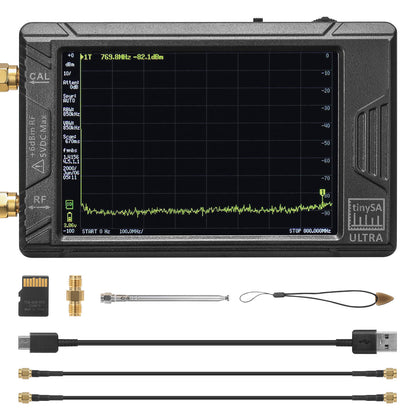
TinySA Ultra Handheld Spectrum Analyzer
A handheld spectrum analyzer can help security teams understand local RF activity during a lawful site survey. It is not a counter-drone weapon and should be used only within applicable radio and privacy rules.
As an Amazon Associate I earn from qualifying purchases.
Why a chain may beat a net in some cases
Nets are already a familiar counter-drone idea, whether launched from another drone, fired from a handheld device, or carried by a dedicated interceptor. A steel chain changes the tradeoff. It is denser, less textile-like in flight, and may be better at catching spinning propellers after an imperfect hit.
The researchers say early comparisons favored chains over textile nets in some tests, though that should not be read as a universal result. Nets still have obvious advantages where a wider capture area matters. Chains may make more sense when the target is close and the goal is to foul a rotor quickly with a compact projectile.
| Approach | Potential advantage | Main limitation |
|---|---|---|
| Steel chain projectile | Simple mechanical entanglement; no jamming signal required | Short-range performance and spread need real-world validation |
| Textile net | Larger capture area and familiar deployment models | Can suffer from drag and may be less effective after glancing contact |
| Laser or directed energy | Fast engagement and no physical projectile | High power, cost, targeting, and safety demands |
| Electronic warfare | Can disrupt control or navigation links | May not work against autonomous or hardened drones |
The buyer question: cheap, simple, but probably short range
For security teams, the attraction is obvious. A mechanical chain projectile would not depend on radio-frequency access, satellite navigation spoofing, or a large power supply. It could, in principle, work during a power outage and against drones that are not listening to a pilot signal.
That does not make it a replacement for layered counter-UAS systems. It looks more like a close-range tool for the final few seconds of an intrusion, especially around fixed sites where drone approach paths can be watched and restricted. Airports, military facilities, prisons, utilities, and event venues all have different legal and safety constraints, and a falling drone remains a hazard even if the projectile itself is lighter and less concentrated than a bullet-like round.
Germany’s interest in practical counter-drone tools is not theoretical. The country has reported more than 1,000 suspicious drone incidents around sensitive locations in 2025, and recent airport disruptions have made small UAVs a public security issue as well as a military one.
The most important caveat is maturity. The KIT-linked work shows a plausible physical mechanism supported by simulations and initial trials, not a proven commercial launcher ready for routine deployment. Air resistance, muzzle effects, target movement, operator training, legal authority, and safe recovery zones all matter before a chain-based system becomes more than an intriguing prototype.
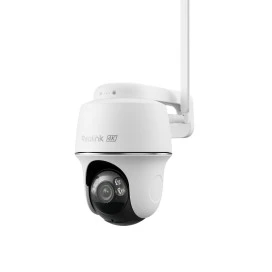
Reolink Go PT Plus Cellular Security Camera
A cellular camera can help monitor remote gates, utility yards, or temporary event perimeters where Wi-Fi may not reach. It supports observation and alerts, but it does not identify or stop drones by itself.
As an Amazon Associate I earn from qualifying purchases.
For now, the concept is worth watching because it asks the right procurement question: does every drone defense problem need expensive electronics, or can some close-range threats be handled by a cheap mechanical projectile? The answer will depend less on the elegance of the physics and more on whether repeated field tests can show dependable stops without creating a bigger safety problem on the ground.