


Intel’s PC processor roadmap is starting to look more crowded, and more deliberately segmented, as the company prepares several CPU families aimed at desktop, laptop and entry-level systems.
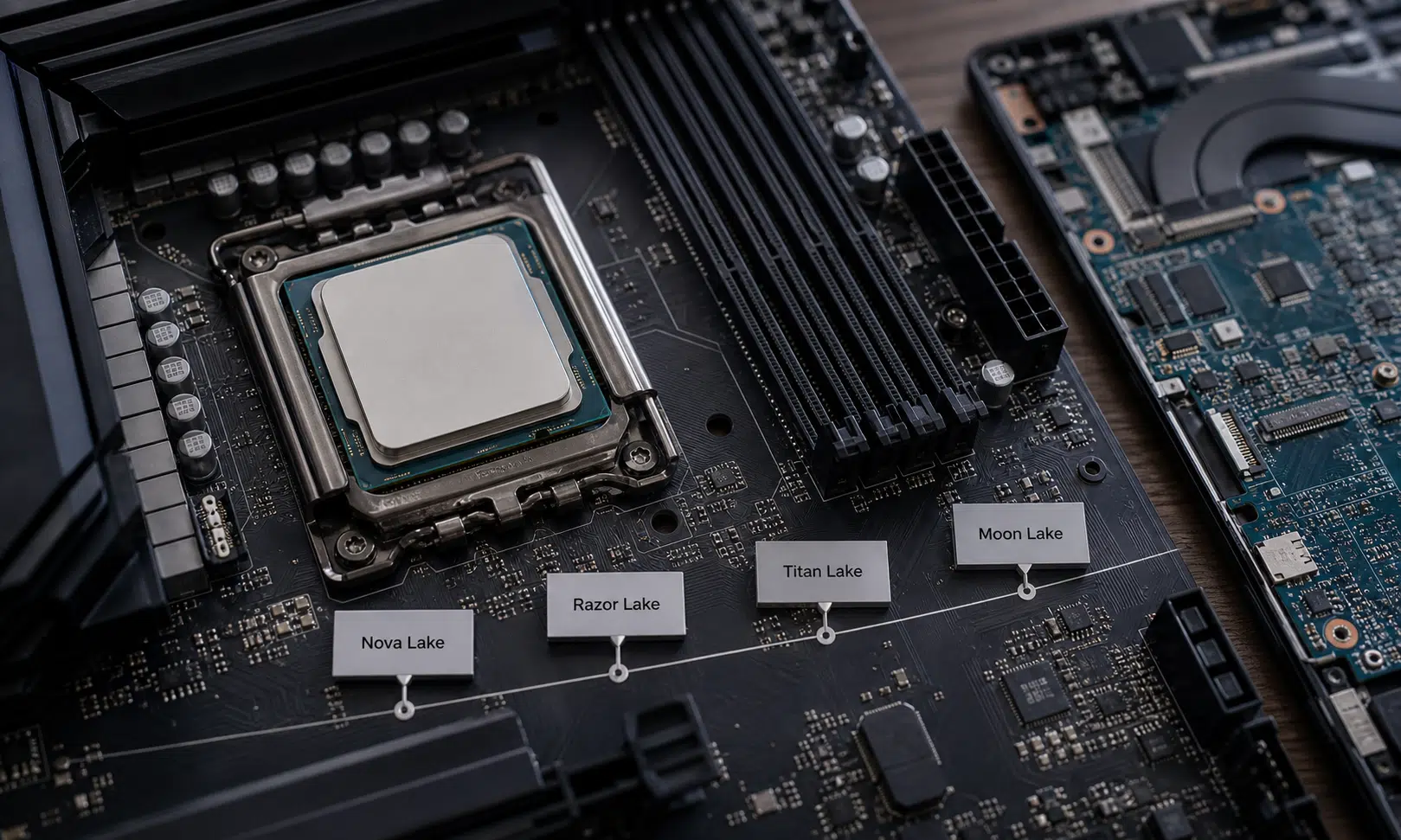
According to industry supply-chain reporting, Intel’s upcoming client roadmap includes Nova Lake, Razor Lake, Titan Lake and Moon Lake. The broad idea is straightforward: Intel wants more than one answer for a PC market now shaped by AMD’s Ryzen lineup, Apple’s in-house silicon and Qualcomm’s renewed Windows PC push.
The reported schedule places Nova Lake first, followed by Razor Lake, with Titan Lake and Moon Lake expected later. Some of the details remain unofficial, especially around exact launch windows and final specifications, so buyers should treat the roadmap as a useful signal rather than a purchase plan today.
Still, the direction matters. If Intel keeps these products on track, the next few CPU cycles could bring sharper separation between high-end desktop chips, gaming laptops, performance notebooks and lower-cost machines.
Intel’s Reported PC Roadmap Is Built Around Several CPU Families
The roadmap centers on four names: Nova Lake, Razor Lake, Titan Lake and Moon Lake. Each appears to target a different slice of the PC market rather than serving as a single, one-size-fits-all generation.
Nova Lake is expected to be the next major client CPU family, with both desktop and mobile variants. Razor Lake is described as the follow-up generation, reportedly keeping compatibility in mind for desktop and mobile platforms. Titan Lake is positioned as a later mobile-focused design with larger architectural changes. Moon Lake is expected to sit at the lower end of the market as an efficient E-core-focused platform.
That division would make sense for Intel. The PC market is no longer just about replacing last year’s mainstream desktop and laptop chips with a faster version. Gaming desktops, thin notebooks, creator laptops, handheld-style systems and budget Chromebooks all have different power, graphics and cost requirements.
For buyers, the main takeaway is that Intel appears to be preparing a broader lineup rather than relying on one flagship architecture to cover every segment. For system builders and laptop makers, that could mean more specific parts to choose from, assuming the schedule holds and final products arrive as described.
One claim in the source reporting says Intel’s platform execution is gradually getting back on track under restructuring efforts that began during Pat Gelsinger’s tenure and continue under Lip-Bu Tan. That assessment has not been independently verified, so it is better read as the view of the cited supply-chain sources rather than a confirmed outcome.
Nova Lake Is Expected To Lead The Next Wave In 2026
Nova Lake is the clearest near-term name in the reported roadmap. It is expected to arrive in 2026 and cover both desktop and mobile systems, including desktop S-series parts and laptop-focused HX and H variants.
The most aggressive reported desktop configuration is a Nova Lake-S chip with up to 52 cores and as much as 288MB of cache. Mobile Nova Lake variants are said to scale up to 28 cores. Those numbers, if they hold, would mark a major expansion in thread-heavy capability for Intel’s client lineup.
The core architecture names attached to Nova Lake are Coyote Cove for performance cores and Arctic Wolf for efficiency cores. As with any pre-launch architecture reporting, final retail silicon may differ by SKU, power class and market segment.
For desktop buyers, Nova Lake is especially important because Intel has been under pressure from AMD’s Ryzen X3D chips in gaming and from Ryzen desktop CPUs in multi-core value. More cache and higher core counts could help Intel compete more directly, but real-world gaming, power draw, platform cost and motherboard support will matter more than headline specifications.

Thermalright Peerless Assassin 120 SE CPU Cooler
A strong air cooler can be one of the easier parts to reuse across desktop upgrades, provided the mounting kit supports the target Intel socket. Check case clearance and motherboard spacing before pairing it with high-power CPUs.
As an Amazon Associate I earn from qualifying purchases.
A natural buying decision point will be whether to upgrade into an Intel platform immediately or wait for the next socket and board ecosystem. If Nova Lake requires a new desktop platform, early adopters may need to budget for a CPU, motherboard and possibly faster memory at the same time.
Laptop buyers should watch the mobile side just as closely. HX and H-class chips usually appear in gaming laptops, creator notebooks and mobile workstations, where cooling and sustained power limits can determine performance more than the CPU name printed on the box.
Razor Lake Could Be The Follow-Up With Easier Platform Continuity
Razor Lake is reportedly planned as the successor to Nova Lake and is expected around 2027. The key detail in the current reporting is compatibility: Razor Lake is described as pin-to-pin compatible on both desktop and mobile platforms.
If that detail carries through to shipping products, it could make Razor Lake a cleaner upgrade path for PC makers and some desktop users. Platform continuity usually helps motherboard vendors, OEMs and system integrators because they can reuse more of the surrounding design instead of rebuilding everything around a new CPU package.
For desktop customers, compatibility can matter as much as raw performance. A CPU upgrade is easier to justify when it does not also require replacing the motherboard. That said, pin compatibility does not always guarantee every existing board will support every future CPU. BIOS support, power delivery and chipset-level features can still create limits.
Razor Lake is expected to include S, HX and H-series products, similar to Nova Lake’s broad coverage. The architecture names currently associated with Razor Lake are Griffin Cove performance cores and Golden Eagle efficiency cores.
The buyer-aware way to read Razor Lake is as a potential second step in Intel’s next platform cycle. Nova Lake may set the foundation, while Razor Lake could refine it and make the platform more attractive if compatibility claims prove accurate.
Titan Lake Points To Bigger Mobile Changes Later In The Roadmap
Titan Lake is described as a later mobile-focused CPU family, with availability expected toward the end of 2028 in the source reporting. It is said to bring larger architectural changes on both the CPU and GPU sides.
The most notable reported architectural shift is Copper Shark, described as a unified core design intended to combine advantages traditionally split between Intel’s P-core and E-core approaches. Golden Eagle is also mentioned as the E-core architecture for the same generation.
That is a meaningful claim, but it is still early. CPU core naming and architecture plans can change before products reach retail systems, especially for parts this far out. For now, Titan Lake is best understood as a sign that Intel may be planning a more substantial mobile architecture transition after Nova Lake and Razor Lake.
The reporting also mentions a separate Intel chip developed with NVIDIA involvement, codenamed Serpent Lake, with an RTX Tile for graphics. That product is described as a response to AMD’s high-end integrated graphics and mobile APU efforts. Because details remain limited, it should be treated as an early roadmap item rather than a confirmed product buyers can plan around.
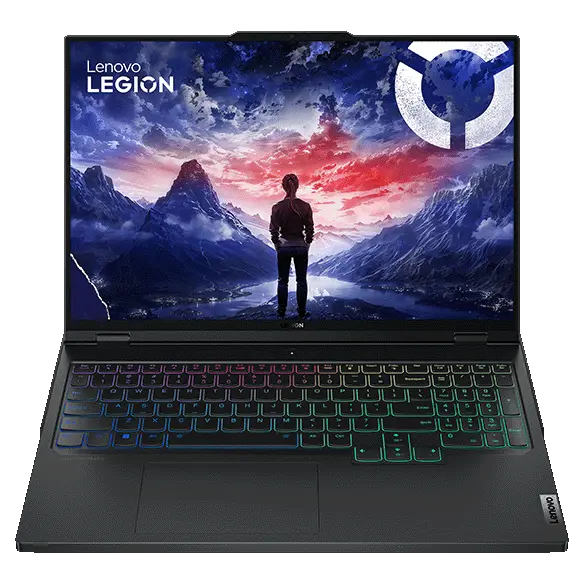
Lenovo Legion Pro 7i Gen 9 Gaming Laptop
A current Intel HX-class gaming laptop is a better fit for readers who need portable performance now rather than waiting for late-roadmap mobile CPUs. Focus on GPU configuration, cooling design, memory and display quality before choosing a model.
As an Amazon Associate I earn from qualifying purchases.
For premium laptop buyers, the important question will be how Intel balances CPU speed, integrated graphics, battery life and discrete GPU pairing. A powerful mobile CPU is useful only if laptop designs can cool it properly and deliver consistent performance away from a short benchmark run.
Moon Lake Appears Aimed At Low-Cost And Entry-Level PCs
Moon Lake is the reported successor to Intel’s Twin Lake family and is expected to focus on E-core-only designs for lower-cost platforms. In practical terms, this is the part of the roadmap most relevant to budget notebooks, education machines, Chromebooks and basic everyday PCs.
Twin Lake follows Intel’s Alder Lake-N-style low-power approach, while Moon Lake is expected to continue that low-cost path rather than replace Intel’s more mainstream Core products. The source material also separates this class from Wildcat Lake, which is described as a more budget-oriented mainstream option based on Panther Lake design elements.
That distinction matters for shoppers. Entry-level E-core-only processors can be perfectly fine for web browsing, schoolwork, streaming, documents and light productivity. They are not meant to compete with high-performance Core Ultra or Ryzen chips in gaming, heavy creation workloads or advanced multitasking.
If Moon Lake arrives as described, the value question will come down to device pricing, memory, storage and display quality. In lower-cost PCs, the CPU is only one part of the experience. A weak screen, soldered low memory or slow storage can make an otherwise adequate processor feel worse than it is.
What This Means For PC Buyers
Intel’s reported roadmap suggests a more aggressive and more segmented client CPU strategy. Nova Lake would address the next high-performance desktop and laptop cycle. Razor Lake could extend that platform with a smoother upgrade path. Titan Lake points to larger mobile architecture changes later on. Moon Lake would keep Intel active in cheaper, efficiency-first PCs.
For anyone buying a PC right now, this roadmap should not create automatic delay anxiety. Pre-launch CPU reporting is useful for understanding direction, but it is not a substitute for actual reviews, pricing and platform availability.
The more practical approach is to match the buying decision to the workload:
- Buy now if the current machine is slowing down paid work, school, gaming or daily use.
- Wait for Nova Lake if the upgrade is optional and a new Intel desktop or performance laptop platform is specifically appealing.
- Watch Razor Lake if socket or platform longevity is a major concern.
- Treat Titan Lake and Moon Lake as longer-term signals, not near-term buying factors.
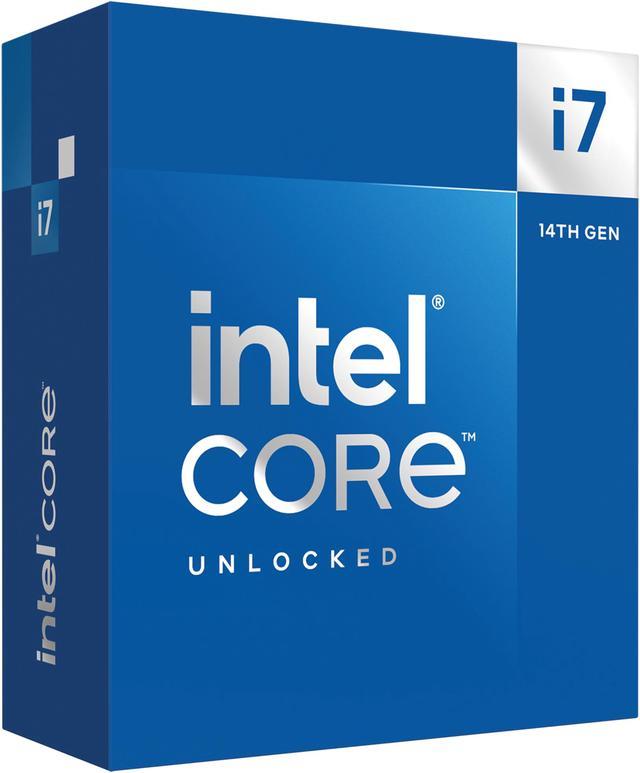
Intel Core i7-14700K Desktop CPU
For readers who should not wait on future roadmap parts, a current unlocked Intel desktop CPU can make sense when paired with a compatible LGA1700 motherboard, adequate cooling and the right memory.
As an Amazon Associate I earn from qualifying purchases.
Intel still has to execute. Product names, core counts and schedules are only the first layer. The real test will come when retail CPUs and laptops can be measured for performance, thermals, battery life, motherboard cost and availability.
If the reported roadmap holds, Intel’s next few PC CPU generations could give buyers more clearly separated choices across desktop, gaming laptop, thin-and-light and entry-level systems. That would be a healthier position than stretching one architecture across too many jobs, but the final verdict has to wait for shipping silicon.