

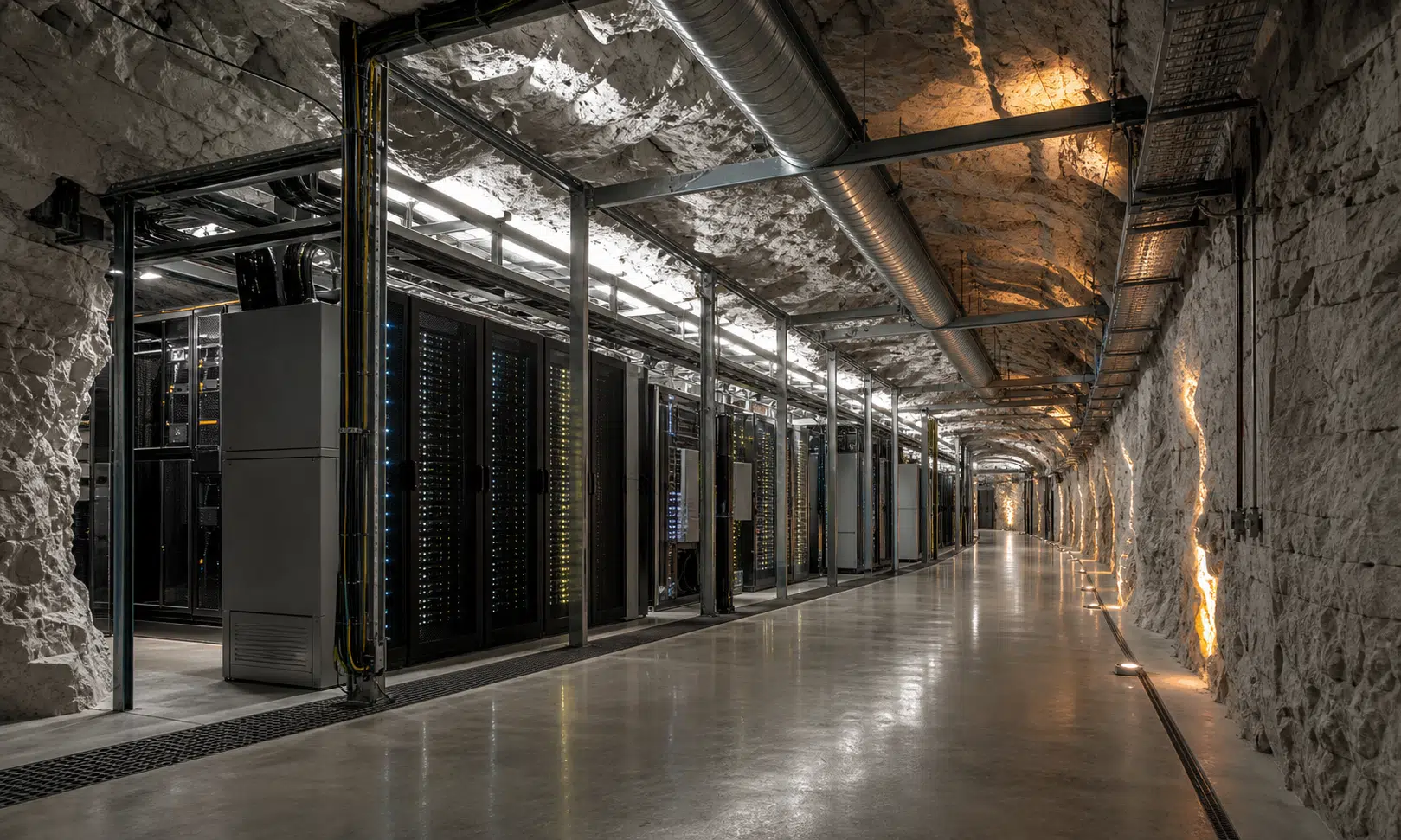

A working mine in the Italian Alps is being turned into one of Europe’s more unusual pieces of digital infrastructure: an underground data center built into the same mountain landscape known for apples, sparkling wine, and cheese.
The project, called Trentino DataMine and branded as Intacture, has completed its fundamental works after less than two and a half years of construction. It sits inside the Tuenetto di Predaia quarry in northern Italy’s Val di Non, where the idea is not simply to hide servers underground, but to use the mountain as part of the facility’s cooling, protection, and land-saving strategy.
That makes the project more than a novelty. For companies, universities, and public agencies weighing where to place future computing capacity, it is a useful case study in what underground data centers can offer, and where their limits still matter.
What makes this underground data center different?
The facility is being built about 328 feet below the surface, inside an active dolomite mine. Project materials describe roughly 80% of the structure as underground, though that figure should be read as part of the project’s own presentation rather than an independently verified measurement.
The appeal is straightforward: rock provides stable conditions, the site uses less visible surface land, and the underground setting can reduce exposure to some outside risks. In a region where underground spaces are already used for storing food and wine, the idea of adding servers to the mountain is unusual, but not random.
For a data center operator, the basic decision comes down to tradeoffs. An underground facility may reduce some cooling and land-use pressures, but it also brings added complexity in excavation, access, maintenance, fire safety, ventilation, and future expansion.
| Decision factor | Underground mine site | Conventional surface data center |
|---|---|---|
| Cooling conditions | Can benefit from stable underground temperatures and natural air movement | Usually depends more heavily on engineered cooling systems |
| Land use | Uses much less surface area when geology and access allow | Requires a larger visible footprint above ground |
| Construction complexity | Requires excavation, shafts, tunnel work, and specialized safety planning | Typically easier to build, inspect, and expand |
| Best fit | Regions with suitable rock, cool conditions, renewable power, and existing industrial access | Broader range of sites, especially near power, fiber, and customers |
Cooling is the core bet
Cooling is one of the main reasons the Trentino project is attracting attention. Servers run continuously and produce heat. A simple way to think about the problem is the warmth from a laptop during heavy use, although a data center operates at a far larger and more demanding scale.
In this case, the underground rooms are described by local officials as staying at about 54 degrees Fahrenheit with no humidity. The design uses fresh air from the valley and the surrounding dolomite rock to help cool the space, while the energy supply is described as entirely renewable and largely tied to local hydropower.
Earlier project materials said Intacture was designed for a power usage effectiveness below 1.25, compared with an average of 1.6 for European data centers. In practical terms, a lower PUE means a larger share of the electricity goes to computing rather than to supporting systems such as cooling.
For buyers or public agencies evaluating similar facilities, this is the important question: does the site reduce total operating demand enough to justify the extra engineering? The Trentino model argues that, in the right place, the geology can do part of the work that mechanical systems would otherwise have to handle.

SensorPush HT1 temperature and humidity monitor
A wireless temperature and humidity monitor can help technical teams watch conditions in closets, lab racks, or small server rooms. It is best suited for local visibility, not as a replacement for enterprise building-management systems.
As an Amazon Associate I earn from qualifying purchases.
A major engineering job, not a server room in a cave
The project should not be mistaken for a few racks placed in an unused tunnel. The site required excavation, wiring, certification, and the creation of a working technology infrastructure inside an active mine.
Official project figures say workers extracted about 2.2 million cubic feet of rock and excavated 9.3 miles of tunnels. The works also included a vertical shaft, known locally as a “fornello,” connecting operating galleries with the surface. The shaft has been reported as more than 130 feet deep, but that detail is best treated as a project-reported figure rather than an independently confirmed measurement.
The first phase starts with 800 kilowatts of capacity. The longer-term plan is to expand in stages toward 6 megawatts, which would give the site a larger role in Italy’s buildout of infrastructure for artificial intelligence, research, and advanced digital services.
That staged approach matters. Underground projects are capital-intensive, and future expansion is less flexible than adding another building on open land. The strongest candidates for this type of development are likely to be places where the mine, power supply, climate, fiber connectivity, and regional demand already line up.
Who is backing the project?
The cost is reported at more than $58 million. About $21 million came through Italy’s National Recovery and Resilience Plan, with the rest coming from the public-private partnership behind Trentino DataMine.
The University of Trento is the implementing body and scientific guide for the project. Private partners include Covi Costruzioni, Dedagroup, GPI, and ISA, bringing construction, IT services, health technology, and investment experience into the same project.
Local officials have framed the facility as a potential strategic hub for research, AI technologies, and digital development. That positioning is important because the project is not only selling storage space for servers. It is also presenting itself as a regional infrastructure asset, one that connects public research, renewable energy, and private technology services.
Land use is one of the clearest advantages
One of the strongest arguments for the site is surface land use. A 2024 project presentation said that, if Intacture had been built fully above ground, it would have occupied the equivalent of 21 Olympic-size swimming pools. Underground, the same presentation said it uses a little more than one.
That comparison is useful because data centers are expanding quickly as cloud services and AI workloads demand more computing power. Not every region can move that infrastructure underground, and underground construction will not solve the broader energy question on its own. But where the geology, temperature, grid, and access are favorable, it can reduce pressure on land and cooling systems.
The buyer-decision lesson is narrow but meaningful: underground data centers are not automatically greener, cheaper, or easier. They become interesting when the site itself offsets enough operational burden to make the extra construction work worthwhile.
How it compares with other European underground projects
Trentino DataMine fits into a wider European pattern. Underground data centers have gained attention because they can offer physical protection, stable environmental conditions, and lower surface impact.
Other examples already exist. Cegeka has announced an underground data center project in Belgian Limburg. Mount10 converted Swiss Alpine bunkers into data centers in the 1990s. Norway’s Lefdal Mine Datacenter opened in 2017.
The Trentino site stands out because it is being developed in an active mine, with traditional local activities still nearby. That mix of agriculture, geology, renewable energy, public research, and AI infrastructure gives the project a different character from a bunker conversion or a purpose-built industrial campus.
| Project example | Location | What the comparison shows |
|---|---|---|
| Trentino DataMine / Intacture | Italian Alps | Active mine setting, local renewable energy focus, staged digital infrastructure buildout |
| Cegeka underground project | Belgian Limburg | Shows continued European interest in below-ground data center models |
| Mount10 | Swiss Alps | Early example of repurposed Alpine bunker infrastructure |
| Lefdal Mine Datacenter | Norway | Established mine-based data center model in Europe |
The practical takeaway
The Italian project is best understood as a test of site selection. It is not claiming that every data center should move underground. Instead, it shows how a specific place, with the right rock, climate, power mix, and industrial access, can change the economics and environmental profile of digital infrastructure.
For organizations comparing future hosting or infrastructure options, the lesson is to look beyond headline capacity. Cooling design, power source, land use, expansion path, and local resilience all matter.
Trentino DataMine’s bet is that the mountain can carry part of that load. If the facility performs as planned, it could become a reference point for regions trying to build AI and cloud infrastructure without treating land and cooling as afterthoughts.

Emporia Vue 3 energy monitor
Circuit-level energy monitoring can help smaller facilities understand how much electricity is going to computing, cooling, and support loads. That kind of baseline is useful before making efficiency upgrades.
As an Amazon Associate I earn from qualifying purchases.

APC Back-UPS Pro 1500VA battery backup
A UPS gives routers, NAS devices, workstations, and small servers time to ride through short outages or shut down cleanly. Larger infrastructure still needs engineered power protection sized for the load.
As an Amazon Associate I earn from qualifying purchases.