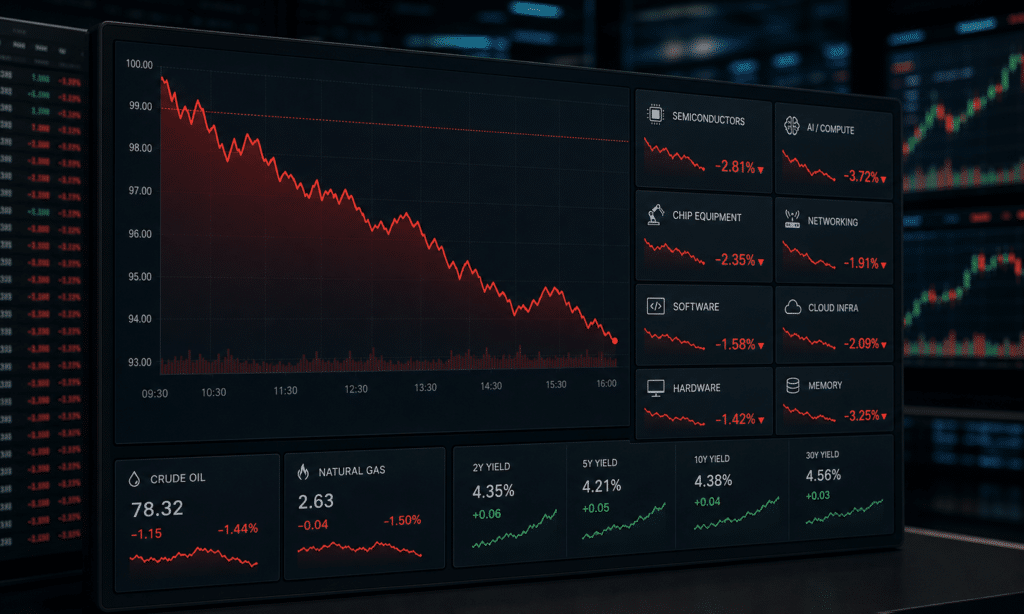
Stock market jitters remained the central theme in a fresh round of reported trading, with US shares said to have recovered some of Friday’s losses while several overseas markets came under renewed pressure from technology-sector selling and volatile oil prices.
The reported picture was uneven. US indexes were described as finishing higher on Monday, with the Nasdaq and S&P 500 recovering modestly. In Asia, however, the pressure appeared sharper, led by a steep decline in South Korea’s Kospi and additional weakness in Japan, Taiwan, Hong Kong and mainland China.
Because several market figures in the source material were not independently verified, they should be read as reported market moves rather than confirmed final data. The broad pattern, however, was clear: investors were said to be reassessing high-growth technology shares while also watching the inflation risk that can come from higher energy prices.
Technology Shares Lead the Reported Sell-Off
The sharpest reported moves came in Asian markets with heavy exposure to technology and chip-related companies. South Korea’s Kospi was said to have fallen nearly 9% shortly after opening before closing 8.3% lower. The source also reported that trading was halted for 20 minutes under a circuit-breaker mechanism intended to slow panic selling.
Japan’s Nikkei was reported to have fallen 3.9%, while European markets were described as mostly lower, though with smaller losses than those reported in Asia. The UK’s FTSE 100 was said to have recovered from early weakness and traded slightly higher.
The pressure followed a steep Friday decline on Wall Street, where the Nasdaq was reported to have dropped by about 4%, its largest fall in more than a year. The source linked that sell-off to concern that a strong US jobs report could keep interest rates elevated, or even raise the risk of further increases.
Technology shares have had a strong run, especially companies tied to artificial intelligence. But the source described investors as becoming more selective, with attention shifting from the promise of AI spending to whether that spending is producing dependable revenue.
Charu Chanana, chief investment strategist at Saxo, was quoted as saying traders were watching a “messy mix” of pressures tied mainly to technology shares and intensified by rising energy prices. She also said investors were repositioning because some AI-related investments may look overvalued. Those comments were not independently verified in the provided material, so they should be treated as reported commentary.
Chip Stocks Add to Market Pressure
South Korean technology shares were reported to have fallen sharply, including Samsung, which the source said closed down 10%, and SK Hynix. The Kospi’s heavy technology weighting was presented as one reason the market was more exposed to the sell-off.
South Korean President Lee Jae-myung was reported to have said the domestic market could remain volatile while also describing local shares as “slightly undervalued.” That statement was included in the source material but was not independently verified here.
Taiwan’s Taiex was also reported to have fallen, with TSMC shares said to be down 3%. TSMC was described as a key supplier to Nvidia. The source also said Nvidia chief Jensen Huang viewed the recent slide in technology shares as a buying opportunity, though that claim was not independently verified in the supplied material.
Susannah Streeter, chief investment strategist at Wealth Club, was reported to have said investors were moving toward technology companies with more reliable income streams and dividends, while also noting concern about the speed of recent gains in tech shares. As with other market commentary in the source, those remarks should be treated as reported rather than independently confirmed.
Oil Prices Add Another Source of Strain
Oil prices were another reported source of market unease. Brent crude was said to have jumped 4.6% to $97.34 a barrel in Asian trading after Iran and Israel exchanged strikes, before later easing back toward $94 a barrel after Iran said it would stop striking Israel.
The source described the attacks as the first exchange between Iran and Israel since a ceasefire involving the two countries and the US was agreed in April. Tehran was reported to have said the strikes were a response to repeated ceasefire violations, while Israel later struck military targets in Iran. Those geopolitical claims were not independently verified in the provided material and should be treated cautiously.
Oil prices were said to have remained volatile since US and Israeli strikes on Iran on 28 February. The source also reported that prices had hovered around $95 in the previous week as traders weighed possible disruption to global energy flows.
Associate Professor Jiajia Yang of James Cook University in Australia was reported to have said traders were again pricing in risks to global oil markets. The source framed the wider concern as a market response to unresolved political issues and the possibility that diplomatic efforts may not be enough to calm energy prices.
Investor Focus Turns to Proof, Not Hype
The reported market reaction suggests investors are no longer treating every AI-linked growth story the same way. Companies with clearer revenue, stronger cash flow or dividends may be receiving more attention, while shares that have risen quickly on AI expectations appear more vulnerable to reassessment.
That does not mean the technology investment story has ended. It means the standard of evidence may be rising. In the source material, Chanana was reported to have said investors want clearer signs that AI demand has turned into “real revenue” and that “the burden of proof has gone up.”
For now, the main pressure points remain familiar: technology valuations, interest-rate expectations and energy-price volatility. The reported moves across Asia, Europe and the US point to a market that is still willing to buy risk selectively, but less willing to ignore stretched prices when inflation and geopolitical risks are also in view.