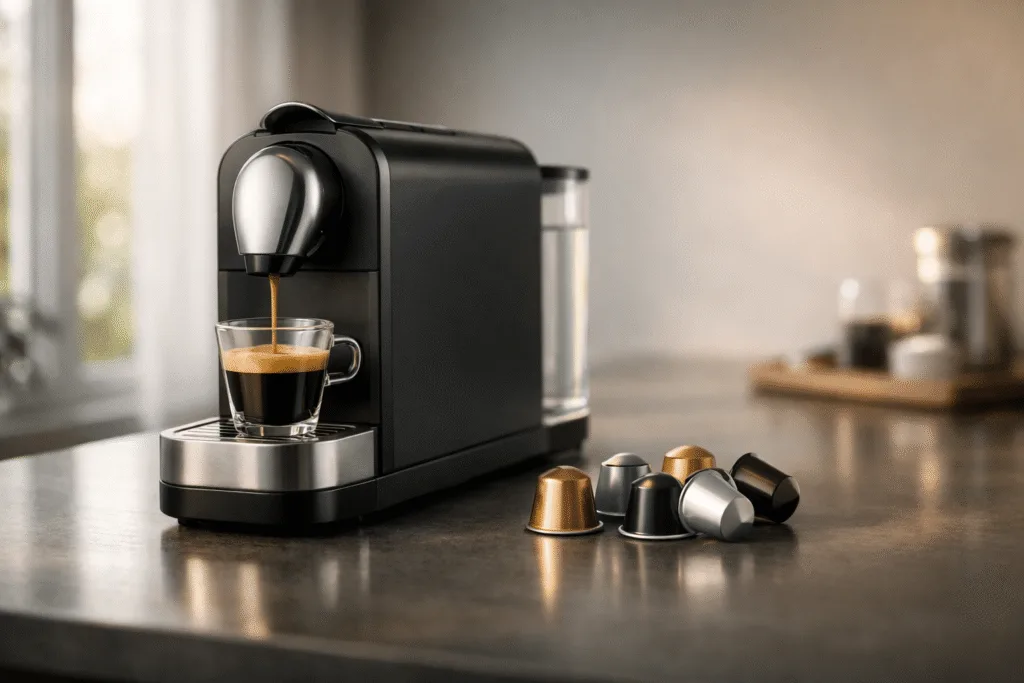
Nestlé launched Nespresso in 1986 as a capsule coffee system initially marketed to offices. After limited early sales, the business shifted toward households, combining machines, recurring capsule purchases and direct sales with positioning as a premium coffee brand.
Nespresso said in September 2022 that it operated in 81 countries. Nestlé subsequently reported Nespresso sales of CHF 6.378 billion for 2024.
From offices to households
The original system offered four coffee varieties. Its machines resembled traditional espresso equipment, and the early sales effort targeted businesses in Switzerland and Japan, including offices without space for a full-size coffee machine. Demand was limited.
Nestlé brought in Jean-Paul Gaillard in 1988 to revive the business, reportedly with closure the alternative if he failed. Gaillard had previously worked at Philip Morris, where he developed the Marlboro Classics clothing brand.
Reflecting on the launch in 2020, Gaillard said, “At the original launch the product was wrong, the positioning was wrong and the targeting was wrong.”
Under Gaillard, Nespresso redirected its marketing toward individual consumers and adopted the presentation of a luxury brand. He said he drew inspiration from the wine industry. Changes included lower machine prices, licensing arrangements with other manufacturers and marketing through the Nespresso Club.
Capsules and direct sales
The business model linked the purchase of a machine to repeated purchases of coffee capsules. This gave Nespresso a continuing market for coffee beyond the initial equipment sale.
The Club also established a direct relationship with customers. People ordering capsules supplied their contact details, while purchase records gave Nespresso information about their preferences and buying habits.
Online sales and boutiques became important distribution channels. Machines also reached buyers through manufacturing and retail partners, so direct sales did not describe every part of the business. By 2010, competitors were selling capsules compatible with Nespresso machines.
The brand’s positioning attracted attention beyond the coffee industry. In 2020, Ogilvy vice-chair Rory Sutherland compared Nespresso with Apple and suggested its achievements would receive greater recognition if it had originated in Silicon Valley.
Capsule waste and coffee sourcing
Nespresso’s aluminum capsules have faced criticism over waste and recycling. Nestlé says the business launched its first dedicated capsule recycling scheme in Switzerland in 1991.
The company also developed a coffee-sourcing program. In a 2022 statement, Nespresso said its AAA Sustainable Quality Program had launched in 2003 in collaboration with the Rainforest Alliance. It described the program as supporting harvest quality, farming practices and farmers’ livelihoods.