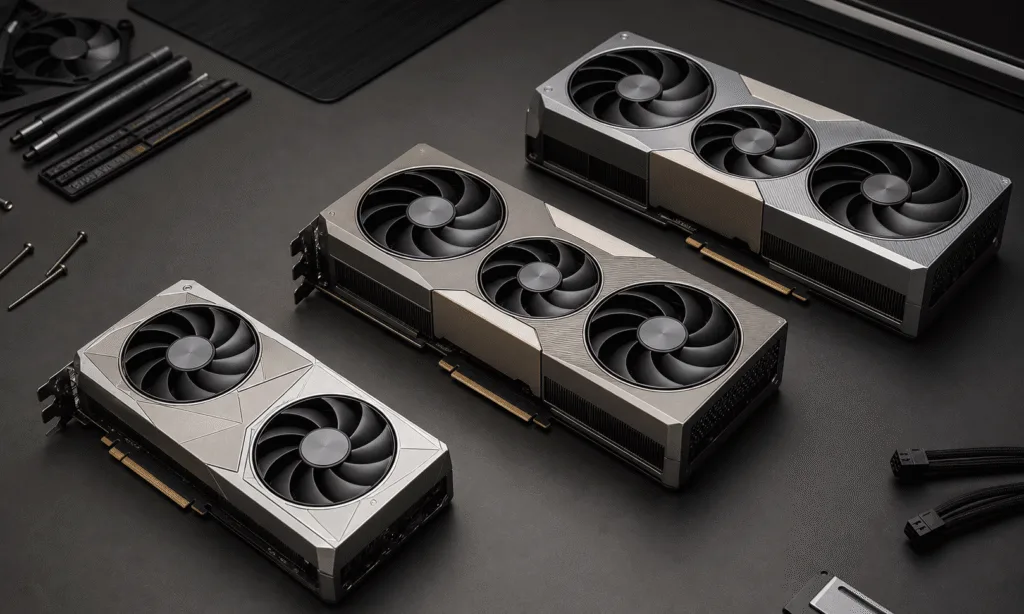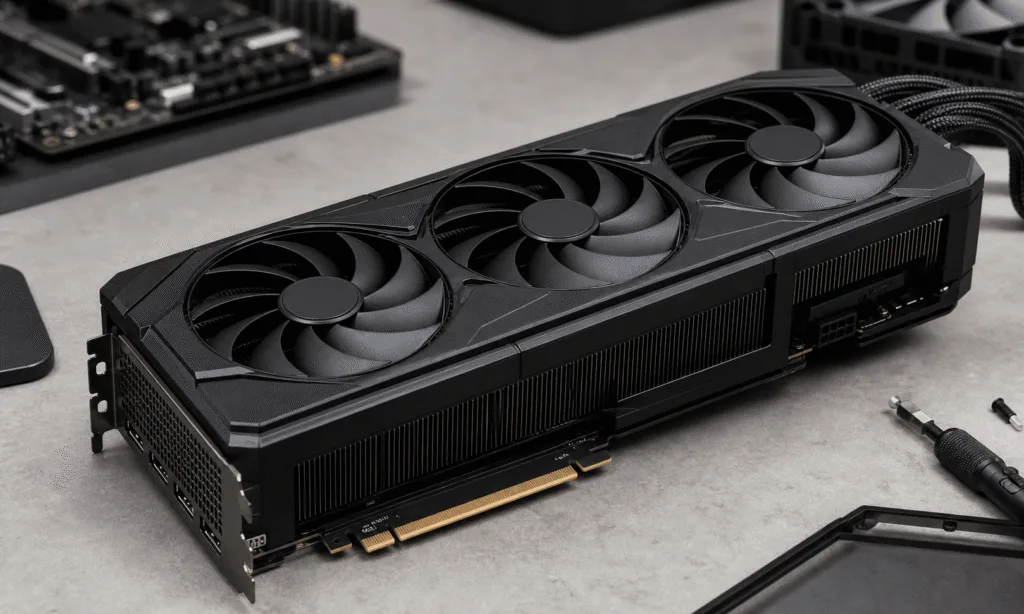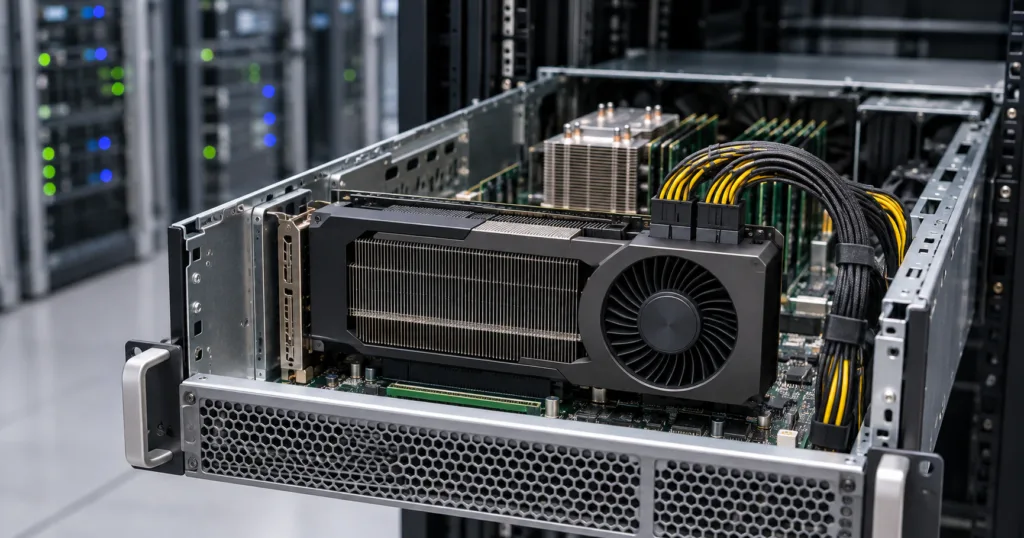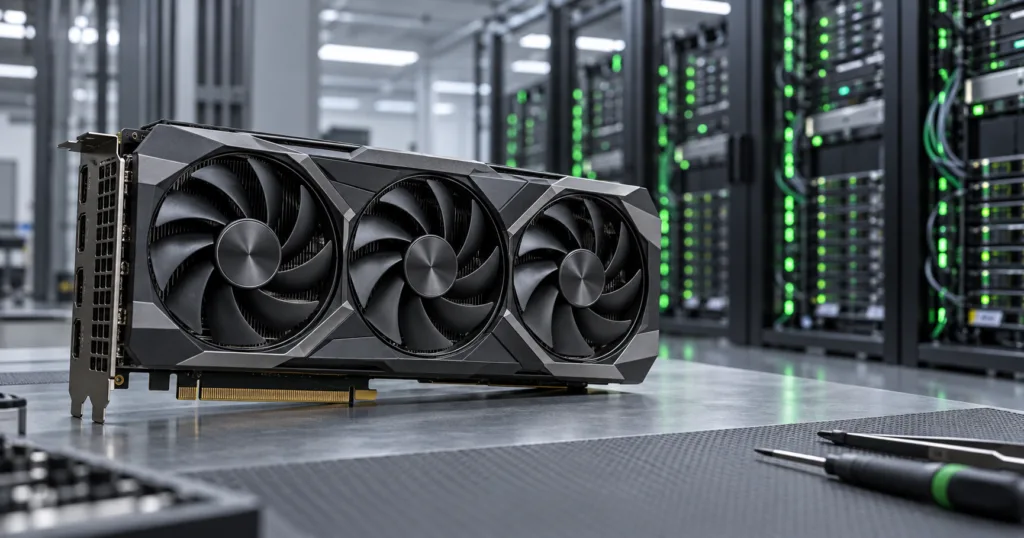
Nvidia’s GeForce RTX 5090 disappeared from the company’s graphics-card marketplace, and Micro Center marked the flagship as “Not Carried,” Tom’s Hardware reported on October 15, 2026. The listing changes followed claims that Nvidia was redirecting the chip used in the card toward professional products.
The changes indicate restricted retail availability, but they do not establish that Nvidia has permanently discontinued the RTX 5090. Tom’s Hardware reported that Nvidia had not officially commented on the situation and still displayed the card on its product website with a starting price of $1,999.
The uncertainty also featured in PCWorld’s October 16 newsletter, in which Alex Wawro discussed the RTX 5090 rumors and Nvidia’s growing data-center business.
Retail listings show limited availability
Tom’s Hardware reported that partner cards from Asus, MSI and Gigabyte remained listed on Micro Center’s website but were unavailable at its physical stores. It identified an exception: an Asus ROG Astral Edition 20 card offered through a roughly $11,000 anniversary bundle. The findings therefore did not establish that RTX 5090 cards had disappeared from every retail channel.
Wawro separately reported finding no RTX 5090 cards available during a search of major retailers for his newsletter. He also described prices exceeding $5,000, substantially above Nvidia’s launch price. His account did not identify a comprehensive set of retailers or provide transaction data establishing an average selling price.
Nvidia announced the RTX 5090 with a $1,999 starting price and a January 30, 2025 release date. Its specifications list 32GB of GDDR7 memory. That launch price provides a historical reference for the pricing discussion, rather than evidence that a card could be purchased for that amount in October 2026.
The memory capacity is central to Wawro’s argument that the card attracts interest beyond gaming. He attributed some of the pricing pressure to AI developers and companies, but did not provide purchasing data quantifying their share of RTX 5090 demand or their contribution to retail prices.
Production claims trace back to hardware leakers
VideoCardz reported on October 10 that the X account MEGAsizeGPU, which uses the handle @Zed__Wang, claimed future supplies of Nvidia’s GB202 chip would be reserved for the RTX PRO range. GB202 is the processor used in the desktop RTX 5090.
Under that account’s claim, newly manufactured GB202 chips would go to professional products rather than new GeForce RTX 5090 cards. VideoCardz said Nvidia had not confirmed the plan or announced an end-of-production date.
A separate account, hongxing2020, posted a purported factory notification claiming Nvidia would stop selling RTX 5090 models, including the China-market D variants. VideoCardz also described that account’s claim that a 24GB RTX 5080 would become the highest-end GeForce model.
These are attributed supply-chain claims, with different implications for chip allocation, card manufacturing and retail sales. A halt in new chip shipments would not, by itself, establish when existing cards or remaining inventory would stop reaching customers.
Wawro discussed the rumors in connection with episode 419 of The Full Nerd. According to PCWorld, Adam Patrick Murray, Brad Chacos and Michael Crider addressed the RTX 5090’s possible future during the episode. Their discussion did not constitute an Nvidia product announcement.
A 24GB RTX 5080 remains a reported plan
The proposed RTX 5080 configuration would increase memory capacity from the established desktop model’s 16GB to 24GB. Nvidia’s published specifications identify the existing card’s memory as GDDR7.
VideoCardz reported that the 24GB replacement claim came from hongxing2020 and that MEGAsizeGPU had not confirmed that part of the story. The two accounts were therefore not independently endorsing every detail of the same product plan.
In an October 12 report, VideoCardz cited Taiwanese publication BenchLife as saying Nvidia was preparing a 24GB RTX 5080 for the first quarter of 2027. BenchLife reportedly said the card would replace the 16GB version, rather than be offered alongside it.
The same account said Nvidia’s add-in card partners had received verbal information but had not yet received development documentation. The first-quarter timing remained a reported target, rather than a confirmed launch schedule.
The reports do not establish a retail price or measured gaming performance for the proposed card. A memory-capacity claim alone does not substantiate a noticeable improvement across games, nor does it establish that the product would match the RTX 5090’s performance.
Data centers dominate Nvidia’s reported revenue
Nvidia’s financial disclosures document the scale of its data-center business. For the quarter ended July 26, 2026, its fiscal 2027 second quarter, Nvidia reported $89.023 billion in Data Center revenue out of $96.221 billion in total revenue. That was approximately 92.5% of the total.
The company changed its presentation of revenue by market platform in the first quarter of fiscal 2027. However, it continued to disclose a separate Graphics segment, covering GeForce GPUs for gaming and PCs as well as enterprise workstation graphics.
That segment generated $7.922 billion in the July quarter. Because it includes workstation products, the figure cannot be treated as consumer gaming revenue alone. The disclosures do not support a claim that Nvidia stopped separately reporting its graphics business.
Nvidia attributed its data-center growth to Blackwell Ultra infrastructure. It also reported stronger Blackwell workstation sales, partially offset by slower consumer PC sales, which the company linked to elevated memory and system prices.