


A spin-off from the Karlsruhe Institute of Technology is trying to make hydrogen production look less like a power plant project and more like a modular solar installation.
Photreon presented a one-square-meter photoreactor panel at Hannover Messe, showing a prototype designed to produce hydrogen using water and sunlight. The company’s pitch is straightforward: instead of using solar panels to make electricity and then feeding that electricity into an electrolyzer, its panel is built to split water directly through a photocatalytic process.
That distinction matters for any business looking at hydrogen as a future fuel or feedstock. Conventional green hydrogen projects can involve photovoltaic arrays, power electronics, electrolyzers, compression systems, water handling, controls, and grid or storage planning. Photreon is positioning its technology as a simpler route for locations where hydrogen supply is expensive, grid access is limited, or on-site production would be more practical than delivery.
The company is not presenting a finished commercial hydrogen network in a box. What it has shown is a prototype and a reactor concept aimed at reducing system complexity. For buyers and project planners, the important question is not whether sunlight and water can make hydrogen in principle. It is whether the technology can be manufactured, deployed, maintained, and scaled at a cost that makes sense outside the lab.
A direct route to solar hydrogen
Most green hydrogen systems follow a two-step path. First, solar panels or another renewable power source generate electricity. Then an electrolyzer uses that electricity to split water into hydrogen and oxygen. It is a proven concept, but it adds layers of equipment and cost.
Photreon’s approach combines light absorption and water splitting inside the photoreactor panel. The company says specially designed light-sensitive materials absorb sunlight, creating the energetic conditions needed to drive the chemical reaction. Water is then split into hydrogen and oxygen without routing power through a separate electrolyzer.
That does not mean the system is automatically cheaper or easier in every setting. Photocatalytic hydrogen production has to solve its own engineering problems, including light management, catalyst performance, gas separation, durability, and safe hydrogen handling. But the appeal is clear: if the reactor can convert sunlight into chemical fuel directly, the project could avoid some of the electrical and electrolysis hardware that makes small hydrogen systems difficult to justify.
For decentralized energy users, fewer major components could also mean a different operating model. A business would not be buying hydrogen as a delivered commodity or relying entirely on a centralized hydrogen network. It could instead install panels where solar exposure and site conditions support local production.
What Photreon showed at Hannover Messe
The centerpiece of Photreon’s presentation was a one-square-meter prototype panel. That size is useful because it moves the concept beyond a small bench-scale demonstration while still keeping the system compact enough to refine.
The company’s founders have emphasized that the panel is designed around direct fuel production. Paul Kant, a Photreon co-founder, described the goal as avoiding the detour through electrically powered electrolysis. In practical terms, that means the panel is not simply another photovoltaic module. It is a reactor that has to manage incoming sunlight, water contact, chemical conversion, and gas removal within the same physical system.
KIT has filed a patent for the internal reactor geometry. According to the project description, that geometry is meant to balance three things at once: how light moves through the panel, how the chemical reaction takes place, and how the generated gases are removed. Efficient gas removal is not a minor design point. Hydrogen and oxygen need to be handled in a controlled way, and the reactor has to keep the reaction environment working as intended.
The company also says the panel design uses common materials and standard manufacturing processes. That claim is important because many promising energy technologies struggle when they leave specialized laboratory fabrication. A system built with familiar materials and production methods has a clearer path toward repeatable manufacturing, although commercial performance would still need to be proven through field testing and scaled production.
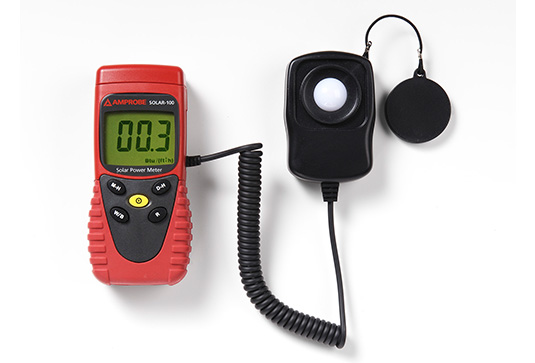
Solar Irradiance Meter for Site Assessment
A solar power meter helps project planners check irradiance at rooftops, open land, or test areas before assuming a site is suitable for solar hydrogen production.
Why decentralized hydrogen is the target
The most practical early use cases for this kind of panel are not necessarily giant hydrogen export hubs. Photreon is pointing to sites where hydrogen is difficult or expensive to supply today.
Medium-sized industrial companies are one example. Specialty chemical producers, food production facilities, and metalworking businesses may have future hydrogen needs but may not be located near a hydrogen pipeline, terminal, or large industrial cluster. For those users, delivered hydrogen can bring logistics costs, storage constraints, and supplier dependence.
A modular solar hydrogen panel would be more interesting if it could be placed on rooftops, open land, or dedicated solar areas and produce fuel close to the point of use. That would not eliminate the need for storage, safety systems, water management, or permitting. It could, however, change the economics for sites that cannot justify a conventional green hydrogen installation.
Remote areas are another logical target. In places without reliable grid access or hydrogen infrastructure, a system that uses only sunlight and water at the production step could reduce dependence on external energy networks. That makes the concept relevant for off-grid industrial sites, sunny regions with weak transmission infrastructure, and future solar hydrogen farms where land and sunlight are abundant.
For buyers, the distinction between “possible” and “bankable” remains critical. A prototype can show that the reactor architecture works at a meaningful panel size. A commercial buyer will still need data on hydrogen output per square meter, operating lifetime, maintenance requirements, water quality needs, gas purity, seasonal performance, and delivered cost per kilogram.
What buyers should watch next
The strongest part of Photreon’s concept is its simplicity at the system level. A panel that produces hydrogen directly from water and sunlight could be easier to explain, site, and replicate than a project built from separate solar and electrolysis blocks. The open question is whether that simplicity holds up after all balance-of-system needs are included.
Hydrogen is not just another solar output. Once produced, it has to be collected, dried or purified if needed, compressed or stored, monitored, and used safely. Even if the photoreactor replaces the electrolyzer, a working installation still needs equipment around the panel. The commercial value will depend on how much of the total project cost the panel can actually reduce.
Performance transparency will also matter. Buyers will want to compare Photreon’s panels with conventional solar-plus-electrolysis systems, delivered hydrogen, and other low-carbon fuel options. Useful metrics would include daily hydrogen yield, efficiency under real sunlight, degradation rate, maintenance intervals, and the cost of replacement parts.
Manufacturing is another test. The company says the design is suited to mass production because it relies on common materials and standard processes. That is promising, but energy hardware often faces a long path from prototype to reliable production line. A one-square-meter panel is a start; repeatable arrays, installation procedures, warranties, and service networks are what make the product credible for industrial customers.

Wall-Mount Hydrogen Gas Detector
A fixed hydrogen detector is relevant for facilities evaluating on-site hydrogen production, especially where storage, ventilation, and alarm integration are part of the project design.
A promising concept, but still early
Photreon’s panel fits into a broader push to make clean hydrogen less dependent on centralized infrastructure. The idea is especially attractive for locations with strong solar resources and limited access to existing hydrogen supply chains.
The technology also reflects a practical shift in how hydrogen projects are being evaluated. Instead of asking only how to make green hydrogen at the largest possible scale, companies are also asking how to produce smaller amounts where they are actually needed. That is where modular equipment can have a commercial role, if the cost and reliability are right.
For now, the safest reading is that Photreon has demonstrated a serious prototype and a clear engineering direction. Its direct-to-fuel photoreactor could reduce some of the complexity associated with standard green hydrogen systems, but it still needs commercial validation before buyers can treat it as an alternative to established electrolysis-based projects.
If the panel can scale from prototype to durable field installations, it could give industrial sites a new way to think about hydrogen: not only as a fuel delivered from elsewhere, but as something produced locally from sunlight, water, and purpose-built reactor panels.