


China’s latest hydrogen aircraft test is easy to oversell. It is also too important to dismiss.
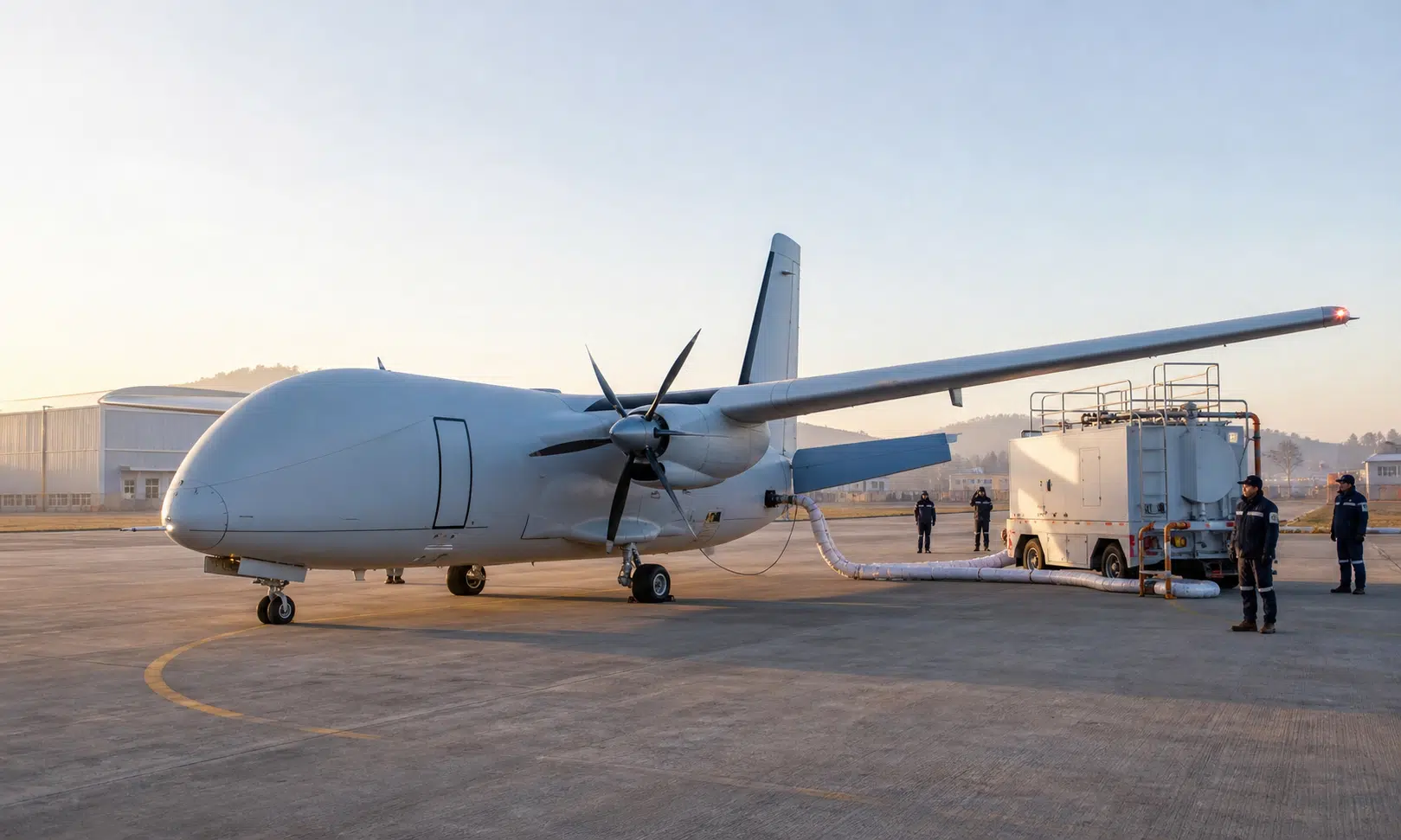
On April 4, 2026, a 7.5-tonne unmanned cargo aircraft powered by the AEP100 hydrogen-fueled turboprop completed a short test flight in Zhuzhou, Hunan Province, according to Chinese state media and follow-up aviation reports. The reported figures were modest but specific: 16 minutes in the air, 36 kilometers covered, a cruising speed around 220 kilometers per hour, and an altitude of about 300 meters.
That does not make the aircraft powered by water, despite the tempting headline shorthand. The engine burns hydrogen. Water vapor is the primary product of that hydrogen reaction, but the aircraft still needs hydrogen fuel, cryogenic storage, careful metering, and a support system that is far more demanding than filling a tank with liquid water.
The useful question is not whether China has solved hydrogen aviation. It has not. The better question is whether this flight changes the near-term decision landscape for cargo operators, airport planners, hydrogen suppliers, and aviation investors watching zero-carbon propulsion. On that narrower point, the answer is yes: it gives China a working demonstration of a megawatt-class hydrogen turboprop in flight, while leaving the hardest commercial questions open.
What Was Tested
The AEP100 is described as a megawatt-class hydrogen-fueled turboprop developed by the Aero Engine Corporation of China. A turboprop uses a turbine engine to drive a propeller, which makes it more relevant to regional aircraft, cargo drones, island routes, and utility aviation than to long-haul jetliners.
The test aircraft was unmanned, and that matters. Removing passengers lowers certification complexity and makes early trials more practical. It also points toward the likely first market: controlled logistics routes where operators can manage refueling, maintenance, flight paths, and risk without needing hydrogen infrastructure across a large public airport network.
The reported test was a maiden flight, not a service trial. It showed that the engine-aircraft combination could take off, fly a planned pattern, and land safely during a brief demonstration. It did not establish long-duration reliability, dispatch economics, maintenance cost, route flexibility, or passenger-aircraft readiness.
For a buyer or operator evaluating hydrogen aviation, that distinction is central. A short successful flight proves technical progress. It does not yet prove a business case.
Direct Combustion Versus Fuel Cells
The most interesting part of the AEP100 is not simply that it uses hydrogen. It is the way it uses hydrogen.
Much of the Western commercial hydrogen-aircraft conversation has centered on fuel cells. In that approach, hydrogen is converted into electricity, which powers electric motors. Airbus, for example, has selected hydrogen fuel cell propulsion for its ZEROe roadmap and has tested megawatt-class fuel cell systems on the ground.
China’s AEP100 takes a different route: direct hydrogen combustion inside a turbine cycle. In practical terms, that is closer to the way conventional turbine engines burn aviation fuel, although hydrogen brings its own storage, combustion, and thermal-management challenges.
| Approach | Why It Appeals | Main Tradeoff | Most Plausible Early Use |
|---|---|---|---|
| Hydrogen direct combustion | Higher power density and a path closer to turbine-engine scaling | Cryogenic fuel handling, hot combustion behavior, emissions control, and engine durability | Unmanned cargo, regional turboprops, controlled logistics corridors |
| Hydrogen fuel cells | Electric propulsion with no carbon dioxide at the aircraft and fewer combustion-related issues | Lower power density today and added complexity from electric drivetrain components | Smaller regional aircraft, demonstrators, airport-supported routes |
Neither path is automatically superior. Direct combustion may scale more naturally for higher-power aircraft, but it still has to answer questions around nitrogen oxides, fuel-system safety, engine life, and fuel efficiency. Fuel cells can offer cleaner onboard operation, but the power and weight equation becomes harder as aircraft size grows.

Hydrogen Aircraft Technology
This technical reference covers liquid hydrogen aircraft concepts, fuel containment, aircraft performance tradeoffs, airport requirements, and safety considerations. It is best suited to readers who want engineering background beyond headline-level hydrogen aviation coverage.
As an Amazon Associate I earn from qualifying purchases.
Why Liquid Hydrogen Is So Hard to Use
Hydrogen is attractive because it contains a lot of energy by mass and can be produced without fossil fuels if the upstream electricity is clean. Aviation cares deeply about weight, so that part of the equation matters.
The problem is volume and temperature. Liquid hydrogen must be kept near minus 253 degrees Celsius. Tanks, lines, valves, sensors, and refueling systems have to work around that extreme cold. Even then, liquid hydrogen takes up more space than conventional jet fuel for the same usable mission profile.
That changes aircraft design. A hydrogen aircraft is not simply a kerosene aircraft with a different tank installed. Designers have to account for larger fuel storage, insulation, boil-off management, weight distribution, and emergency handling. Airports also need equipment and procedures that most do not currently have.
The AEP100 flight therefore says as much about systems integration as it does about the engine. If the reported performance is taken at face value, the aircraft showed that a cryogenic hydrogen fuel system, combustion system, controls, and turboprop drivetrain could work together in flight for a short mission.
That is meaningful. It is also the beginning of a long validation process rather than the end of one.
Who This Technology Is For First
The first realistic customers are unlikely to be commercial airlines flying passengers between major cities. The near-term fit is narrower and more controlled.
Potential early users include:
- Unmanned cargo operators running repeatable short routes
- Island logistics networks where centralized refueling can be planned
- Regional cargo services with predictable operating bases
- Government-backed demonstration corridors
- Industrial zones where green hydrogen production already exists or is being developed
Those use cases are not as glamorous as passenger aircraft, but they are where hydrogen aviation has a better chance of proving itself. Operators can start with limited routes, specialized crews, dedicated ground equipment, and aircraft that do not need to satisfy the same cabin, passenger-safety, and airline-scheduling demands as commercial airliners.
This is also why China’s low-altitude economy matters. The phrase covers drones, air taxis, cargo aircraft, and other below-mainline aviation uses. It gives policymakers and manufacturers a place to test technology before pushing it into the stricter world of passenger transport.
The Buyer Decision: Signal, Not Proof
For anyone making procurement, investment, or infrastructure decisions, the AEP100 flight should be treated as a signal rather than a green light.
The signal is that hydrogen direct combustion is moving from ground research into flight testing at meaningful power levels. That can influence long-range planning for airport hydrogen hubs, green hydrogen supply contracts, maintenance training, and regional cargo networks.
The missing proof is commercial readiness. A 16-minute test does not answer whether an operator can fly multiple daily missions, maintain the engine economically, source hydrogen at a competitive price, or insure and certify the aircraft at scale.
A practical review of the technology should focus on five decision criteria:
- Range: Can the aircraft carry a useful payload far enough to matter?
- Turnaround: Can it be refueled and inspected quickly enough for commercial service?
- Hydrogen cost: Is clean hydrogen available at a price that competes with kerosene or sustainable aviation fuel?
- Infrastructure: Can storage, refueling, safety systems, and staff training be built at the route level?
- Certification: Can regulators approve the fuel system, engine behavior, emergency procedures, and maintenance regime?
Until those answers improve, the technology is best viewed as a strategic option rather than an aircraft category ready for broad purchasing.
Aircraft Propulsion: Toward Net-Zero Aviation
For readers comparing turbine combustion, electric propulsion, and alternative aviation fuels, this propulsion text provides a broader framework for how aircraft engines are evaluated in a net-zero aviation context.
As an Amazon Associate I earn from qualifying purchases.
How It Compares With Airbus’ Hydrogen Bet
Airbus has been more public about hydrogen fuel cell propulsion for commercial aircraft. Its ZEROe concept is aimed at a future aircraft using electric propeller propulsion powered by hydrogen fuel cells, with a 2035 ambition still shaping much of the discussion around airport readiness.
The contrast is useful. Airbus is building toward a fuel-cell aircraft ecosystem: electric motors, fuel cell stacks, cryogenic hydrogen storage, airport partnerships, and route planning. China’s AEP100 test points toward a turbine-based hydrogen path that could appeal where higher shaft power and turboprop familiarity matter.
This is not simply East versus West. Both approaches face the same basic constraint: hydrogen aircraft need hydrogen airports. Without production, liquefaction, storage, delivery, refueling, safety clearance, and trained ground crews, even a good aircraft has nowhere useful to operate.
The difference is where each program appears to be placing its early confidence. Fuel cells look cleaner and quieter but remain power-density constrained. Direct combustion looks more scalable for larger power demands but has a harder combustion and emissions-control problem to solve.
Verdict: Important for Cargo, Premature for Passengers
The AEP100 test deserves attention because it moves hydrogen direct combustion from a technical argument into a flight-demonstrated system. For unmanned freight, island logistics, and tightly managed regional operations, that is a serious development.
It does not mean hydrogen passenger planes are around the corner. It does not mean aviation can quickly move away from kerosene. It also does not mean water-powered airplanes are real in the way viral headlines imply.
The clearest verdict is this: China has shown a credible early flight milestone for a hydrogen turboprop engine, but the commercial product is still unproven. Operators should watch endurance testing, repeat-flight reliability, refueling procedures, hydrogen cost curves, and certification progress before treating this as a purchasing category.
For now, the AEP100 is best understood as a testbed with strategic weight. It shows where China wants part of aviation to go: toward domestically developed propulsion, lower carbon emissions at the aircraft, and less dependence on imported liquid fossil fuel. Whether that becomes a practical aircraft market will depend less on one short flight and more on the infrastructure and economics built around the next hundred.

The Hype About Hydrogen, Revised Edition
This updated hydrogen critique is useful for readers weighing cost, infrastructure, leakage, production pathways, and adoption timelines. It pairs well with the article’s caution that a short flight test is a signal, not commercial proof.
As an Amazon Associate I earn from qualifying purchases.