

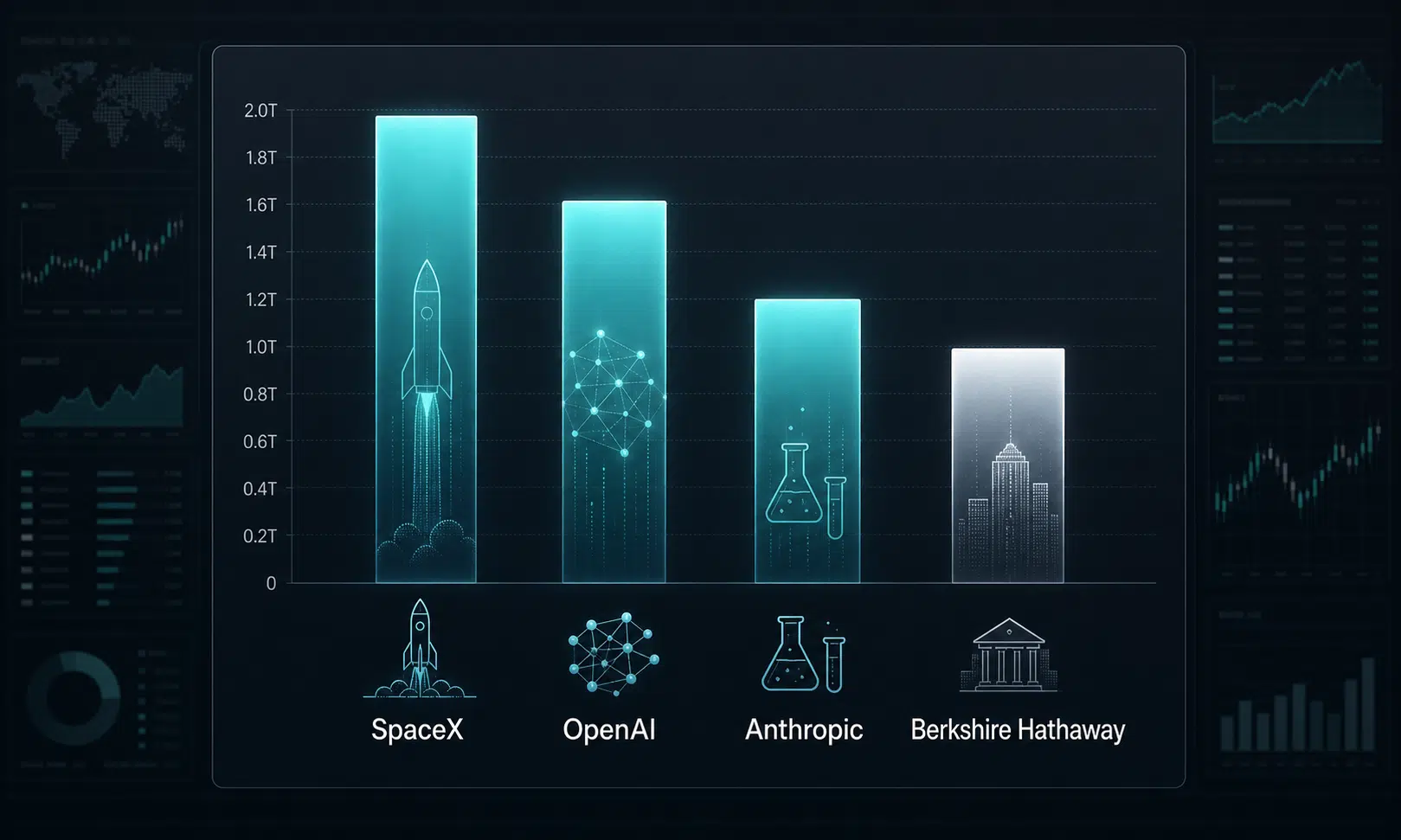

Traders Are Pricing In Trillion-Dollar Public Debuts
Prediction markets are treating the next wave of private tech listings as more than routine IPO candidates. SpaceX, OpenAI and Anthropic are all being discussed as companies that could command market values normally reserved for the largest public businesses in the world.
The attention intensified after SpaceX filed for its public debut and reports said OpenAI could move toward a confidential IPO filing. Anthropic has also been part of the conversation, though a firm public-listing timeline has not been confirmed.
On Kalshi, traders have recently assigned high odds to OpenAI filing for an IPO in 2026. Anthropic is also drawing IPO speculation, but the cleaner takeaway for investors is narrower: prediction markets are trying to handicap not just whether these companies go public, but how aggressively public buyers may value them on day one.
According to pricing cited from Polymarket, traders have been weighing first-day valuations above $1 trillion for the group. Those market-implied expectations have not been independently verified and should not be read as confirmed IPO targets. They do, however, show how much enthusiasm has built around space infrastructure and artificial intelligence as public-market themes.

Initial Public Offerings, Second Edition
This IPO-focused book explains how offerings are arranged, priced, and studied after listing. It is most useful for readers who want background before tracking high-profile public debuts.
As an Amazon Associate I earn from qualifying purchases.
How The Expected Valuations Compare
The numbers being discussed are large enough to make a comparison with Berkshire Hathaway unavoidable. Berkshire’s market value was recently cited around $1.03 trillion, while Meta and Tesla were described as being around the $1.5 trillion range. Those public-company comparisons can shift quickly, but they frame the scale of what traders are debating.
| Company | Recent private or reported valuation context | Prediction-market first-day valuation discussion | Key investor question |
|---|---|---|---|
| SpaceX | Valued at about $1.25 trillion in February | Traders were cited as debating a close above $2.2 trillion | Can launch, Starlink and future space businesses justify a mega-cap public multiple? |
| OpenAI | Last cited near $852 billion | Traders were cited as debating a close above $1.4 trillion | How durable are revenue growth, margins and enterprise demand after listing? |
| Anthropic | Reported funding talks have centered on a much higher private valuation | Traders were cited as debating a close above $1.8 trillion | Can Claude’s enterprise traction support public-market expectations? |
| Berkshire Hathaway | Recently cited around $1.03 trillion in market value | Already public | Offers a benchmark for scale, profitability and revenue depth |
The comparison is useful, but only up to a point. Berkshire is a mature conglomerate with enormous revenue and operating history. Deutsche Bank analyst Adrian Cox noted that Berkshire generated more than $350 billion in revenue last year. SpaceX’s 2025 revenue was cited at $18.67 billion, while OpenAI was reported to have generated $13.1 billion.
Anthropic’s 2025 revenue picture is less clear. Reports have said the company may be approaching a profitable quarter at nearly $11 billion in revenue, but that has not been independently confirmed. SpaceX and OpenAI have also been described as unprofitable despite their private-market valuations.
What Buyers Should Weigh Before Chasing The IPOs
For prospective investors, the key issue is not whether SpaceX, OpenAI or Anthropic are important companies. It is whether the first public price would already assume years of flawless growth.
A trillion-dollar valuation can make sense only if buyers believe the company has a long runway, defensible margins and enough market power to turn revenue into durable profit. That is a different question from whether the brand is famous or the technology is impressive.
Useful decision criteria include:
- Revenue quality: recurring enterprise contracts are easier to value than hype-driven demand.
- Profit path: losses matter more once a private company becomes a public stock.
- Capital needs: space systems and frontier AI both require enormous ongoing investment.
- Valuation discipline: a great business can still be a poor purchase at the wrong price.
- Market absorption: several mega-IPOs arriving close together could compete for the same pool of institutional buyers.

Valuation: Measuring and Managing the Value of Companies
This corporate valuation reference walks through cash flow, growth, capital cost, multiples, and interpreting valuation results. It suits readers who want a structured way to judge whether a public price already assumes too much.
As an Amazon Associate I earn from qualifying purchases.
There is a counterargument. Cox pushed back on concerns that the U.S. market could not absorb several very large IPOs, noting that the total U.S. stock market is far larger than it was during the dot-com peak and that the current decade has seen far fewer IPOs per year than the late 1990s.
That may reduce the fear of a mechanical shortage of buyers. It does not remove valuation risk.
The Practical Takeaway
SpaceX, OpenAI and Anthropic could become defining public listings if they come to market. Prediction markets suggest traders are preparing for valuations that could put them near or above some of the world’s largest public companies on the first day of trading.
But prediction-market odds are not fundamentals, and reported IPO preparation is not the same thing as a confirmed listing price. Buyers should separate three questions: whether the IPO happens, what valuation the company receives, and whether that valuation leaves enough upside after the first trade.
For investors comparing these names with established mega-caps such as Berkshire Hathaway, the tradeoff is clear. Berkshire offers scale, revenue depth and a long public record. SpaceX, OpenAI and Anthropic offer growth narratives that could be extraordinary, but the opening price may already charge investors heavily for that future.