

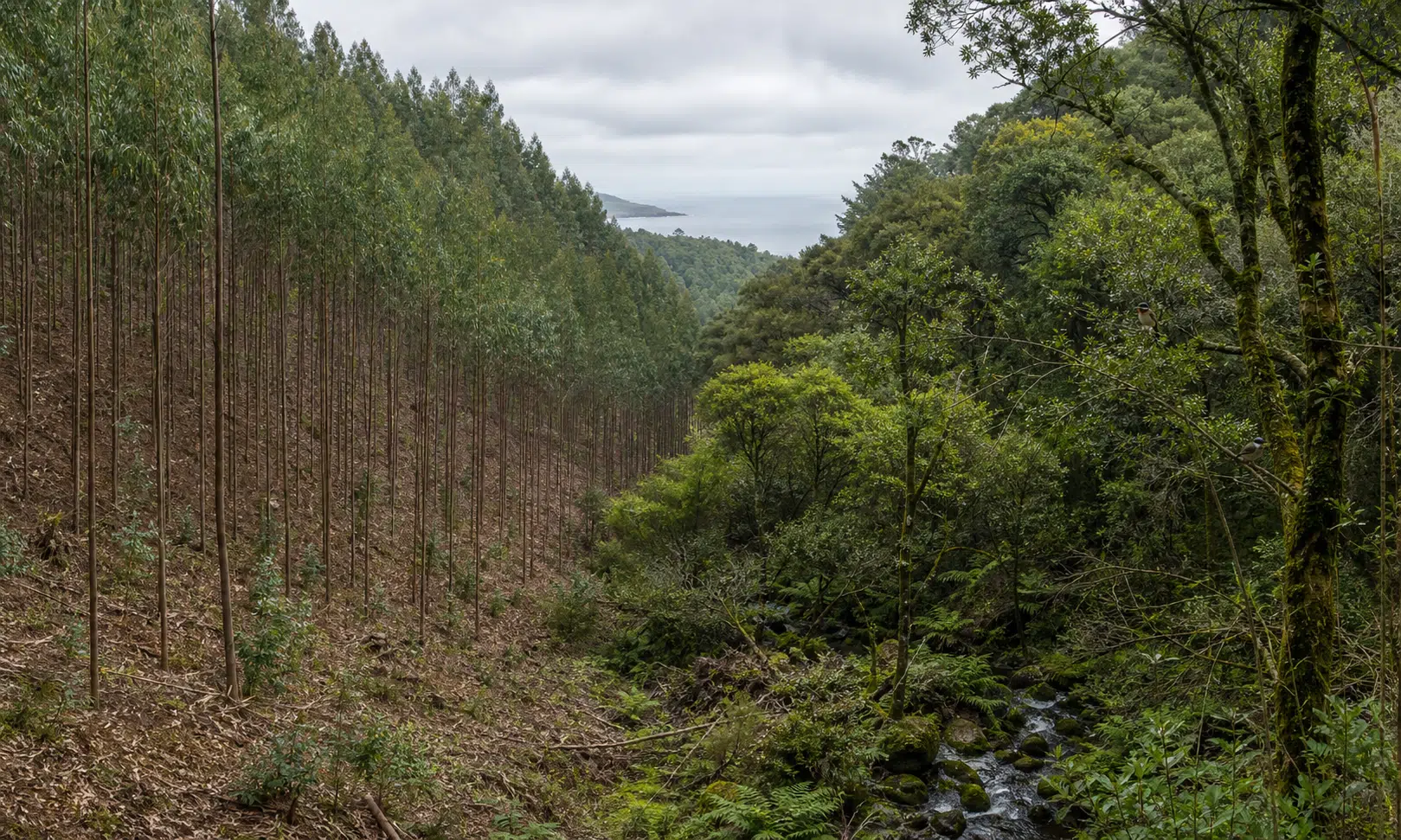

Planting trees is usually framed as an obvious environmental win. Galicia, in northwestern Spain, shows why that shorthand can break down fast.
Eucalyptus plantations spread because the tree grows quickly and fits industrial forestry needs. From a distance, the result can still look like a forest: tall trunks, dense green cover, and hillsides that appear productive. The harder question is whether those plantations function like the native woodlands they often replace.
For native birds, the answer appears to be no. Research on forest plots around Fragas do Eume Natural Park has linked eucalyptus stands with lower bird richness and abundance than native woodland. Put more plainly: fewer kinds of birds, and fewer birds overall, were associated with eucalyptus-dominated areas.
That distinction matters because this is not a debate about whether trees are good or bad. It is about whether a fast-growing plantation can stand in for a complex forest system built around older native trees, understory plants, insects, nesting cavities, streams, and seasonal food sources.
The real comparison is plantation versus forest
The central tradeoff is easy to miss because both sides of the landscape are green. Eucalyptus plantations can deliver timber and pulp, and they can do it on relatively short production cycles. Native forests are slower, messier, and less uniform, but that structural complexity is exactly what many species use.
A plantation tends to simplify the forest. It can reduce the variety of plants growing beneath the canopy, limit the number of old trees with cavities, and change the food available for birds that depend on insects. A native woodland, by contrast, usually provides more layers: canopy, shrubs, deadwood, leaf litter, and older trees with cracks or holes.
| Forest feature | Eucalyptus plantation | Native woodland |
|---|---|---|
| Main advantage | Fast-growing timber and pulp production | More complex habitat for wildlife |
| Tree structure | Often more uniform and managed | More varied ages, shapes, and cavities |
| Bird habitat value | Lower richness and abundance reported in studied plots | Higher richness and abundance reported in studied plots |
| Best suited for | Industrial forestry output | Biodiversity, nesting, feeding, and ecological resilience |
That makes Galicia’s eucalyptus question less like a simple conservation slogan and more like a land-use comparison. The useful question is not whether a hillside has trees. It is what kind of forest those trees create, and which species can actually live there.
Why birds are an early warning signal
Birds are visible enough for people to notice, but they also sit inside a broader ecological web. Many forest birds rely on insects, seeds, older trunks, and understory vegetation. When those pieces are reduced, the effect can show up as quieter woods and thinner bird communities.
Insect-eating species are especially exposed to that shift. Birds such as long-tailed tits, goldcrests, marsh tits, Eurasian treecreepers, and common chaffinches are tied to the small prey and layered vegetation found in healthier native woodland. If a plantation supports fewer insects or less varied vegetation, it can become a poorer feeding ground.
Hole-nesting birds face a different constraint. Great spotted woodpeckers, European green woodpeckers, and Eurasian nuthatches need older trees with cavities, cracks, or softer sections where nesting is possible. Eucalyptus plantations managed on short rotations may be harvested before many trees develop those features.
That is where the biodiversity tradeoff becomes concrete. A straight, fast-growing trunk may be economically useful, but it does not automatically provide the cavities, bark texture, deadwood, or food web that forest birds need. Tree cover and habitat quality are related, but they are not interchangeable.
The eucalyptus problem extends beyond birds
The ecological concern around eucalyptus is not limited to nesting sites. Eucalyptus can influence the plants growing around it, including through allelopathy, a process in which chemical compounds from a plant can inhibit the growth of other plants nearby. Leaf litter and soil effects have also been raised as concerns in the broader debate over the tree’s role in Spanish landscapes.
Those changes matter because understory plants are not decorative. They support insects, provide cover, shape soil conditions, and help young native trees regenerate. When the understory is simplified, the forest loses some of the smaller systems that larger animals depend on.
Streams can also be affected when eucalyptus leaves enter freshwater systems. Different leaf litter can change decomposition patterns and the tiny organisms that help power aquatic food webs. That may sound like a small technical issue, but river ecosystems often begin with those small organisms: larvae, decomposers, amphibians, and the food sources that support fish and birds.
The result is a quieter kind of environmental decline. It may not look like an obvious collapse from a roadside. It can look like fewer insects under stones, fewer nesting opportunities in old trunks, and fewer native birds using a stand that still appears green.
Why Spain has not simply walked away from eucalyptus
Eucalyptus has economic weight. It supplies material for forestry and paper industries, and that explains why the tree has remained politically difficult even as ecological concerns have grown.
Spain’s debate has been running for years. Scientific advisers have recommended treating some eucalyptus species as invasive because of their ability to spread and transform ecosystems. Government decisions have not always followed that recommendation, reflecting the tension between conservation goals and a forestry sector built partly around eucalyptus production.
Galicia has tried a more targeted approach by restricting new eucalyptus plantations. The region has moved to extend a moratorium on new plantings until 2030, while still leaving room for some exceptions tied to replacing existing eucalyptus areas and shifting parts of the landscape toward conifers or broadleaf trees.
That compromise shows how hard this issue is in practice. Removing every eucalyptus tree immediately is not a realistic forestry policy. Letting plantations continue expanding without limits is difficult to square with the biodiversity concerns. The practical path sits somewhere between those poles: tighter controls, restoration of native habitat, and better design inside working forests.
The practical fix is not just fewer trees
The most useful intervention is not necessarily a blanket war on eucalyptus. A more practical option is to make plantation landscapes less hostile to wildlife by leaving unmanaged strips free of eucalyptus and allowing native vegetation to return.
Those strips could give insects, shrubs, and birds somewhere to persist inside a production landscape. They would not turn a plantation into old-growth woodland, but they could reduce the ecological dead zone effect that comes from large, uniform stands.
For land managers, the tradeoff is clear. Eucalyptus can remain a productive forestry crop, but plantations need to be judged against more than output. The comparison has to include bird habitat, understory recovery, stream health, fire risk, and the long-term resilience of the wider landscape.

Spain Birds Folding Pocket Guide
A compact Spain bird guide can help readers connect habitat quality with the birds actually present in a woodland, plantation edge, or stream corridor. It is most useful as a simple field reference for common species rather than a technical ecology text.
As an Amazon Associate I earn from qualifying purchases.
For readers weighing the broader lesson, the point is not that planting trees is harmful. It is that tree planting is not automatically restoration. A forest is more than a canopy on a map. It is a living system with layers, gaps, old trunks, leaf litter, water, insects, and the animals that depend on them.
Galicia’s eucalyptus plantations are a reminder that climate and biodiversity goals can collide when speed and scale become the only metrics. More trees can still mean less nature if the wrong forest replaces the right one.