

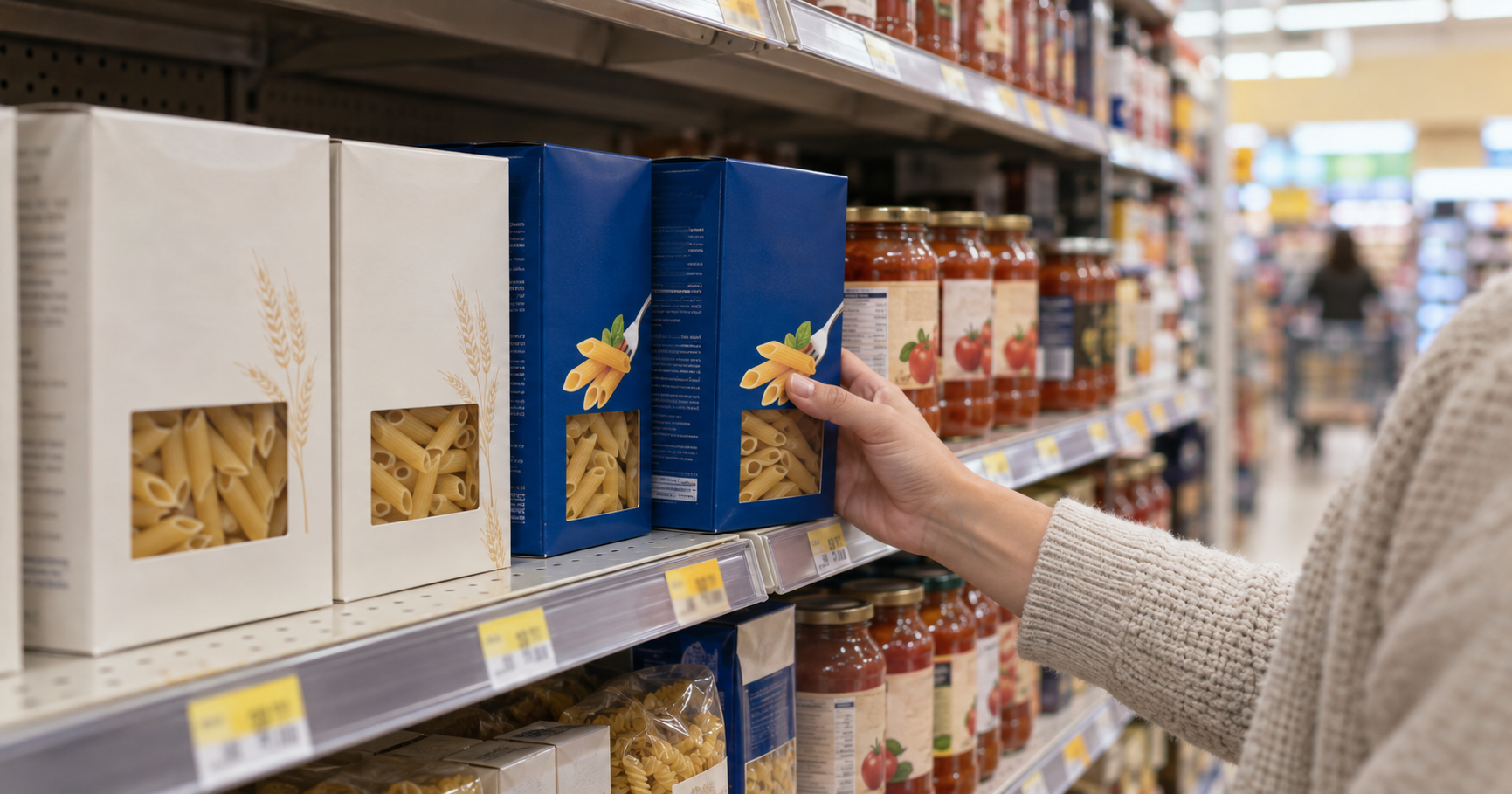

Store brands give retailers a way to compete for grocery spending with products carrying their own labels. National food brands face a different test: whether shoppers will keep paying for a familiar name when an alternative is within reach.
The comparison comes down to staying power. Retailers need repeat purchases to make their own-brand investments worthwhile. Packaged-food companies need pricing that supports profits without steadily eroding demand. The available figures suggest pressure on branded products, although they cannot show that every lost sale went to a store brand.
How much ground have store brands gained?
Circana’s March 2026 estimate put US private-label consumer packaged-goods sales at $330 billion, representing 24% of units and 23% of spending in the measured market. Those figures cover consumer packaged goods, a broader category than groceries alone.
FMI’s 2026 shopper survey also suggests that private labels may have appeal beyond temporary savings. Among respondents, 92% said they had store-brand products at home, while 94% said they would keep buying them if grocery prices declined.
That is evidence of stated preferences, rather than a guarantee of future purchases. Still, it gives retailers a reason to treat private labels as a lasting part of their offering.
What retailers are putting behind their labels
Kroger put sales from its Our Brands portfolio at more than $39 billion in 2025. That establishes the scale of the business, but revenue alone does not reveal how much more profit an own-label product generates than a competing national brand.
Walmart’s April 2026 Great Value announcement outlined a packaging redesign spanning almost 10,000 food and consumables items, with a rollout planned over two years. The company said the redesign would retain the products inside.
These are different commitments: an established sales base at Kroger and a broad presentation overhaul at Walmart. Both illustrate how retailers can build businesses around their own labels. Neither establishes a universal margin advantage.
Price increases and sales growth tell different stories
McCormick’s third quarter of fiscal 2026 illustrates why the details matter. The company recorded about $2.02 billion in sales, up 17.4% year over year, with its McCormick de Mexico acquisition contributing most of that growth. Organic sales, which exclude acquisition and currency effects, increased 1.9%.
Pricing contributed positively, while volume and product mix slipped. Conagra’s first quarter of fiscal 2027 showed a different outcome: positive price and mix were outweighed by lower volume.
| Measure | McCormick, Q3 fiscal 2026 | Conagra, Q1 fiscal 2027 |
|---|---|---|
| Reported net sales change | +17.4% | -1.4% |
| Organic sales change | +1.9% | -1.1% |
| Pricing contribution | +2.2% from price | +1.0% from price and mix |
| Volume contribution | -0.3% from volume and mix | -2.1% from volume |
The companies group product mix differently, so the pricing and volume components are not directly interchangeable. Even so, both show why revenue needs a closer look: acquisitions, prices and the combination of products sold can change the headline without demonstrating stronger underlying demand.
These results do not isolate private-label competition as the cause of weaker volumes.
What matters when comparing the two sides
For readers assessing grocery businesses, the useful question is whether growth holds up after separating pricing from demand.
Retailers’ own-brand sales show the size of their opportunity; sustained purchases and profitability determine its value. For packaged-food manufacturers, organic growth and volume trends help reveal whether customers are continuing to buy as prices change.
Operating margins add another necessary check. A business can sell more while earning less on each dollar of revenue, and a price increase can protect profitability even when volume falls.
Store brands therefore deserve attention as competitive alternatives. A verdict on either business model still needs evidence that sales translate into durable profits.