

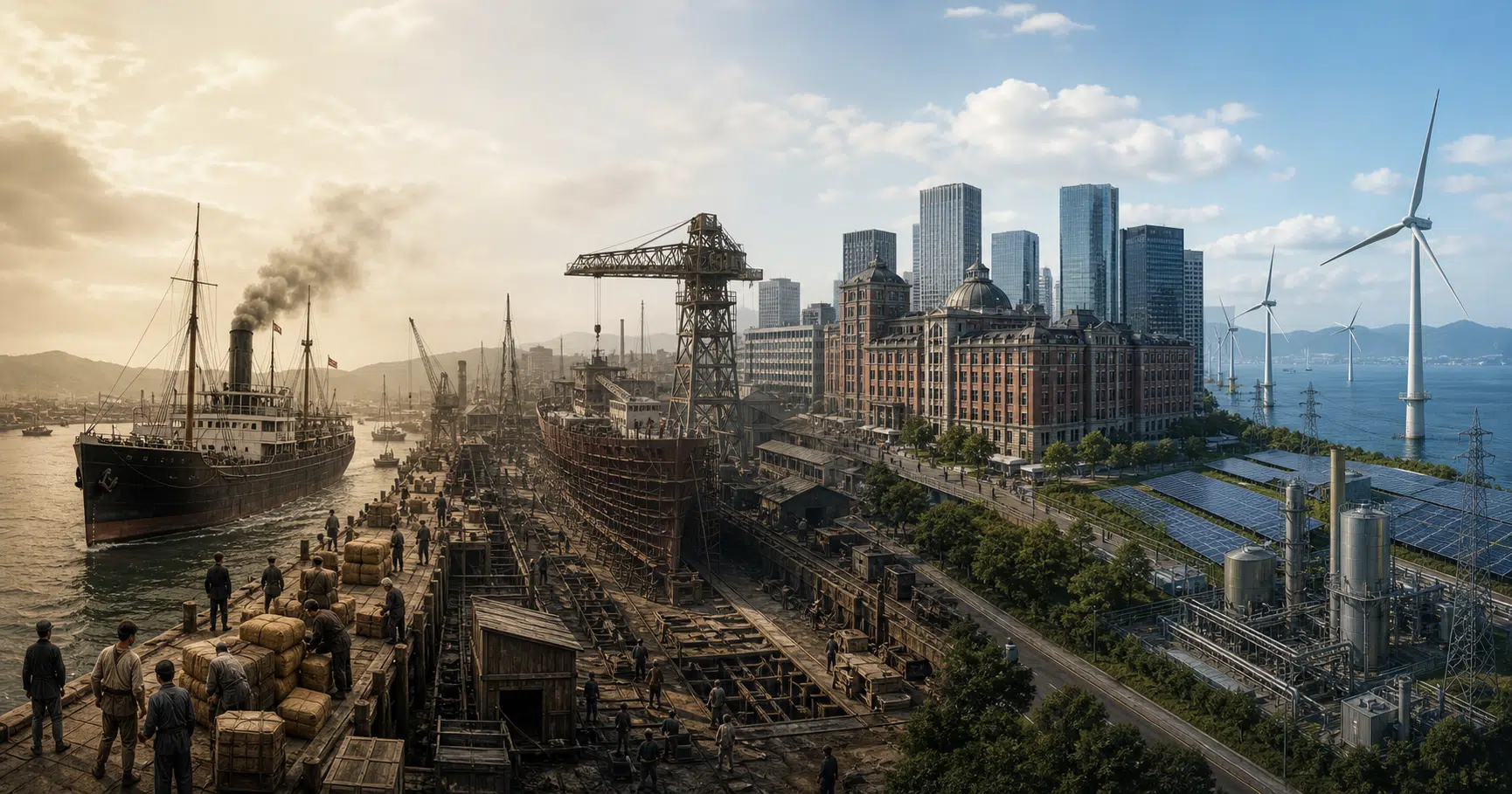

Mitsubishi is one of the most recognizable names in Japanese industry, but it does not describe one conventional corporation. The three-diamond identity appears across independently managed businesses involved in fields as different as finance, real estate, electronics, chemicals, automobiles and heavy industry.
Understanding how that network took shape requires going back to the upheaval surrounding Japan’s Meiji era. Mitsubishi dates its beginnings to 1870, when Yataro Iwasaki took charge of a small shipping operation connected to the former Tosa domain. Shipping was the foundation, but it did not remain the limit of the business for long.
Over the next 75 years, four presidents from the Iwasaki family pushed the organization into mining, shipbuilding, banking, trading and property. Their tenures also tracked Japan’s transformation from a country emerging from feudal rule into an industrial and increasingly international economy.
That family-led organization ended after World War II. Mitsubishi’s postwar chronology marks the dissolution of its headquarters in 1946, after which affiliated businesses operated as separate companies. The name eventually returned, but the centralized structure did not. That distinction remains essential: modern Mitsubishi companies share historical roots, a brand identity and certain long-standing principles, but they are not divisions of one giant parent company.
Four presidents shaped the early Mitsubishi organization
Mitsubishi’s first era can be read through the priorities of its four Iwasaki presidents. Each inherited a business built for a different economic moment, and each changed its structure rather than simply maintaining what came before.
| President | Tenure | Central contribution |
|---|---|---|
| Yataro Iwasaki | 1870–1885 | Established shipping as the core business and began moving into adjacent industries |
| Yanosuke Iwasaki | 1885–1894 | Expanded mining and real estate while preparing a generational transition |
| Hisaya Iwasaki | 1894–1916 | Introduced a more modern divisional management structure |
| Koyata Iwasaki | 1916–1945 | Emphasized international business, social responsibility and institutional principles |
The progression was not a straight line from one product to another. It was a repeated process of converting capabilities gained in one field into an entry point for the next. Shipping required ships, fuel, insurance, financing, warehouses and trading relationships. Those needs helped make shipbuilding, mining, banking, logistics and commercial property logical areas of expansion.
This pattern explains both Mitsubishi’s reach and its later complexity. The organization was becoming an industrial system long before modern conglomerates made that model familiar.
Yataro Iwasaki built the business around shipping
The political changes of the late Tokugawa and early Meiji periods disrupted established commercial arrangements across Japan. Former domain businesses had to adjust to a national government, newly developing markets and growing overseas trade. Yataro Iwasaki emerged from that environment with experience in the Tosa domain’s commercial operations.
Mitsubishi’s corporate chronology connects its beginning to a shipping business established in 1870. Yataro later assumed management, and the operation adopted the Mitsubishi name as Japan’s new commercial order took shape. The name became associated with a transportation company that could move people, mail and cargo between the country’s emerging centers of trade.
Shipping was a strategic industry in a country composed of islands and trying to build national infrastructure. It was also capital-intensive. Operators needed vessels, ports, repair facilities, fuel and enough financial resilience to survive changes in demand. That combination created both risk and opportunity for an ambitious company.
Yataro’s importance lies less in a single dramatic decision than in the business architecture formed during his tenure. Mitsubishi began as a shipping-centered enterprise, then moved into activities that could support transportation or benefit from the same capital, engineering and administrative capabilities.
Warehousing and documentation services sat naturally beside shipping. Financial services could support trade and large industrial projects. Coal supplied steamships, while metal mining connected Mitsubishi to the raw materials demanded by an industrializing economy. Ship repair and construction offered a route from operating vessels to building them.
The purchase and development of mining interests became an important part of that strategy. Mitsubishi invested in technology and management for copper and coal operations, establishing mining as more than a side business. Those assets could produce revenue while also supporting the transportation and industrial operations developing around them.
In 1884, Mitsubishi leased the Nagasaki Shipyard from the Japanese government and later purchased it. The transaction was a major step beyond shipping services. Control of a shipyard gave the business a direct position in heavy manufacturing and created the foundation for an operation that would eventually build increasingly large and sophisticated vessels.
That move captures the logic of early Mitsubishi. Instead of remaining only a customer of industrial infrastructure, the company sought to own and operate parts of that infrastructure. The same pattern would surface again in property, finance and manufacturing.
Yataro died in 1885, leaving an organization that was broader than the shipping company with which it had started. Its next leader faced the challenge of preserving that base while adapting to a more competitive and institutionally mature Japanese economy.
Yanosuke Iwasaki expanded the portfolio
Yanosuke Iwasaki, Yataro’s younger brother, became Mitsubishi’s second president in 1885. He had spent time studying in the United States before returning to Japan, giving him firsthand exposure to a business culture developing on a different scale from the one he knew at home.
His tenure was defined by continuity, but not passivity. Mining became an increasingly important part of Mitsubishi’s business mix. Yanosuke had helped assess mining opportunities while his brother was president, and that experience made him a central figure in developing the company’s resource interests.
The strategic value of mining extended beyond selling coal and metals. It provided fuel and materials for other industrial operations while giving Mitsubishi experience with engineering, labor-intensive production and long-term capital investment. Those capabilities would matter as the organization moved deeper into manufacturing.
Yanosuke also made one of Mitsubishi’s most consequential property decisions: acquiring a large area of Marunouchi next to the Imperial Palace in Tokyo. The district had previously been used for government and military purposes, and its commercial future was far from obvious at the time of the purchase.
Yanosuke saw the potential for a modern office district serving Japan’s expanding economy. His exposure to Western cities helped shape that vision. Marunouchi would eventually become one of Tokyo’s most important business centers and a defining part of Mitsubishi’s real-estate identity.
The purchase also demonstrated a shift in how Mitsubishi thought about infrastructure. Ships and mines supported the movement and production of goods; an office district could support the institutions managing a modern economy. Real estate was not simply a store of value. It could be developed as a platform for commerce.
In 1893, Mitsubishi was reorganized as Mitsubishi Goshi Kaisha under Japan’s new commercial framework. Yanosuke then handed the presidency to Yataro’s son, Hisaya, while continuing to play a supervisory role.
Yanosuke later became governor of the Bank of Japan. During his time there, he was involved in Japan’s adoption of the gold standard and in building cooperation with Yokohama Shokin Bank, an institution in the lineage of today’s MUFG Bank.
His interests also extended beyond corporate management. He established the Seikado Bunko Library around a collection of books received from the scholar Yasutsugu Shigeno. Yanosuke collected East Asian books, artworks and cultural objects at a time when Westernization was changing what many Japanese institutions and collectors valued. His son Koyata continued expanding the collection.
That preservation work is a useful counterpoint to Mitsubishi’s industrial expansion. The organization’s leaders were closely associated with modernization, but modernization did not always mean discarding the cultural material that preceded it.
Hisaya Iwasaki introduced a modern management system
Hisaya Iwasaki became the third president in 1894 at the age of 28. Before taking the job, he had studied at the University of Pennsylvania’s Wharton School during a period when American industrialists were building enormous businesses in oil, steel, railroads and coal.
That experience influenced Hisaya’s approach to both management and architecture. His former Tokyo residence, designed by British architect Josiah Conder, combined Western and Japanese elements and is preserved as Kyu-Iwasaki-tei Gardens. More consequentially for Mitsubishi, Hisaya brought a more structured view of corporate administration to an organization that had grown across multiple industries.
Shipbuilding provides the clearest example of the scale Mitsubishi was beginning to pursue. Nagasaki Shipyard built the Hitachi Maru, a roughly 6,000-ton passenger-cargo vessel, in the 1890s. Building a commercial ship of that class represented a significant advance for a Japanese yard at a time when British builders dominated the field.
The experience helped the shipyard compete for larger and more technically demanding orders. These included the 13,402-ton liner Tenyo Maru, completed in 1908, as well as major naval construction. Mitsubishi was no longer merely extending a shipping business into repairs; it was developing the engineering capacity of a large shipbuilder.
Growth at that scale exposed the limitations of a company governed through highly centralized personal authority. Banking, mining, sales, real estate and shipbuilding had different economics and operational requirements. They needed leaders who could make specialized decisions while remaining accountable for costs and results.
In 1908, Hisaya introduced a divisional management system. Mitsubishi Goshi Kaisha organized its activities into banking, shipbuilding, administration, mining, sales and real-estate divisions, transferring direct management authority to those units.
The change looks familiar from a modern corporate perspective, but it marked an important break with the organization’s founder-led origins. Individual divisions gained responsibility for their own operations and finances. Senior leadership could evaluate performance by business rather than treating Mitsubishi as a single undifferentiated enterprise.
That structure also made further expansion more manageable. A company can diversify only so far if every meaningful decision passes through one person. Divisional authority turned Mitsubishi’s growing range of businesses into an organizational system instead of a collection of assets attached to a family office.
Hisaya stepped down in 1916 and transferred leadership to his cousin Koyata. Japan was benefiting economically from demand generated by World War I, making it an unusually strong moment for a transition. Hisaya largely stayed out of day-to-day management afterward rather than competing with his successor for control.
His work after retirement included agriculture and cattle raising at Koiwai Farm. In 1924, he founded Toyo Bunko, built in part around the Asian collection of George Ernest Morrison. The institution developed into a major center for Asian studies, with a collection of roughly 950,000 documents as well as cultural artifacts.
Hisaya’s tenure therefore left two related legacies. Inside Mitsubishi, he helped replace personal rule with a more durable management structure. Outside it, he helped establish an institution designed to organize, preserve and study knowledge on a similarly long horizon.
Koyata Iwasaki defined Mitsubishi’s principles
Koyata Iwasaki, Yanosuke’s son, became Mitsubishi’s fourth president in 1916. Educated at the University of Cambridge, he brought an international outlook to a company already involved in global commerce.
His presidency covered a far more unstable period than the wartime boom that accompanied his appointment. Mitsubishi had to navigate the economic turbulence that followed World War I, the Great Depression, Japan’s growing militarization, World War II and, finally, the order to dismantle the zaibatsu system.
Koyata argued that a company’s obligations extended beyond immediate profit. Mitsubishi’s management philosophy came to emphasize responsibility to society, integrity and fairness, and international understanding through business. In 1934, those ideas were formally adopted as guiding principles.
The principles were practical as well as aspirational. Economic downturns put pressure on companies to protect themselves at the expense of suppliers, producers and customers. Koyata instead promoted cooperation and accountability, treating the health of the wider commercial system as part of Mitsubishi’s long-term interest.
He was also wary of speculative growth. After the boom that followed World War I, Koyata urged managers to avoid businesses built on easy speculation and short-term gains. His preferred model was slower, grounded in productive assets and sustainable operations.
That philosophy would later become part of Mitsubishi’s explanation for its relatively restrained posture during Japan’s asset-price bubble in the 1980s and early 1990s. The economic context was radically different, but the underlying warning was recognizable: rising prices can make weak investments look sound, and discipline matters most when markets reward its absence.
Koyata’s internationalism was severely tested during World War II. His personal views on diplomacy did not always align with the direction taken by Japan’s government, yet Mitsubishi operated inside a wartime system in which major industrial groups were expected to serve national policy. The contradiction between international commercial ideals and wartime mobilization cannot be reduced to a clean corporate morality tale.
After Japan’s surrender in 1945, the Allied occupation authorities ordered the dissolution of the country’s zaibatsu conglomerates. Koyata defended Mitsubishi’s relationships with international partners and maintained that it had tried to conduct business honorably, but the centralized organization he led would not survive the occupation’s economic restructuring.
Koyata died in December 1945. His death closed the era of Iwasaki family leadership just as the structure built over four presidencies was being dismantled.
Marunouchi became a model business district
The development of Marunouchi shows how Mitsubishi’s long-term approach worked when applied to a physical place. The first modern office building in the district opened in 1894 with a British red-brick design. Tokyo Station followed in 1914, strengthening the area’s role as a national transportation and business hub.
By the early 1920s, American-style office construction offered larger buildings and faster building methods. Koyata approved a new Mitsubishi building that reflected those techniques. The original Marunouchi Building opened in February 1923 after construction by a New York firm.
Only months later, the Great Kanto Earthquake devastated Tokyo. The building survived, reinforcing its status as a landmark opposite Tokyo Station. It remained there until 1999, when it was demolished as part of a broader redevelopment program. A new Marunouchi Building opened on the site in 2002.
Marunouchi’s evolution was never the product of a single building. Its value came from the concentration of transport, offices, financial institutions, shops and public space. That mix made the district an early example of real estate functioning as business infrastructure rather than isolated construction.
The postwar breakup changed what Mitsubishi meant
The Allied occupation’s zaibatsu policy targeted concentrated economic power. Mitsubishi’s headquarters was dissolved in September 1946, and affiliated businesses were relaunched as independent companies. Restrictions initially covered the Mitsubishi name and three-diamond mark, as well as overlapping leadership among former affiliates.
The result was not a temporary administrative reshuffle. It ended the command structure that had connected the businesses to a central headquarters and the Iwasaki family. Companies with common roots now had to establish their own management, finances and competitive positions.
The San Francisco Peace Treaty took effect in 1952, and restrictions on former zaibatsu names and emblems were lifted. Mitsubishi companies could reclaim the shared identity, but they did not reconstruct the old family-controlled conglomerate.
Executives began holding regular luncheon meetings in 1952, and the gathering was named the Mitsubishi Kinyokai in 1954. These meetings created a venue for communication without turning the participating companies into subsidiaries of a common parent.
Mitsubishi Corporation followed its own route back to scale. Trading operations that had been divided after the war were recombined through a series of mergers, culminating in a unified company in 1954. Mitsubishi Heavy Industries completed the reunification of its predecessor companies in 1964.
The Mitsubishi Public Affairs Committee was also established in 1964. Its mission included community activity, social contribution, brand recognition and communication among companies using the Mitsubishi identity.
This loose network is the key to understanding Mitsubishi in the present day. Shared branding can make the companies look like departments of a single enterprise, particularly to consumers encountering Mitsubishi cars, elevators, air conditioners, bank branches or chemical products. Legally and operationally, however, the companies are separately managed.
That structure gives the Mitsubishi name unusual flexibility. Companies can cooperate where their interests overlap, preserve a common historical identity and still make independent strategic decisions. It also means that the performance or policy of one Mitsubishi company should not automatically be treated as the position of every other company carrying the name.
Reconstruction created room for ambitious engineering
Postwar Japan demanded infrastructure on a national scale, and Mitsubishi companies participated in projects spanning transportation, energy, manufacturing and communications.
One of the most visible examples was the weather radar installed at the summit of Mount Fuji. After the 1959 Isewan Typhoon caused catastrophic damage and left more than 5,000 people dead or missing, the Japan Meteorological Agency moved to improve its ability to detect approaching storms.
Mitsubishi Electric won the contract for the radar equipment. Construction at the summit required moving materials and working in extreme conditions. The facility was completed in August 1964, began operating in 1965 and could observe weather systems as far as 800 kilometers away.
The Mount Fuji radar remained part of Japan’s meteorological observation system until 1999. In 2000, it was recognized as an IEEE Milestone in electrical engineering. The project illustrated how postwar industrial recovery could translate into technology with an immediate public purpose: better information about dangerous weather.
Mitsubishi Heavy Industries also participated in the consortium that produced the YS-11, a domestically developed passenger aircraft associated with Japan’s return to civil aircraft manufacturing. The project brought together companies with different engineering specialties, a model suited to the complexity and cost of aviation.
The 1960s also brought partnerships with overseas companies. Mitsubishi Petrochemical was established in 1956 as a joint venture with Shell. Mitsubishi Reynolds Aluminum followed in 1962 with Reynolds International, while Mitsubishi Precision was formed through a combination of Mitsubishi companies and General Precision.
These ventures reflected a pragmatic approach to internationalization. Foreign partners offered technology, capital or market knowledge, while Japanese participants contributed local operations, industrial capacity and distribution. The arrangements were not simply imports of Western expertise; they were mechanisms for building durable domestic businesses around shared capabilities.
Consumer markets were expanding at the same time. Mitsubishi helped establish Diamond Credit in 1967, an early step in the growth of Japan’s credit-card industry and an ancestor of Mitsubishi UFJ NICOS. The move connected Mitsubishi’s established financial presence to a more consumer-oriented economy.
A common identity survived without common ownership
The Mitsubishi Foundation was established in 1969, the year before the 100th anniversary associated with the group’s founding. It supports academic research and social-welfare programs, extending the idea of corporate responsibility beyond the operations of individual companies.
For the centenary in 1970, Mitsubishi sponsored a pavilion at the Japan World Exposition in Osaka. Group companies later participated in major expositions in Okinawa, Kobe, Tsukuba, Osaka and Aichi.
Those events served more than a promotional purpose. International expositions offered a stage for Japanese companies to present industrial technology, design and visions of future life to a mass audience. For Mitsubishi, they also provided a way for separately managed companies to appear under a shared identity.
The three principles associated with Koyata’s presidency supplied another point of continuity: responsibility to society, integrity and fairness, and global understanding through business. Their language is broad, and each company must translate it into decisions within its own industry. Even so, the principles help explain how the Mitsubishi identity persisted after the original organization disappeared.
Brand continuity after a forced breakup is not automatic. A logo alone cannot coordinate companies with different shareholders, customers and competitive pressures. Mitsubishi maintained cohesion through recurring executive contact, public-affairs work, foundations, joint projects and a historical vocabulary that companies could share without recreating centralized control.
Marunouchi became the network’s most visible physical legacy
Mitsubishi Estate’s redevelopment of Marunouchi, Otemachi and Yurakucho continued the property strategy initiated during Yanosuke’s presidency. By the late 20th century, aging buildings and changing expectations for offices created pressure for another large cycle of reconstruction.
After plans to replace the Marunouchi Building were announced in 1995, redevelopment accelerated around Tokyo Station. The new Marunouchi Building opened in 2002. Projects involving the Industry Club of Japan and Mitsubishi UFJ Trust and Banking followed in 2003, while Marunouchi My Plaza and Marunouchi Oazo opened in 2004. The Tokyo Building arrived in 2005, followed by the Shin-Marunouchi Building and The Peninsula Tokyo in 2007.
Later projects broadened the district beyond conventional offices. A museum opened in 2010 in a reconstruction of the Mitsubishi Ichigokan, the red-brick building originally completed in 1894 and later demolished. The Marunouchi Eiraku Building was completed in 2012, along with the North and South towers of Otemachi Financial City.
The Otemachi Financial City Grand Cube, completed in 2016, incorporated a Japanese inn nearby. The Otemachi Park Building followed in 2017 with serviced apartments, adding a residential component to a district historically dominated by offices.
This sequence shows the modern development strategy at work. The objective was not merely to replace old towers with taller ones. Hotels, retail, cultural institutions, residences and public spaces could make the area useful outside traditional office hours while strengthening its role as an international business center.
TOKYO TORCH, the large Tokiwabashi project near Tokyo Station, represents the next stage of that approach. Plans call for a tower of roughly 390 meters as the project’s defining structure. Because schedules and specifications for projects of this scale can change, its eventual form will be determined by construction progress and final development decisions.
Heavy industry is being redirected toward lower-carbon systems
The Mitsubishi story began with steamships and expanded through coal, metals and large industrial machinery. That history gives its modern energy businesses a difficult assignment: reducing emissions from systems built around combustion while continuing to supply the power and industrial equipment economies depend on.
Mitsubishi Heavy Industries has worked across power generation, nuclear technology, renewable energy and carbon capture. In 1984, it delivered a combined-cycle power plant in Japan with thermal efficiency above 44 percent, a significant improvement over conventional thermal generation at the time. Combined-cycle systems use heat that would otherwise be wasted to generate additional electricity, improving the output obtained from a given amount of fuel.
The company continued developing higher-efficiency generation systems as pressure grew to reduce the environmental impact of fossil-fuel power. Efficiency alone does not eliminate carbon emissions, but it can lower fuel consumption and emissions per unit of electricity produced.
MHI has also remained involved in nuclear power, including safety improvements, maintenance and restart support for existing Japanese plants. Its development work has included next-generation reactor concepts, high-temperature gas-cooled reactors and technologies associated with the nuclear fuel cycle.
Renewable-energy activity has covered wind, geothermal and hydropower. These fields differ sharply in engineering requirements, but all draw on the project management and heavy-equipment experience accumulated across Mitsubishi’s industrial businesses.
Carbon capture adds another track. MHI began developing technology to separate carbon dioxide from combustion flue gas in 1990 and went on to deliver commercial capture systems for chemical and power plants. In 2020, it began a pilot project in the United Kingdom involving carbon capture at a biomass power station.
The breadth of this portfolio reflects the scale of the transition rather than certainty about one winning technology. Power systems have long operating lives, different countries rely on different energy mixes, and industrial processes cannot all be electrified in the same way. Mitsubishi’s engineering businesses are therefore working across efficiency, lower-carbon power and emissions management at the same time.
Mitsubishi’s history is a story of repeated reinvention
The history of Mitsubishi is not simply the expansion of a shipping company into more industries. It is a sequence of structural changes shaped by Japan’s political and economic transformation.
Yataro established a shipping-centered enterprise and began extending it into industrial operations. Yanosuke strengthened mining and made the Marunouchi property investment that would shape central Tokyo. Hisaya introduced divisional management suited to a diversified company. Koyata gave the organization a more explicit philosophy while leading it through economic crisis, militarization and war.
The postwar breakup ended that organization, but it did not erase the capabilities or identities of the businesses that had grown inside it. Independent Mitsubishi companies rebuilt around trading, finance, heavy industry, electronics, chemicals, real estate and consumer markets. They retained a common name without restoring the old command structure.
That combination can be confusing, but it is also what makes Mitsubishi unusual. It is neither one corporation nor merely a licensing arrangement. It is a network held together by history, selective cooperation, institutional relationships and a visual identity that has survived radical changes in ownership and governance.
The industries have changed, and the problems facing them have changed as well. Ships and coal once defined the center of the business. Later eras emphasized offices, aircraft, electronics, petrochemicals, consumer finance and national infrastructure. Energy efficiency and decarbonization have since become increasingly important parts of the industrial agenda.
Across those shifts, the recurring Mitsubishi strategy has been to build for long cycles: acquire capabilities, organize them into durable businesses and avoid treating short-term market enthusiasm as a substitute for productive value. That approach did not remove the political and economic contradictions surrounding a major industrial group. It did, however, help a 19th-century shipping operation leave a recognizable imprint on businesses still operating across the global economy.