

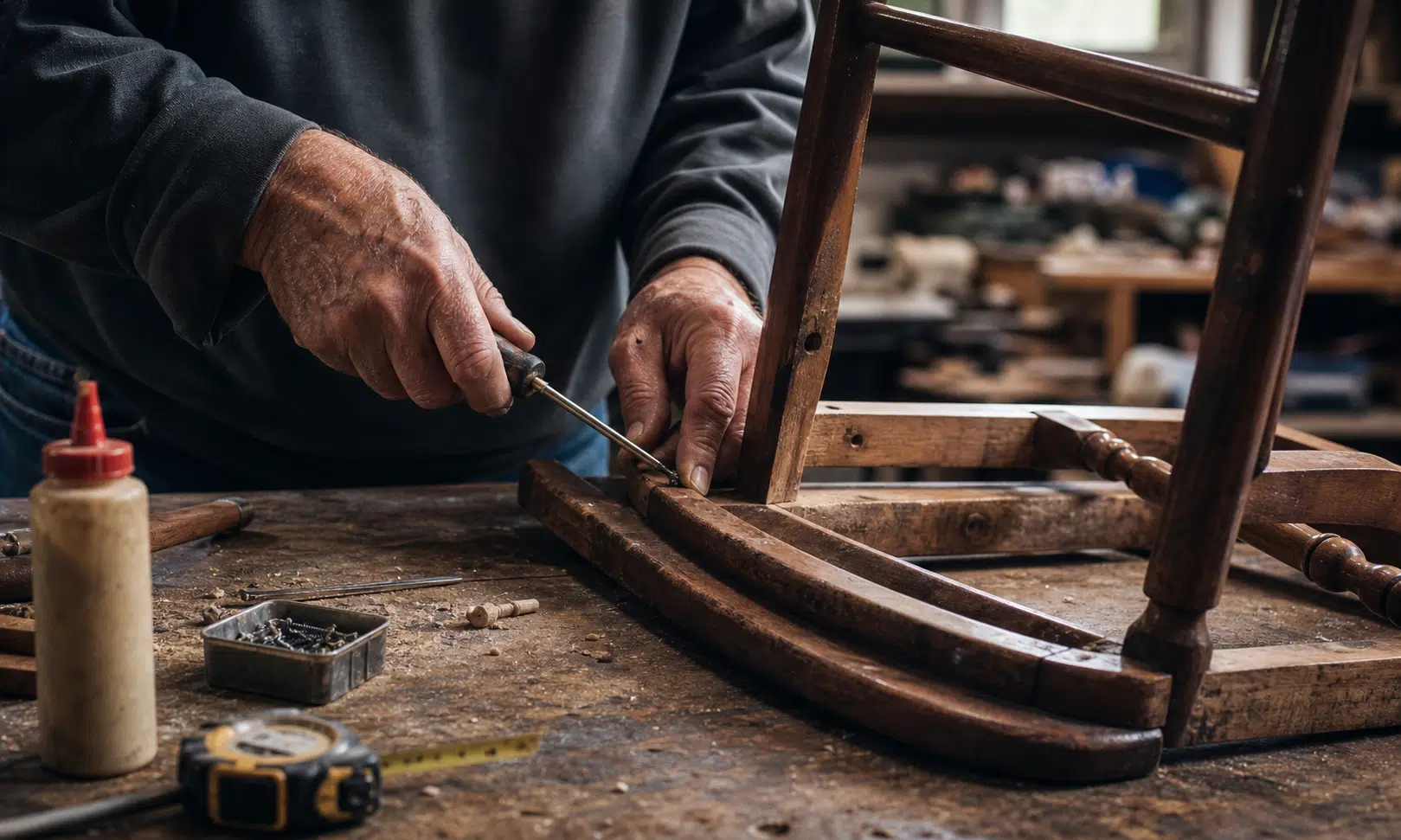

Almost every family has a version of this person: the father who sees a broken chair, a buzzing fan, a half-working remote, or a loose cabinet handle and reaches for a screwdriver before anyone can suggest buying a replacement.
To someone raised in a world of cheap gadgets, fast shipping, and next-day replacements, the instinct can look irrational. Why spend an hour opening up a device that might cost $18 to replace? Why keep a chair with a history of wobbling? Why store a drawer full of screws, tape, glue, batteries, and mystery parts that may or may not ever be useful?
The answer is not always thrift. Money can be part of it, especially for people who grew up with tighter budgets or a stronger expectation that things should last. But repair can also carry emotional weight. For some fathers, fixing something is a way to stay useful, to solve a visible problem, and to protect the small objects that have absorbed family history over time.
That does not mean every repair attempt is wise. Some broken products are unsafe, inefficient, or not worth the time. But the reflex itself often makes more sense when it is viewed less as a shopping decision and more as a personal ritual: a practical act with emotional meaning attached.
Repair Can Be A Way To Stay Useful
A broken object creates a simple question: can this be made whole again? For someone who has spent years in a family role built around fixing problems, that question can feel surprisingly personal.
Many fathers were socialized around usefulness. They were expected to provide, repair, carry, assemble, drive, troubleshoot, and quietly handle whatever needed doing. Over time, those habits can become part of identity. A stuck drawer or broken lamp is not just an inconvenience. It is a small opportunity to be capable in a visible, concrete way.
That is one reason repair can feel satisfying even when the object itself is not especially valuable. The task has a beginning, a problem, and a result. Something did not work. Then, because of patience and skill, it worked again. In a world where many forms of work are abstract, delayed, or invisible, repair offers unusually direct feedback.
This is especially true with older household objects. A chair that can be tightened, a hinge that can be adjusted, or a fan that can be cleaned gives the repairer a clear sense of competence. The repair may be small, but the signal is powerful: I can still solve this.
That feeling helps explain why the modern right to repair debate often resonates beyond smartphones and laptops. Repair is not only about parts availability or consumer savings. It is also about whether people are allowed to understand, maintain, and extend the life of the things they own.
The Emotional Reward Is Practical, Not Sentimental Fluff
Repair can look sentimental from the outside, but the reward is often practical and psychological at the same time.
A repair project can offer competence, control, and connection. Competence comes from diagnosing the problem and applying skill. Control comes from not being forced immediately into a replacement purchase. Connection comes from helping someone else in the household, even if the help is never announced as a grand gesture.
That combination can make a simple fix feel disproportionately satisfying. Replacing an object may be faster, but it does not always deliver the same sense of completion. Buying a new remote solves the remote problem. Fixing the old one solves the remote problem and proves that the problem was solvable.
There is also a quiet independence in repair. A person who can fix a hinge, patch a wire, clean a motor, or stabilize a table is less dependent on the replacement cycle. That does not make every repair rational, but it does make the impulse understandable. Repair gives the owner a little agency back.
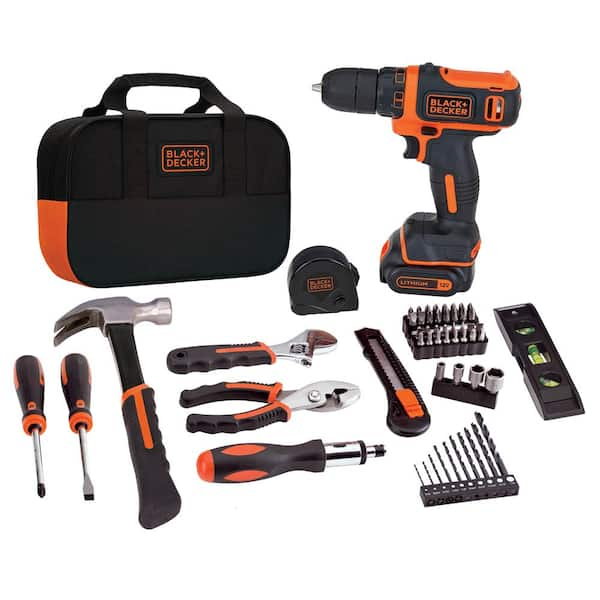
BLACK+DECKER 12V MAX Cordless Project Kit
A compact home repair kit with a drill, screwdrivers, pliers, hammer, tape measure, level, utility knife, and bits can cover many simple household fixes. It is best suited for light repair, assembly, tightening, measuring, and basic maintenance rather than major electrical or structural work.
As an Amazon Associate I earn from qualifying purchases.
For readers who actually want to repair more things at home, the useful buying decision is not usually a niche gadget. It is a basic, safe, well-organized toolkit: screwdrivers, pliers, a utility knife, a tape measure, hex keys, electrical tape, and a small set of fasteners. The point is not to turn every household problem into a project. It is to make simple fixes less frustrating when they are genuinely worth doing.
Older Objects Often Carry More Than Their Price Tag
One reason repair can be hard to explain is that objects do not hold the same value for everyone in a household.
A dining chair might look replaceable to one person and irreplaceable to another. An old clock may not be the most accurate clock in the house, but it may be connected to a parent, a move, a first home, or decades of routine. A toolbox might be scratched, heavy, and outdated, yet still represent years of work and self-reliance.
People often value things more once those things become part of their lives. Ownership creates familiarity. Familiarity creates attachment. The object becomes more than its materials or resale value. It becomes a marker of time.
That is why replacing a broken item can sometimes feel emotionally wrong even when it is financially easy. A new lamp may produce the same light, but it will not carry the same history. A new chair may be sturdier, but it will not have been present for years of ordinary family life.
This is where repair becomes a form of preservation. The repaired object may not be perfect. It may even show the repair. But that visible imperfection can become part of the story rather than a reason to discard it.
Repair Is Also A Language Of Care
Not everyone expresses affection through direct emotional language. For many people, care is communicated through action: filling the gas tank, sharpening a knife, tightening a loose screw, replacing batteries, patching a leak, or quietly fixing something before anyone asks.
For fathers who grew up with fewer models for verbal emotional expression, this can be especially important. Repair becomes a way of saying something without making a speech. The message is practical on the surface, but emotional underneath: your problem matters enough for me to spend time on it.
That kind of care can be easy to miss because it often happens in the background. A door stops sticking. A shelf stops leaning. A bicycle brake works again. The fix may be noticed for only a moment, but the effort behind it can carry real meaning.
This does not mean repair should be romanticized into an obligation. No one needs to keep every broken thing out of respect for the person who fixed it. But it does explain why the act can matter to the person doing the fixing. The finished repair is not only a working object. It is proof of attention.
Convenience Culture Changed The Calculation
The tension around repair is partly generational because the replacement economy has changed so quickly.
Many modern products are cheap to buy, hard to open, and difficult to repair. Wireless earbuds, sealed phones, smart speakers, low-cost furniture, and compact appliances are often designed around replacement rather than long-term maintenance. Even when a fix is possible, parts may be expensive or unavailable, and the labor may cost more than a new item.
That reality can make repair look outdated. For younger consumers, replacing a broken product is often the default because the market has trained them that replacement is normal. A device breaks, a new one arrives, and the old one disappears into a drawer, closet, or recycling bin.
For people who grew up around more durable objects, that default can feel wasteful. They may remember appliances that were repaired, shoes that were resoled, furniture that was refinished, and tools that lasted decades. In that context, throwing something away before attempting a fix can feel careless, even if the modern product was never built for repair in the first place.
Neither side is automatically wrong. The better question is whether the object is safe, repairable, meaningful, and worth the time.
- If the item has sentimental value, repair may make sense even when replacement is cheaper.
- If the item is unsafe, electrically damaged, or structurally compromised, replacement or professional repair may be the better choice.
- If the product is inexpensive but frequently fails, replacing it with a more durable version may be more practical than repeatedly fixing it.
- If the repair teaches a useful skill or prevents waste, the value may go beyond the immediate cost.
This is where buyer judgment matters. A replacement is not automatically wasteful, and a repair is not automatically noble. Sometimes the smartest purchase is a safer, longer-lasting version of the thing that keeps breaking.
Fixing Things Can Become A Kind Of Focus
Repair work also has a mental rhythm that many people find calming. It requires attention, patience, and a sequence of small decisions. Find the fault. Open the housing. Test the part. Clean the contact. Tighten the screw. Reassemble. Try again.
That kind of task can pull someone away from the noise of the day. It is tactile, contained, and usually free from the constant interruption of screens. Even a failed repair can provide a sense of having tried to understand the problem instead of immediately giving up on it.
For some fathers, the garage, basement, shed, or tool drawer becomes more than a storage area. It becomes a place where problems are concrete and solvable. That is a different kind of mental space from work email, bills, family logistics, or the open-ended stress of daily life.
The focus required by repair also explains why interruption can be irritating. From the outside, it may look like someone is fussing with junk. From the inside, they may be deep in a problem-solving loop, holding several small observations in mind.
When Repair Becomes A Problem
There is a line between meaningful repair and unhelpful attachment. Keeping a useful object alive is one thing. Refusing to replace anything, even when it is unsafe or making life harder for everyone else, is another.
A repair habit can become frustrating when broken items pile up, shared spaces turn into storage areas, or the household has to work around objects that no longer do their job. It can also create conflict when one person sees sentimental value and another sees clutter.
The practical middle ground is to separate the emotional question from the functional one. An object may be meaningful, but still not worth repairing. Another object may be cheap, but worth fixing because it is familiar, durable, or tied to a specific memory.
A useful household rule is simple: if the object is safe, repairable, and wanted, fixing it can be worthwhile. If it is unsafe, unusable, or only being kept out of guilt, it may be time to let it go.
The Real Meaning Behind The Screwdriver
The father who tries to fix everything is not always making a purely economic argument. Sometimes he is preserving memory. Sometimes he is asserting competence. Sometimes he is resisting a culture that treats too many objects as disposable. Sometimes he is simply showing care in the language he knows best.
That does not mean every old remote deserves surgery or every broken chair deserves another chance. But the habit is often more layered than it looks. A repair can be a small act of usefulness, a private exercise in patience, and a way to keep a piece of family life from disappearing too quickly.
The fixed lamp was never only a lamp. The tightened chair was never only a chair. Sometimes the object is just the surface. Underneath it is a person trying, in a practical and familiar way, to keep something important working.