

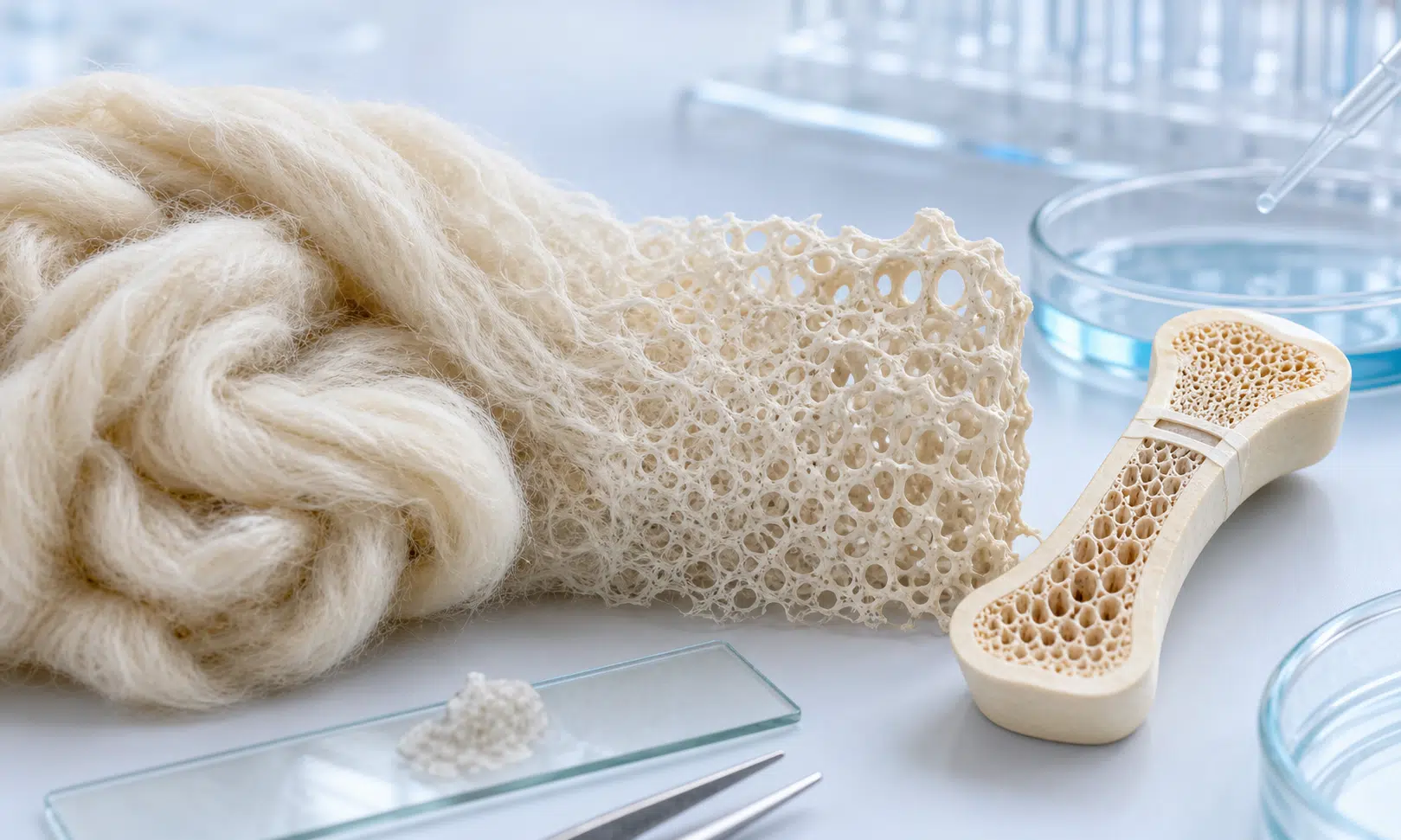

Scientists at King’s College London have shown that wool may have a useful role far beyond clothing and textiles. In a new study, researchers tested whether keratin, a natural structural protein extracted from wool, could be used as a sustainable material to help repair damaged bone.
The team found that wool-derived keratin could support bone regeneration in a living animal model. In the study, the material helped guide new bone growth across damaged areas and produced bone tissue that was more closely organized like natural, healthy bone than tissue formed with a standard collagen-based approach.
The work is still at the research stage, but it points to a possible new use for wool, a renewable material that can also be a waste product in farming. If further studies support the findings, keratin-based scaffolds could become part of future medical and dental repair materials.
How Wool Became a Bone Repair Candidate
Keratin is best known as the protein found in hair, nails, feathers and wool. It gives those materials their strength and structure. The King’s College London team focused on keratin from wool and used it to create membranes designed to act as scaffolds during bone healing.
In regenerative medicine, a scaffold gives cells a structure to grow on while damaged tissue repairs itself. For bone repair, the material needs to stay stable long enough to support new growth, integrate with nearby tissue and avoid getting in the way of healing.
To test the idea, the researchers extracted keratin from wool and chemically treated it to form more stable membranes. These membranes were then tested first with human bone cells in the laboratory. The cells grew on the material and showed signs associated with healthy bone formation.
That early lab work was followed by testing in rats with skull defects that were large enough that they would not be expected to heal on their own. Over several weeks, the researchers watched how the keratin membranes performed as new bone began to form across the damaged area.
What the Study Found
The researchers compared the wool-derived keratin membranes with collagen membranes, which are widely used in regenerative medical and dental settings. Collagen has often been treated as a leading scaffold material in this field, though the study’s broader claims about its long-term status and limitations should be understood in context rather than as a universal rule.
In this experiment, collagen membranes produced more bone overall. The keratin membranes, however, appeared to produce bone with a more organized structure. The newly formed tissue showed better-aligned fibers and qualities that more closely resembled natural bone.
That difference matters because bone repair is not only about filling a gap. The strength, alignment and structure of the new tissue can affect how well the repaired area may function. The researchers also reported that the keratin membranes integrated smoothly with surrounding tissue and remained stable during the healing period.
The team said this was the first time a wool-based material had been successfully tested in a living animal model for bone repair. Dr Sherif Elsharkawy, from King’s Faculty of Dentistry, Oral & Craniofacial Sciences, described the result as an important step because it showed keratin working inside a living biological system rather than only as an early materials concept.
Why Sustainability Matters Here
One reason the finding is drawing attention is the source material. Wool is naturally derived, renewable and already produced at scale. In some agricultural settings, lower-value wool can become waste, so using it for medical materials could add value to an existing resource.
The study does not mean wool-based keratin membranes are ready for routine patient care. More research would be needed to assess safety, performance, durability and suitability for different types of bone injuries. Human clinical use would also require further testing and regulatory review.
Still, the work suggests that keratin could become a serious candidate in the search for more sustainable regenerative materials. If future studies confirm the early results, wool may eventually help scientists design bone repair scaffolds that are both biologically useful and less dependent on existing material sources.