

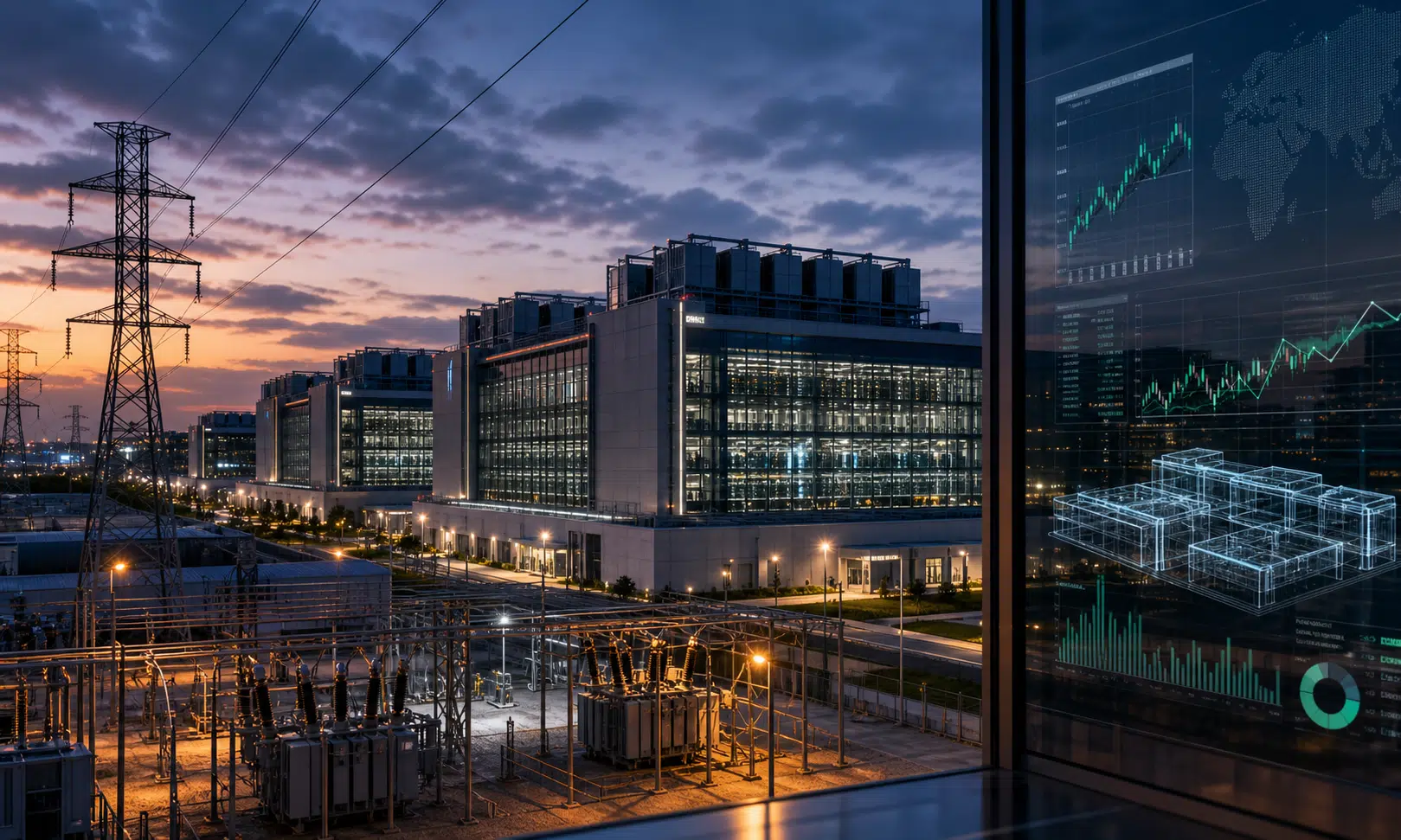

BlackRock CEO Larry Fink is making it clear that the firm’s AI ambitions are not limited to software, chips or headline-grabbing tech partnerships. The next part of the race, in his view, is physical: data centers, power, financing and the long-term infrastructure needed to keep artificial intelligence systems running.
Speaking at the Milken Institute Global Conference in Los Angeles, Fink said BlackRock is preparing to announce a partnership with an unnamed hyperscaler to build data centers. The announcement, he said, is expected later this week.
That detail matters because hyperscalers are the companies most directly exposed to the compute demands of AI. Amazon, Microsoft, Google and Meta are spending heavily to expand cloud capacity, train large models and support enterprise AI products. For those companies, data center access is no longer just an operations issue. It is a strategic constraint.
For BlackRock, the opportunity is different but closely tied to the same pressure point. The firm is trying to place itself near the financial plumbing of the AI buildout: infrastructure funds, energy projects, data center transactions and long-duration capital.
Why BlackRock Is Moving Deeper Into AI Infrastructure
AI has turned data centers into one of the most watched infrastructure categories in global markets. More advanced models require more compute. More compute requires more chips, more cooling, more electricity, more land, more fiber and more financing. That chain of demand is why asset managers are paying attention.
BlackRock has already moved aggressively in this direction. Its acquisition of Global Infrastructure Partners, completed in 2024, expanded the firm’s reach in private infrastructure investing. GIP now operates as part of BlackRock and gives the company a larger platform for investments tied to energy, transport, digital infrastructure and similar long-term assets.
Fink has framed the AI buildout as a capital-intensive infrastructure cycle rather than a short-lived technology trade. That is an important distinction for investors and enterprise buyers. If AI demand keeps rising, the bottlenecks may not be model quality or software adoption alone. They may be power availability, data center construction timelines and the ability to finance projects at a scale that matches hyperscaler demand.
BlackRock has also been part of broader AI infrastructure efforts involving major technology and investment partners, including Microsoft, Nvidia and MGX. A group led by GIP has announced plans to acquire Aligned Data Centers in a transaction valued at about $40 billion, though investors should treat deal timelines and final closing details as subject to the usual approvals and market conditions.

Data Center Handbook
A technical data center reference can help readers understand why AI capacity depends on more than chips. It gives context on site planning, power, cooling, risk management and operations behind large infrastructure deals.
As an Amazon Associate I earn from qualifying purchases.
The broader direction is still clear: large pools of private capital are looking for ways to own or finance the assets that AI companies need but may not want to carry entirely on their own balance sheets.
The Hyperscaler Connection
Fink did not name the hyperscaler involved in the upcoming partnership. That leaves open the most important commercial question: whether the deal is tied to one of the largest cloud platforms, a specialized AI infrastructure buyer or a more targeted data center customer.
The distinction matters. A partnership with a major cloud provider could point to large-scale, multi-region capacity planning. A narrower deal could focus on specific geographies, power access or specialized facilities built around AI workloads.
For buyers of cloud services, the takeaway is not simply that another data center deal may be coming. It is that infrastructure pressure is now part of the cost structure behind AI products. If demand for compute keeps rising faster than new capacity comes online, enterprise customers could feel it through pricing, availability, contract terms or regional deployment limits.
That is why Fink’s comments about shortages drew attention. He was reported as telling the Milken audience that, even with enormous spending plans across the technology sector, he expects capital to remain tight relative to the size of the infrastructure need.
Power, Compute And Chips Are Becoming Financial Questions
Fink’s argument is not only about data centers. He described shortages across power, compute and chips, which are three separate but connected constraints.
- Power determines where large AI facilities can realistically be built and how quickly they can operate at scale.
- Compute determines how much AI training and inference capacity companies can sell or reserve.
- Chips determine how fast new clusters can be assembled and upgraded.
Each of those constraints has a financial dimension. A data center project can be delayed by grid access. A cloud provider can face higher costs if demand for accelerators stays high. An enterprise buyer can find that the cheapest region or most available capacity is not the one that fits its compliance, latency or business needs.
That is the practical point behind the infrastructure investment rush. AI adoption is not just a question of whether companies want the technology. It is also a question of whether the supporting capacity exists at a predictable cost.
Could Compute Become A Tradable Market?
One of Fink’s more striking ideas was the possibility of a future market for compute futures. The concept is still speculative, but the logic is easy to understand.
Companies already use futures and other financial contracts to manage exposure to commodities such as oil, natural gas, electricity and agricultural products. If compute becomes a large and volatile operating cost, some companies may want tools to hedge that exposure in a similar way.
A compute futures market would not be simple. Compute is not a single uniform commodity. A unit of AI capacity can vary by chip type, location, availability window, energy cost, networking, software stack and service-level guarantees. Still, the fact that a major asset manager CEO is talking about compute in market-structure terms shows how far AI infrastructure has moved into the financial mainstream.
For enterprises, the near-term lesson is more grounded: AI budgets should not assume that compute costs will always fall smoothly. Procurement teams may need to pay closer attention to reserved capacity, vendor concentration, workload placement and the difference between training costs and ongoing inference costs.

Infrastructure as an Asset Class
Readers following BlackRock’s AI infrastructure strategy may benefit from a broader framework for how infrastructure assets are financed, evaluated and structured. This is most useful for readers thinking beyond public tech stocks.
As an Amazon Associate I earn from qualifying purchases.
Why Asset Managers Want A Role In The AI Buildout
Alternative asset managers have been moving toward AI infrastructure for several reasons. Data centers can require large upfront capital commitments. Power projects can take years. Hyperscalers may want partners that can help finance growth without forcing every asset onto their own books. Pension funds, sovereign funds and institutional clients may want exposure to long-term infrastructure themes.
That makes AI infrastructure attractive to firms that specialize in private markets. The deals can be large, complex and tied to long-term contracts, which fits the kind of capital these managers often control.
BlackRock is not alone. Other large private market firms have also been looking for ways to participate in the AI cycle, from direct infrastructure investments to partnerships focused on bringing AI tools into portfolio companies. The difference is that BlackRock’s scale and Fink’s public messaging make its moves especially visible.
There is also a risk side. Data centers are expensive, energy-intensive and dependent on demand forecasts that may change. If AI usage grows more slowly than expected, if chips become more efficient faster than planned, or if regulatory and grid constraints delay projects, some investments could look less attractive. That is why buyers and investors should separate the long-term infrastructure thesis from the assumption that every AI-related deal will produce strong returns.
What To Watch Next
The immediate question is which hyperscaler BlackRock plans to name and what kind of data center partnership the announcement describes. The details will matter more than the headline.
Investors and technology buyers should watch for several signals:
- Whether the partnership includes a named cloud provider or a broader consortium.
- How much capital is committed at launch versus planned over time.
- Where the data centers will be built and whether power access is already secured.
- Whether the facilities are designed primarily for AI training, inference or general cloud workloads.
- How much risk sits with BlackRock, the hyperscaler and any outside investors.
Fink’s larger message is that AI infrastructure is becoming a capital market story as much as a technology story. The companies building models need compute. The cloud platforms need data centers. The data centers need power. And all of it needs financing on a scale that few industries can absorb casually.
That does not prove there is no AI bubble, and it does not make every infrastructure bet automatically sound. But it does explain why BlackRock wants to be close to the buildout. If AI demand keeps expanding, the winners may include not only the companies selling models and chips, but also the firms that finance the physical systems beneath them.

Cloud FinOps
As compute becomes a larger operating cost, finance and engineering teams need shared practices for forecasting, allocating and optimizing cloud spend. A FinOps guide fits the article’s warning that AI budgets should not assume smooth cost declines.
As an Amazon Associate I earn from qualifying purchases.