

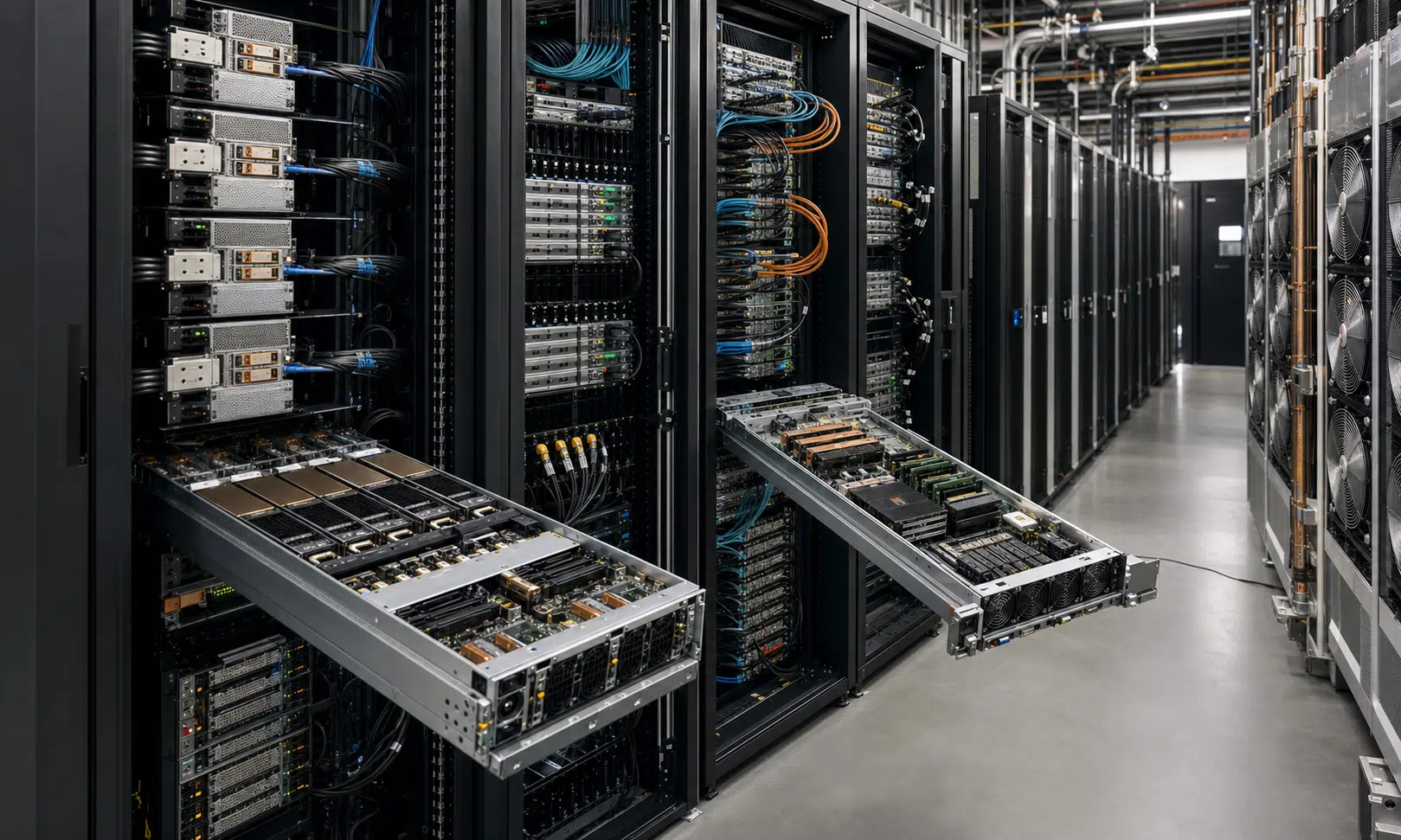

The server market is no longer just a contest between Intel Xeon and AMD EPYC boxes. In revenue terms, the center of gravity has moved toward AI infrastructure: rack-scale GPU systems, custom accelerator platforms, and Arm-based designs that sit inside some of the most expensive data center deployments being sold.
IDC’s Q1 2026 estimates put the global server market at $122.6 billion, up 30.4% from the same quarter a year earlier. The numbers should be treated as market estimates rather than audited shipment data, but they point to a clear pattern: buyers are spending heavily on accelerated systems, and that spending is changing how the server market looks on paper.
The headline shift is that non-x86 platforms were estimated at $58.7 billion in quarterly revenue, or 47.9% of the market. IDC has attributed more than 95% of that non-x86 revenue to Arm-based systems, which implies Arm servers were above 45% of server revenue for the quarter. That does not mean Arm has overtaken x86 in unit shipments. It means the highest-priced AI systems are pulling revenue share toward platforms that often include Arm CPUs.
For buyers, the practical takeaway is more specific than “Arm beats x86.” General-purpose x86 servers still matter enormously, especially for virtualization, databases, storage-heavy deployments, and conventional enterprise workloads. But if the budget is tied to AI training, inference clusters, or hyperscale accelerator deployments, the purchasing conversation is increasingly about the full platform: GPUs, interconnects, memory, power, cooling, rack density, and the CPU architecture bundled into that system.
AI Accelerators Are Pulling the Market Forward
The most important number in IDC’s Q1 2026 estimate is not x86 share or Arm share. It is accelerated-server revenue.
Systems equipped with GPUs were estimated at $68.9 billion for the quarter, up 24.8% year over year and equal to 56.2% of total server revenue. Servers using other accelerator types, including custom ASICs and FPGAs, were estimated at $17.7 billion, up 122.1% year over year. Put together, accelerated servers accounted for about $86.6 billion, or 70.6% of the market.
That makes the server market look very different from the volume story. A large installed base of x86 machines can still dominate ordinary shipment counts, but a smaller number of expensive AI systems can dominate revenue. A rack-scale AI platform can cost orders of magnitude more than a mainstream single-socket or dual-socket server, so revenue share moves quickly when hyperscalers, cloud providers, enterprises, and sovereign AI projects start buying complete AI clusters.
This is why Arm’s rise needs careful reading. Arm is gaining visibility because it is attached to some of the most expensive systems in the market, including Nvidia’s Grace-based AI platforms and custom CPUs built by cloud providers. The processor architecture matters, but the bill of materials is usually being driven by accelerators, memory, networking, and rack-scale integration.
For organizations planning data center purchases, this distinction matters. A company buying conventional compute capacity is not facing the same decision as a company building an AI cluster. The former is likely comparing platform maturity, virtualization support, software compatibility, CPU availability, and service contracts. The latter has to evaluate accelerator supply, power budgets, cooling design, networking topology, cluster management, and whether the full stack is available from a vendor it can actually buy from.

APC Smart-UPS SMT1500C
For labs, edge sites, and small server rooms, a business-class UPS can help protect management nodes, networking gear, or test servers from power interruptions. Match capacity, runtime, and outlet requirements to the actual load before buying.
As an Amazon Associate I earn from qualifying purchases.
Arm Revenue Share Is Rising, but x86 Still Owns Mainstream Volume
IDC’s estimates show x86 server revenue at $63.9 billion in Q1 2026, down 2.9% year over year. That decline should not be read automatically as weakening x86 demand. The market research framing points instead to component availability as a major constraint, including CPUs, DRAM, NAND, and hard drives.
That fits the broader reality of enterprise infrastructure. X86 servers remain the default choice for a wide range of deployments, including cloud instances, private virtualization clusters, databases, software-defined storage, edge workloads, HPC nodes, video processing, encryption, and many accelerator-equipped systems. A GPU server does not have to be Arm-based; many accelerator systems still use AMD or Intel CPUs.
Volume data also tells a different story from revenue. Mercury Research analyst Dean McCarron has estimated that AMD and Intel shipped nearly 20 million EPYC and Xeon Scalable processors for data center systems in 2025. Nvidia, by contrast, has been expected to ship millions rather than tens of millions of Grace and Vera CPUs in the near term. Custom Arm CPUs from cloud providers such as AWS, Google, Microsoft, and Alibaba add meaningful scale, but public shipment figures are not consistently available.
The result is a split market. X86 remains the practical baseline for most server fleets, especially where software compatibility and operational familiarity matter. Arm is gaining revenue share where cloud-scale buyers and AI platform vendors can control more of the stack, tune software around the hardware, and justify custom or semi-custom designs at very large scale.
What the Vendor Rankings Say About AI Spending
The vendor table also reflects the AI buildout. Dell was estimated as the largest server supplier by revenue in Q1 2026, with $20.3 billion and a 16.5% market share. Its estimated revenue was up 244.1% from Q1 2025, a surge tied to AI server demand. Supermicro ranked second at $9.3 billion, up 128.9% year over year.
Lenovo was estimated at $5.6 billion, up 36.5%, while IEIT Systems was estimated at $4.0 billion, down 7.0%. HPE was estimated at $3.7 billion, up 17.2%. ODM Direct revenue remained the largest category at $61.5 billion, though its estimated share dropped from 64.1% in Q1 2025 to 50.2% in Q1 2026.
| Vendor category | Q1 2026 revenue estimate | Q1 2026 share | Year-over-year growth |
|---|---|---|---|
| Dell Technologies | $20.3B | 16.5% | 244.1% |
| Supermicro | $9.3B | 7.6% | 128.9% |
| Lenovo | $5.6B | 4.6% | 36.5% |
| IEIT Systems | $4.0B | 3.3% | -7.0% |
| HPE | $3.7B | 3.0% | 17.2% |
| ODM Direct | $61.5B | 50.2% | 2.1% |
| Rest of market | $18.1B | 14.8% | 48.3% |
The apparent shift from ODM Direct toward branded vendors needs some caution. IDC’s ODM Direct classification is based on which company invoices the customer, not necessarily which company manufactures the hardware. Many AI servers can still be built by large ODMs while being sold through brands such as Dell or HPE. In other words, a higher branded-vendor share does not automatically mean ODMs are building fewer systems.
The buyer-side implication is that enterprises and government-backed AI projects may be leaning on branded suppliers because they need procurement support, warranties, service coverage, financing options, and integration help. Hyperscalers can still buy direct or design custom platforms, but newer AI infrastructure buyers often need a vendor that can package the system and stand behind it.
How Buyers Should Read the Arm-vs-x86 Comparison
A simple architecture comparison misses what is actually happening. The question is less “Should the data center move to Arm?” and more “Which platform fits the workload, supply chain, and operating model?”
- Choose x86 when compatibility is the priority. Existing enterprise software, virtualization stacks, management tooling, and staff experience often make AMD EPYC and Intel Xeon systems the lowest-friction option.
- Consider Arm when the platform is purpose-built. Arm can be attractive when it comes inside a cloud provider’s custom instance, an AI rack-scale system, or a controlled software environment where the buyer does not need broad legacy compatibility.
- Evaluate accelerated systems as full platforms. For AI infrastructure, CPU architecture is only one part of the purchase. GPU availability, accelerator type, memory capacity, networking, rack power, cooling, and service support can matter more than the host CPU alone.
- Watch supply constraints. If CPUs, memory, storage, or accelerators are constrained, the best architecture on paper may not be the best architecture a buyer can deploy on schedule.
Nvidia’s role is central because its rack-scale AI systems bundle GPUs with Arm-based Grace CPUs, and future Vera-based platforms are expected to continue that approach. Some commentary has suggested Arm server revenue could move above 50% if these higher-priced systems keep scaling, but a firm timeline has not been publicly confirmed. Treat that as a plausible direction of travel, not a settled forecast.
The Bottom Line
IDC’s Q1 2026 estimates show a server market being reshaped by AI infrastructure spending. Arm-based systems appear to have captured a much larger share of revenue than they did in the x86-dominated server market of the previous decade, but that shift is tightly linked to expensive accelerator-heavy platforms.
X86 is not disappearing. It remains the workhorse architecture for mainstream server volume and a huge share of enterprise infrastructure. But revenue is following the most expensive systems, and those systems are increasingly defined by GPUs, ASICs, FPGAs, custom silicon, and rack-scale AI designs.
For buyers, the useful comparison is not ideological. X86 remains the safer default for broad compatibility and conventional workloads. Arm is becoming harder to ignore in cloud-scale and AI-specific environments, especially when it arrives as part of an integrated system from Nvidia or a hyperscale cloud provider. The server market is shifting, but the winning architecture still depends on what the workload actually needs.