

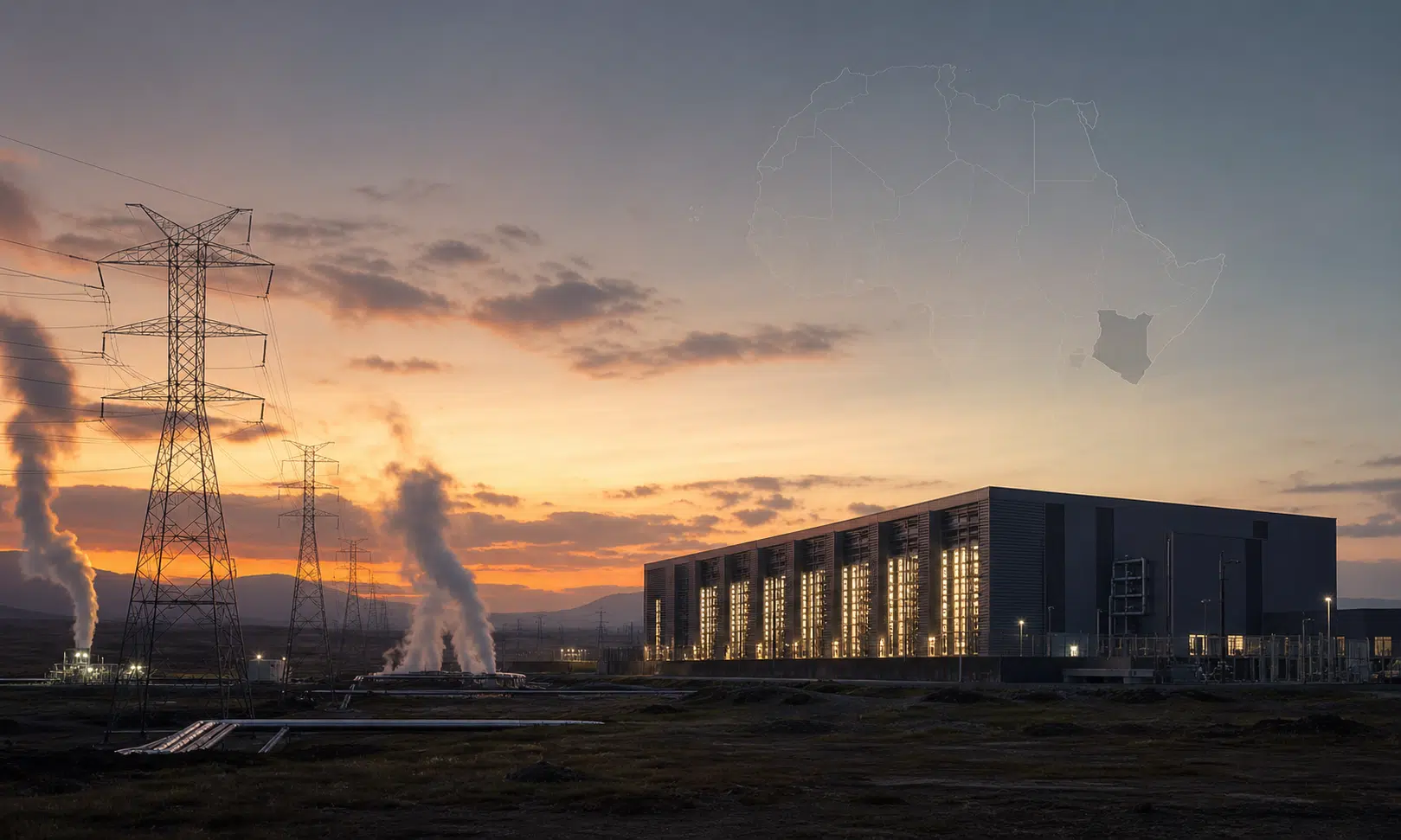

Microsoft and G42’s planned $1 billion data center project in Kenya has run into a hard infrastructure problem: the facility may be too large for the country’s current power system and too financially risky for the government to support on the terms requested.
The project was announced in May 2024 as a major digital investment package for Kenya, with Abu Dhabi-based G42 expected to lead development of a green data center that would run Microsoft Azure services for a new East Africa cloud region. The site was tied to Kenya’s geothermal resources in the Olkaria area, a location that gave the proposal a cleaner energy story than many AI infrastructure builds.
That advantage has not removed the basic capacity issue. The first phase was described as a 100-megawatt build, while the longer-term plan reportedly envisioned a facility scaling toward 1 gigawatt. For a country whose installed electricity capacity is commonly cited at a little over 3 gigawatts, that is not a routine utility request.
Why the power numbers matter
Reports around the stalled project have cited comments from Kenyan President William Ruto warning that powering the full data center would require switching off a large share of the country. The exact phrasing has not been independently verified here, so the safer reading is simpler: Kenyan officials are treating the proposed power draw as a national grid planning problem, not just a private data center procurement issue.
The numbers explain why. Kenya’s peak electricity demand reached roughly 2.4 gigawatts in early 2026, while total installed capacity is around 3.0 to 3.2 gigawatts. A 1-gigawatt data center campus would therefore represent a very large share of the country’s current installed base. Even a 100-megawatt first phase would be meaningful in a market where major generation and transmission upgrades take time.
| Power figure | Why it matters |
|---|---|
| 100MW first phase | Large enough to require serious local grid planning and firm supply agreements. |
| 1GW long-term target | Comparable to about a third of Kenya’s currently cited installed power capacity. |
| About 3.0GW to 3.2GW installed capacity | Shows why a hyperscale AI campus would compete with broader national demand. |
| About 2.4GW peak demand | Leaves limited headroom without new generation, transmission, or dedicated supply. |
The Olkaria geothermal complex is central to Kenya’s clean-energy pitch, but it is not an unlimited resource. Reports have put the complex’s output at roughly 950MW across its plants, meaning even the initial phase would require a noticeable portion of available geothermal production if it depended heavily on that area.
The dispute is also financial
The delay is not only about megawatts. Bloomberg and outlets citing its reporting say Microsoft and G42 sought guaranteed annual capacity payments from the Kenyan government. In plain terms, the companies wanted the government to commit to paying for a defined amount of cloud or computing capacity each year.
Kenya reportedly could not meet the requested guarantee level. That matters because hyperscale data centers require large upfront commitments: land, grid connections, cooling systems, transmission access, long-term energy contracts, and customers with enough demand to justify the build. Without a firm anchor buyer or payment guarantee, the business case becomes harder to finance.
Kenyan information officials have reportedly said the project has not been withdrawn and that talks continue, while also acknowledging that the scale still needs more structuring. A separate 60MW project with local developer EcoCloud has also been mentioned in reports, though that detail should be treated as still under discussion rather than completed.
A warning for AI infrastructure deals
The Kenya project shows the tension behind the global AI buildout. Microsoft, Amazon, Google, Meta, and other major technology companies are racing to secure power for cloud and AI workloads. The bottleneck is increasingly not whether companies can buy chips or build server halls, but whether utilities can deliver enough electricity on a schedule that matches AI demand.
That pressure is visible in the United States and Europe, where grid queues, substation shortages, transformer lead times, and local opposition have slowed some data center projects. In emerging cloud regions, the challenge can be sharper because hyperscale demand arrives in blocks that are unusually large compared with the existing national grid.
For Kenya, the attraction is clear. A major Azure region could support local cloud adoption, lower latency for East African customers, and position the country as a regional digital infrastructure hub. The risk is also clear: if the project requires public guarantees or power commitments that crowd out other users, the economics become politically sensitive.
Microsoft’s partnership with G42 was framed in 2024 as a major step for cloud services, AI development, connectivity, and digital skills in Kenya. Microsoft President Brad Smith joined G42’s board as part of the wider Microsoft-G42 relationship, and Microsoft described the Kenyan investment package at the time as one of the largest and broadest digital investments in the country’s history.
For now, the project appears to be in renegotiation rather than canceled. The likely path forward is a smaller first phase, a slower expansion plan, firmer dedicated power development, or a revised government commitment that reduces financial exposure. The wider lesson is already visible: AI infrastructure is no longer just a technology deployment story. It is an energy, finance, and national planning story too.