

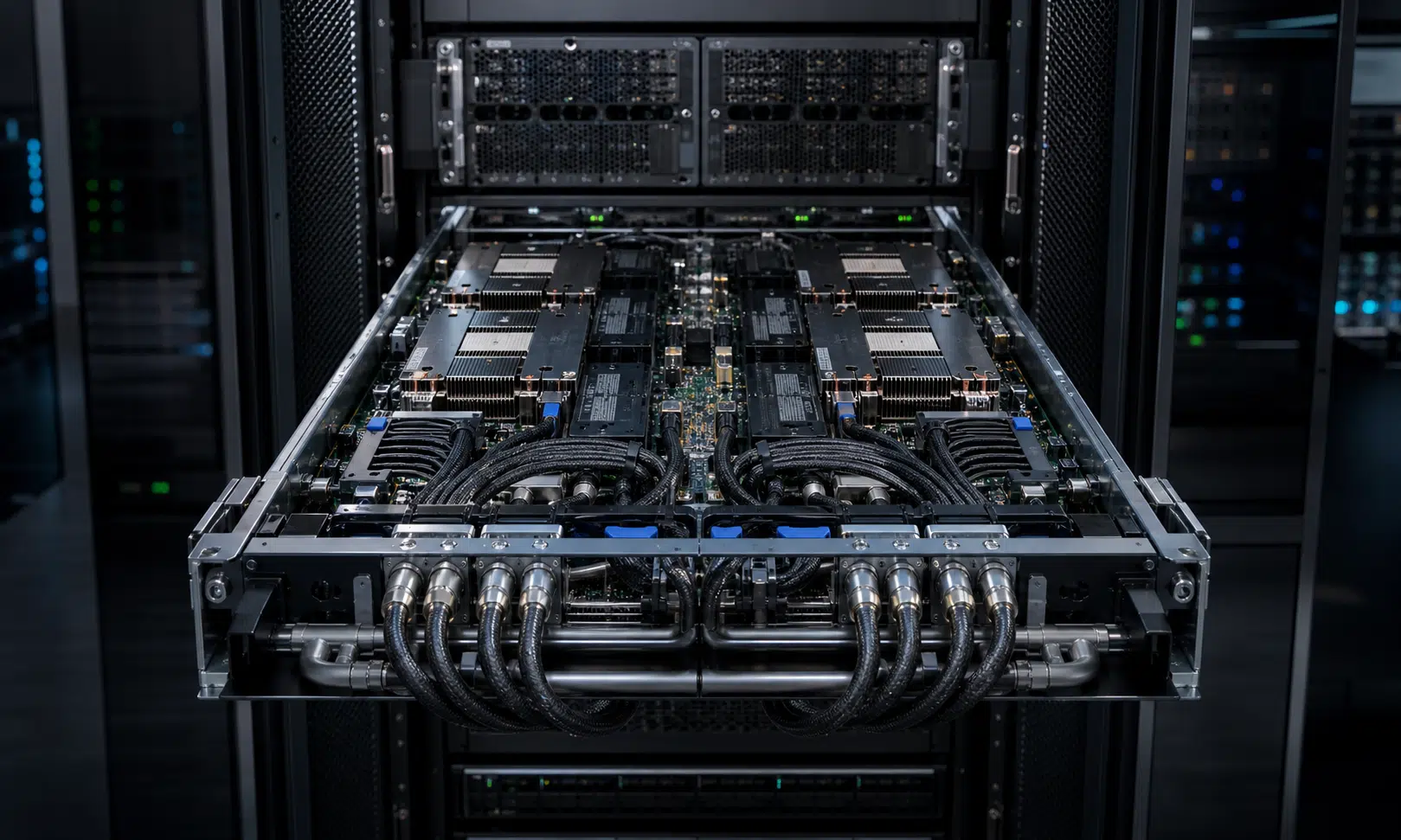

NVIDIA’s Vera CPU is becoming more than a supporting part of the company’s next AI platform story. For buyers planning large AI clusters, Vera is the piece that shows NVIDIA wants a bigger share of the data center rack, not just the GPU budget.
A market note attributed to GF Holdings Hong Kong has circulated with claims that CoreWeave, Meta, Oracle and Alibaba are among early adopters or interested customers for NVIDIA Vera CPU racks. That customer list has not been independently confirmed, so it should be treated as a market signal rather than a settled purchasing record. Still, the names are useful for understanding the type of buyer NVIDIA is targeting: hyperscalers, AI cloud providers and companies running infrastructure at a scale where CPU-side bottlenecks can become expensive.
The verified part is that Vera is real, it is central to the Vera Rubin platform, and NVIDIA is positioning it for agentic AI, reinforcement learning, orchestration, analytics, storage, cloud and HPC workloads. In practical terms, Vera is NVIDIA’s answer to a problem that GPU-heavy AI factories increasingly face: once accelerator clusters grow large enough, the host CPU, memory subsystem and rack fabric can decide how much useful work the GPUs actually sustain.
What Vera Changes in the Buying Conversation
For years, AI infrastructure buying was often framed around GPUs first: which accelerator, how many, how much HBM, and what training or inference throughput the system could deliver. Vera does not remove that conversation, but it widens it. NVIDIA is arguing that next-generation AI racks need a CPU designed for data movement, control-heavy software environments and coherent access across accelerated systems.
That matters because agentic AI workloads are not just long matrix-math runs. They can involve many concurrent environments, tool calls, retrieval steps, orchestration services, compilers, runtime systems and memory movement around GPUs. If the CPU side cannot keep pace, the expensive accelerators sit underused or the system becomes harder to scale efficiently.
NVIDIA’s official positioning for Vera focuses on three buyer-facing ideas:
- Higher CPU throughput for orchestration, data processing and control-heavy AI workflows.
- More memory bandwidth and capacity than Grace, using LPDDR5X-based SOCAMM memory.
- Coherent CPU-GPU connectivity through NVLink-C2C for systems built around Vera Rubin.
That is why Vera should be read less like a conventional server CPU launch and more like a rack-level platform move. NVIDIA is not only selling chips; it is trying to define the default architecture for AI factories that need CPUs, GPUs, networking, DPUs and software to operate as one managed system.
Reported Early Buyers: Useful Signal, Not Confirmed Fact
The reported customer list is commercially interesting, but it needs careful handling. CoreWeave, Meta and Oracle are plausible targets because each has a clear reason to evaluate large-scale AI infrastructure. Alibaba is more complicated because U.S. export controls around advanced AI hardware make any China-related deployment question sensitive and product-specific.
The available report says these companies have shown interest in or secured Vera CPU racks as early adopters. That has not been independently verified, and no firm public timeline tied to those specific customers should be treated as confirmed. A safer reading is that NVIDIA’s Vera push is already being watched by the kinds of companies that buy AI systems in rack-scale quantities.
For infrastructure buyers, the point is not whether every name in the circulating list is final. The point is that Vera is aimed at the same procurement tier that buys complete AI platforms, not isolated CPUs. If the largest cloud and AI operators standardize around NVIDIA’s CPU-plus-GPU rack architecture, smaller buyers may later inherit that design through cloud instances, managed AI platforms and OEM systems.

Data Center Handbook, 2nd Edition
For teams modeling AI rack deployments, a current data center planning reference can help frame power, cooling, reliability, cabling and operations questions before vendor quotes arrive.
As an Amazon Associate I earn from qualifying purchases.
Vera CPU Specs That Matter
NVIDIA’s public specifications make clear why Vera is being positioned as a Grace successor for AI infrastructure. The CPU uses NVIDIA-designed Olympus Arm cores and supports Spatial Multithreading, which brings the thread count to 176 across 88 cores. NVIDIA also emphasizes LPDDR5X memory bandwidth, larger memory capacity and NVLink-C2C bandwidth for coherent CPU-GPU communication.
| Area | NVIDIA Vera CPU detail | Why buyers should care |
|---|---|---|
| CPU cores | 88 NVIDIA-designed Olympus cores | More host-side compute for orchestration, analytics and AI control workloads |
| Threads | 176 threads with Spatial Multithreading | Designed to keep many concurrent environments responsive |
| Memory | Up to 1.5 TB LPDDR5X system memory | Useful for memory-intensive data processing and agentic workloads |
| Memory bandwidth | Up to 1.2 TB/s | Helps reduce CPU-side data movement limits |
| CPU-GPU link | 1.8 TB/s NVLink-C2C coherent bandwidth | Supports tighter CPU-GPU sharing inside accelerated systems |
| Security | Confidential computing support | Important for cloud, enterprise and multi-tenant AI deployments |
The cleanest comparison is against NVIDIA’s own Grace CPU. Vera increases the core count, thread count, memory bandwidth and memory capacity, while moving to NVIDIA’s custom Olympus core design. NVIDIA says the CPU can be used inside Vera Rubin systems and also in configurations such as CPU racks and dual- or single-socket server designs.
That flexibility is important. A buyer may not need a full Vera Rubin GPU rack to care about Vera. If NVIDIA’s server partners deliver standard Vera CPU systems, the chip could also show up in analytics, storage, orchestration and cloud workloads where the main requirement is memory bandwidth and efficient data movement rather than direct GPU acceleration.
Where Vera Fits Against AMD, Intel and Custom Silicon
Vera enters a market that is already crowded with high-performance data center CPUs. AMD EPYC and Intel Xeon remain the familiar choices for general-purpose server fleets, while hyperscalers have invested heavily in custom Arm silicon and internal accelerators. The buyer question is not whether Vera replaces all of those options. It is whether Vera becomes the preferred CPU when the surrounding infrastructure is already NVIDIA-heavy.
That is a narrower but very valuable lane. If an AI cluster is built around NVIDIA GPUs, NVIDIA networking, BlueField DPUs and the CUDA software stack, choosing Vera may simplify integration and improve platform-level tuning. The tradeoff is that buyers become more committed to NVIDIA’s rack architecture and roadmap.
A practical evaluation should focus on workload fit:
- Vera looks strongest for GPU-adjacent AI infrastructure, agentic workloads, orchestration, data movement and memory-heavy services.
- AMD and Intel remain natural comparison points for broad enterprise server refreshes, mixed workloads and environments that value supplier diversity.
- Custom hyperscaler CPUs can still win when the buyer controls the full software stack and has enough volume to justify deep internal optimization.
For most enterprises, Vera will probably be encountered through cloud infrastructure, OEM servers or managed AI platforms before it becomes a direct CPU shopping decision. For hyperscalers and AI cloud providers, it is a more immediate architectural question: standardize further on NVIDIA’s rack design, or keep CPU procurement separate from accelerator procurement.
Memory Demand and Supply Chain Risk
Vera’s use of LPDDR5X and support for up to 1.5 TB of system memory per CPU make memory supply an obvious watch item. It is reasonable to expect large Vera deployments to increase demand for the memory technologies used in those systems, but the scale and timing of any supply constraint have not been publicly confirmed.
That distinction matters for buyers. Procurement teams should not assume shortages purely because a new platform supports large memory capacity. They should, however, ask vendors specific questions about lead times, qualified memory suppliers, serviceability, rack density, liquid cooling requirements and whether capacity commitments are tied to complete NVIDIA rack purchases.
The same caution applies to production timing. NVIDIA has publicly positioned Vera Rubin and Vera CPU systems as part of its next AI infrastructure generation, and product plans point to deployments through partners. But firm timelines for any particular customer, region or rack configuration should be confirmed directly with NVIDIA, OEMs or cloud providers before purchase planning.

Fluke Networks LinkIQ Cable+Network Tester
Cable and network testing tools are useful when validating lab racks, edge deployments or smaller AI infrastructure builds before scaling the design into larger environments.
As an Amazon Associate I earn from qualifying purchases.
Buyer Verdict: Who Should Pay Attention Now?
Vera is not a consumer CPU story, and it is not mainly about replacing every server CPU in the data center. It is a strategic AI infrastructure product aimed at buyers who are already thinking in racks, clusters and sustained accelerator utilization.
Vera is most relevant for AI cloud providers, hyperscalers, large model labs and enterprises building dedicated AI factories. These buyers should evaluate Vera when CPU-side orchestration, memory bandwidth, coherent CPU-GPU communication and platform integration are limiting factors or likely to become limiting factors as clusters scale.
Vera is less urgent for conventional enterprise server buyers that are not building around NVIDIA accelerators at scale. For those teams, AMD and Intel comparisons will remain more direct unless a cloud provider or OEM packages Vera in a way that clearly improves cost, performance or manageability for a specific workload.
The commercial takeaway is straightforward: NVIDIA is trying to make the AI rack a larger, more integrated sale. Vera gives the company a stronger CPU story alongside Rubin GPUs, NVLink, networking and DPUs. The reported interest from major AI infrastructure buyers has not been fully verified, but the direction is clear enough. In the next wave of AI hardware decisions, the CPU is no longer a background component. It is part of the platform lock-in, performance profile and supply chain risk that buyers need to model from the start.
APC NetShelter Switched Rack PDU
A switched rack PDU can help teams manage and monitor power at the rack level in evaluation labs, staging environments and smaller infrastructure deployments.
As an Amazon Associate I earn from qualifying purchases.