


OpenAI says two employee devices were breached during the recent TanStack supply chain attack, an incident tied to a wider campaign that compromised trusted software packages across the npm and PyPI ecosystems.
The company said its investigation found no impact to customer data, production systems, intellectual property, or deployed software. It did, however, observe activity consistent with credential-focused malware behavior in a limited set of internal source code repositories that the two affected employees could access.
That distinction matters for buyers and security teams. This was not described as a direct compromise of OpenAI’s production environment. It was a developer-side supply chain event where attackers used trusted software channels, developer machines, repositories, and credentials as the path inward.
OpenAI said it isolated affected systems and accounts, revoked sessions, rotated credentials for affected repositories, temporarily restricted deployment workflows, and worked with a third-party incident response firm. The company also began rotating code-signing certificates used for its applications as a precaution after certificates for macOS, Windows, iOS, and Android products were exposed.
For macOS users, OpenAI said desktop applications need to be updated before June 12, 2026, because apps signed with older certificates may eventually fail to launch or receive updates due to Apple’s notarization process. The advisory did not present the same immediate update requirement for every platform, so organizations should follow platform-specific guidance from OpenAI rather than assuming one uniform action applies everywhere.
What Happened In The TanStack Supply Chain Attack
The breach OpenAI described is part of the broader Mini Shai-Hulud supply chain campaign, which affected hundreds of packages distributed through normal package repositories. The campaign initially hit packages associated with TanStack and Mistral AI before spreading to other projects through stolen credentials and trusted CI/CD workflows.
The practical risk was simple: malicious package versions could appear to arrive through legitimate release channels. That makes detection harder because teams may trust the package name, maintainer account, registry path, or release automation.
According to public reporting on the TanStack incident, attackers abused weaknesses in GitHub Actions workflows and CI/CD configuration. The goal was to run malicious code, extract tokens, and publish compromised versions through the normal release process. Once attackers had access to credentials, they could move from one project to another by compromising maintainer accounts, package publishing tokens, and repository workflows.
The malware used in the campaign targeted the kinds of secrets that are most valuable in developer and cloud environments, including GitHub tokens, npm publishing tokens, AWS credentials, Kubernetes secrets, SSH keys, and environment files.
Security researchers have also reported possible persistence behavior involving developer tooling, including Claude Code hooks and VS Code auto-run tasks. Those reports should be treated as investigation leads unless confirmed in a given environment, but they are still useful for defenders because they point to places that are easy to miss during cleanup.
Microsoft Threat Intelligence has also described a related Linux information-stealing component and a possible destructive behavior under certain system conditions. Those details should not be treated as universally observed in every compromised environment, but they reinforce the same operational point: this class of attack is not limited to stealing one package token and disappearing.
Why This Is A Buying Decision, Not Just A News Event
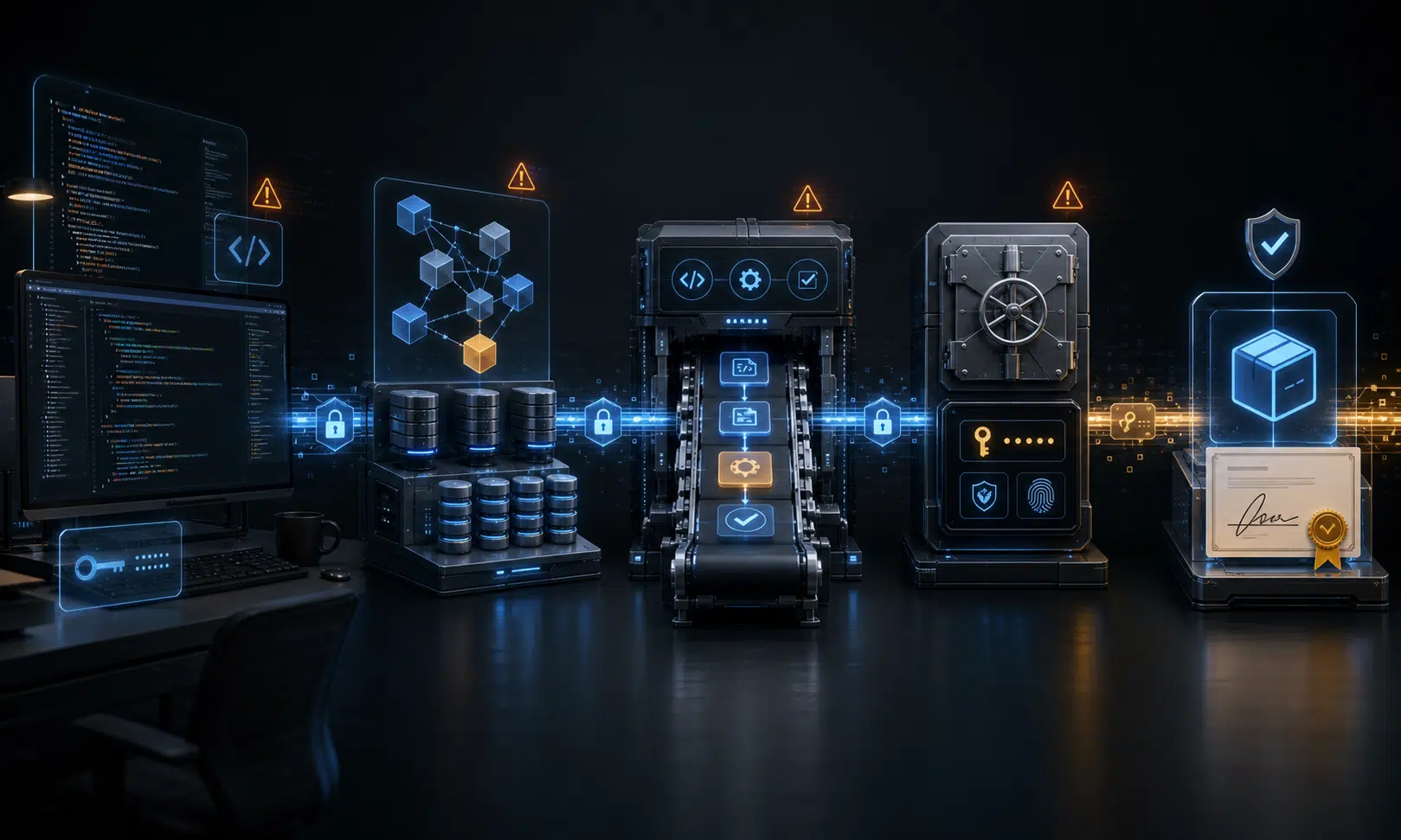
For security leaders, the OpenAI incident is useful because it shows where traditional control categories start to blur. Endpoint security, source code management, secrets scanning, package registry monitoring, CI/CD hardening, cloud identity controls, and code signing governance all intersect in the same attack path.
A tool that only answers one narrow question may still be valuable, but it will not cover the full chain. Buyers evaluating supply chain security products should ask what stage of the attack the product actually validates or blocks.
| Security area | Why it matters in this incident type | Buyer question to ask |
|---|---|---|
| Developer endpoint protection | Employee devices can become the first place where tokens and repository access are exposed. | Can it detect credential theft behavior and suspicious developer tool changes? |
| Secrets management | Stolen tokens can let attackers publish packages, access repositories, or reach cloud services. | How fast can exposed credentials be found, revoked, and rotated? |
| CI/CD security | Trusted release workflows can be abused to ship malicious packages through normal pipelines. | Does it inspect workflow permissions, token scope, and release behavior? |
| Package security | Compromised versions may arrive from legitimate registries and familiar maintainers. | Can it flag suspicious package updates before developers install them? |
| Code signing governance | Exposed signing assets can create trust and update risks even if no abuse is confirmed. | Can signing certificates be inventoried, rotated, and monitored centrally? |

YubiKey 5C NFC
A hardware security key can reduce the risk of account takeover when developer, cloud, or repository credentials are targeted. The YubiKey 5C NFC supports USB-C and NFC, making it practical for teams that use laptops and mobile approval flows.
As an Amazon Associate I earn from qualifying purchases.
That table is also a useful way to avoid overbuying. A package scanner, for example, may help with malicious dependency detection, but it may not harden GitHub Actions. A secrets scanner may find leaked credentials, but it may not catch unauthorized package publication. A validation platform may show how far an attacker can move, but it may not prove that every detection rule fired or that every cloud permission boundary held.
The better buying conversation starts with the attack path, then maps controls to each stage.
What OpenAI Says It Did After The Breach
OpenAI’s response focused on containment, credential cleanup, workflow restriction, and certificate rotation.
The company said it isolated affected systems and accounts, revoked active sessions, rotated credentials tied to affected repositories, and temporarily restricted deployment workflows while it investigated. It also brought in an outside incident response firm.
The code-signing certificate rotation is a separate but important part of the response. OpenAI said it had not detected misuse of the exposed certificates to sign malicious software, but it is rotating them anyway. That is the expected risk reduction move when signing material may have been exposed, because code signing depends on trust continuing to mean something.
For enterprise IT teams, the immediate action is inventory. If employees use OpenAI desktop applications on managed macOS devices, administrators should check whether the affected apps are updated before the June 12, 2026 deadline. Teams should also watch vendor guidance for any platform-specific update notices rather than assuming that macOS instructions apply identically to Windows, iOS, or Android.
How To Evaluate Supply Chain Security After This Incident
This attack is a reminder that supply chain security is not one product category. It is a set of connected controls that need to work under pressure.
Security buyers should evaluate tools against concrete workflows, not broad marketing labels. A practical review should include:
- Whether the tool can detect suspicious package updates from trusted maintainers.
- Whether it can inspect GitHub Actions, CI/CD permissions, and release automation risks.
- Whether it can find and prioritize exposed tokens, cloud keys, SSH keys, and environment files.
- Whether it supports rapid credential revocation and rotation workflows.
- Whether it monitors developer endpoints for credential theft and tool persistence indicators.
- Whether it gives security teams enough evidence to confirm that affected systems are clean.
- Whether it can help inventory and rotate code-signing certificates.

Apricorn Aegis Secure Key 3NX
For small teams, a hardware-encrypted USB drive can be useful for storing recovery codes, response notes, or sensitive handoff files outside normal synced folders. Use it as a controlled storage aid, not as a replacement for enterprise key management or an HSM.
As an Amazon Associate I earn from qualifying purchases.
The strongest fit will vary by organization. A software company with frequent package publishing may need deeper registry and CI/CD controls. A company with many developers but limited security staff may get more value from automated secrets response and managed endpoint detection. A regulated enterprise may need better evidence collection, approval gates, and certificate lifecycle management.
Where Automated Testing Fits
Automated penetration testing can still help, but this incident shows its limits if used alone. The main question in this case is not only whether an attacker can move through a network. It is also whether trusted development workflows can be abused, whether credentials are over-scoped, whether malicious package behavior is detected, and whether response teams can rotate access quickly.
For that reason, buyers should compare validation products by the surfaces they actually test. A tool that validates lateral movement does not automatically validate package publishing risk. A tool that checks cloud configuration does not automatically prove developer endpoints are clean. A tool that scans dependencies does not automatically prove CI/CD tokens are safe.
Response Checklist For Security Teams
Organizations that use TanStack packages, affected npm or PyPI packages, or development environments exposed to the campaign should treat the incident as a credential and workflow investigation, not only a package cleanup task.
A focused response should include:
- Identify whether any affected package versions were installed in developer machines, build systems, or production pipelines.
- Review CI/CD logs for unusual workflow runs, unexpected package publication events, or new release automation behavior.
- Rotate potentially exposed GitHub, npm, cloud, SSH, Kubernetes, and environment-based credentials.
- Audit GitHub Actions permissions and reduce token scope where possible.
- Check developer workstations for suspicious changes to editor tasks, automation hooks, and startup behavior.
- Confirm whether code-signing certificates, release keys, or mobile signing assets were accessible from affected systems.
- Document what was exposed, what was rotated, and what monitoring is in place after cleanup.
The key is to avoid a narrow fix. Removing a malicious package version does not help if the attacker still has a valid publishing token. Rotating one credential does not help if the same workflow can mint another broad token. Rebuilding one workstation does not help if persistence is present in shared developer tooling.
The Bottom Line For Buyers
OpenAI’s disclosure does not describe a compromise of customer data or production systems. It does show how quickly an upstream package attack can become a developer credential problem, a repository access problem, a release workflow problem, and a code-signing governance problem.
That is the real lesson for security buying. Supply chain defense should not be evaluated as a single checkbox. Buyers need to know which tools cover package intake, which tools cover developer devices, which tools cover CI/CD, which tools cover secrets, and which tools help prove that response work is complete.
The right control mix depends on the environment, but the decision criteria are now clearer: follow the trust chain from developer workstation to package registry to build pipeline to signed application. Any gap in that chain can become the attacker’s next release channel.