

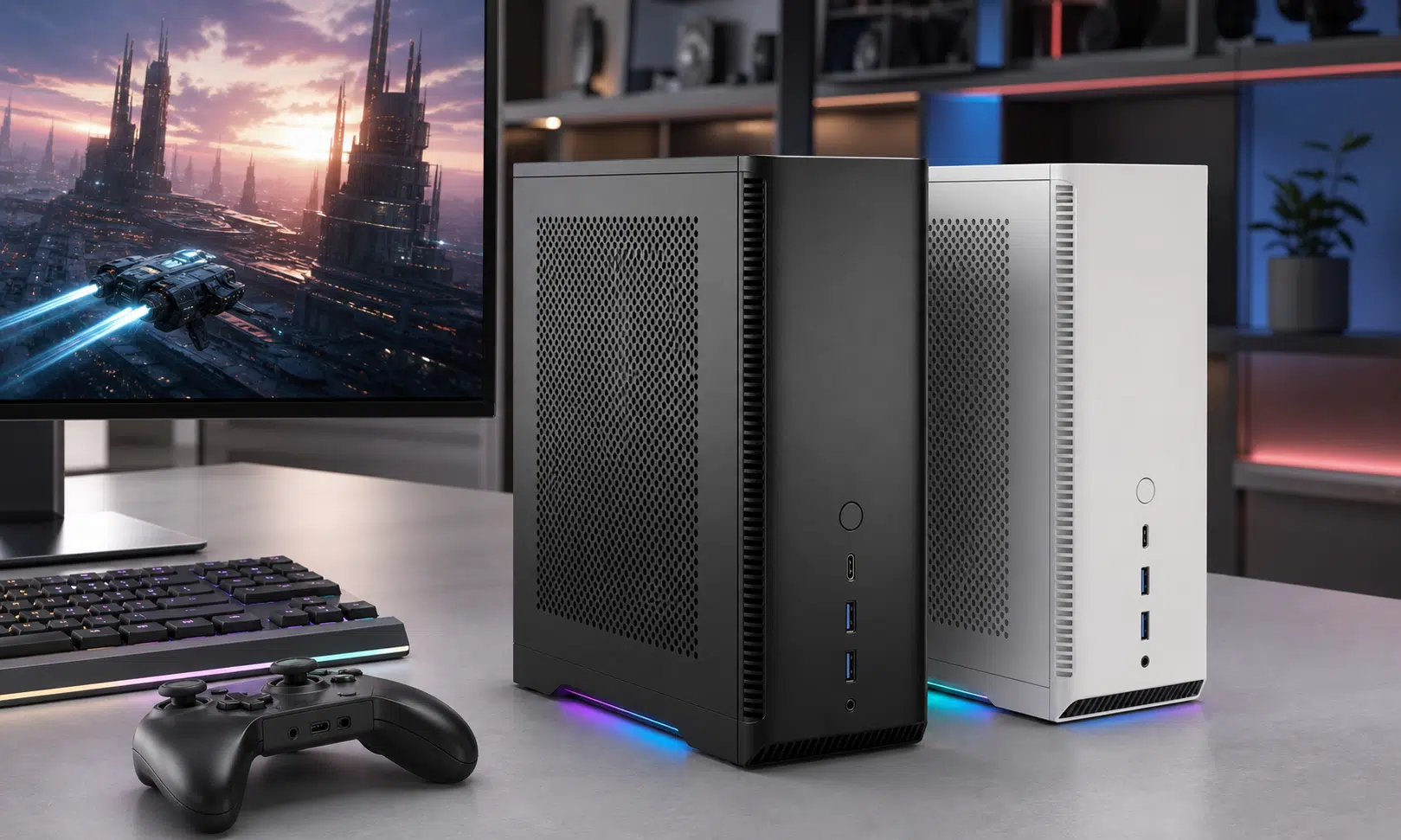

ASUS has introduced a new ROG NUC 16 model for 2026, and the headline spec sheet is not hard to understand: a compact gaming PC with Intel’s Core Ultra 9 290HX Plus and up to an NVIDIA GeForce RTX 5080 Laptop GPU. The harder question is who this machine is really for once pricing enters the conversation.
The new system has appeared first in China, where listings point to a price well above the mainstream gaming PC market. The black version has been reported at 29,999 RMB, roughly $4,420, while the white version has been reported at 30,499 RMB, roughly $4,490. Those specific retail details have not been independently verified here, but they frame the main issue clearly: this is not just a small-form-factor gaming PC. It is a premium mini desktop priced against serious full-size alternatives.
ASUS is positioning the ROG NUC 16 as a compact high-performance system rather than a console replacement in any practical price sense. The box may be far smaller than a traditional desktop tower, but the reported launch pricing puts it closer to boutique gaming desktops, high-end laptops, and custom small-form-factor builds than to a PlayStation or Xbox.
What ASUS Is Changing With the ROG NUC 16 2026
The 2026 ROG NUC 16 appears to keep the same broad idea as the previous ROG NUC design: a compact gaming system built around mobile-class high-end hardware. The chassis is still described around a 3-liter form factor, though that detail should be treated as based on current product material rather than a separately verified measurement.
The biggest platform change is the move to Intel’s Core Ultra 9 290HX Plus. ASUS material also points to GPU options reaching up to the GeForce RTX 5080 Laptop GPU. The product page information available so far does not appear to make every GPU configuration fully clear, while promotional material has been reported to mention RTX 5080, RTX 5070 Ti, RTX 5070, and RTX 5060 options using the same CPU platform. Until ASUS publishes clearer regional configuration pages, buyers should treat the exact SKU split as something to verify before ordering.
The memory spec is also ambitious for a compact PC. ASUS lists support for up to 128GB of DDR5-6400 CSODIMM memory, according to current product information, though final retail configurations can vary by region and seller.

ASUS ROG NUC 970
The ROG NUC 970 is the most natural current comparison point for shoppers interested in ASUS compact gaming PCs. It keeps the same desk-friendly idea while using earlier-generation ROG NUC hardware.
As an Amazon Associate I earn from qualifying purchases.
For buyers comparing this against a gaming laptop, the appeal is obvious enough. The ROG NUC 16 can sit on a desk like a tiny desktop, connect to full-size monitors and peripherals, and avoid the built-in display, keyboard, and battery compromises of a laptop. For buyers comparing it against a desktop tower, the tradeoff is different: the ROG NUC buys space efficiency and simplicity, but it gives up the upgrade flexibility and pricing advantages that often make desktops attractive in the first place.
Reported Specs and Buyer-Relevant Details
The ROG NUC 16 is not a barebones office mini PC with gaming branding. It is aimed at users who want high-end gaming or creator performance in a much smaller footprint than a tower. The reported and listed features make that clear.
| Category | ROG NUC 16 2026 details | Buyer note |
|---|---|---|
| CPU | Intel Core Ultra 9 290HX Plus | Main platform upgrade over the earlier Core Ultra 9 275HX model |
| GPU | Up to NVIDIA GeForce RTX 5080 Laptop GPU | Exact regional GPU variants should be checked before purchase |
| Memory | Up to 128GB DDR5-6400 CSODIMM listed | Useful for heavy multitasking and creator workloads if configured that way |
| Power | 380W adapter on supported SKUs, according to ASUS material | Suggests ASUS is giving the compact system more power headroom than before |
| Cooling | Three fans, vapor chamber, SSD heatsink listed | Thermal design matters heavily in a 3-liter gaming PC |
| Display output | Thunderbolt 4, DisplayPort 2.1 UHBR20, HDMI 2.1, support for up to five 4K displays listed | Strong fit for multi-monitor desks and compact creator setups |
| Networking | 2.5GbE listed | Appropriate for a premium desktop-class setup |
ASUS also describes a revised cooling and power setup. Current material says supported SKUs ship with a 380W power adapter, which ASUS positions as 15% higher wattage than the ROG NUC 2025 adapter. The cooling system is described as using three fans, a vapor chamber with broad thermal coverage, and a dedicated SSD heatsink. ASUS also claims sustained-load noise below 38 dBA, though real acoustic behavior will depend on workload, ambient temperature, placement, and final configuration.
One practical change is the support for both vertical and horizontal placement. ASUS says the system can detect orientation with a built-in G-sensor and adjust thermal behavior when placed horizontally. That is a sensible feature for a machine that may live under a monitor, beside a TV, or on a cramped desk, but it is also the sort of claim that needs review testing before buyers can know how much it changes real performance.
ROG NUC 16 2026 vs ROG NUC 2025
The 2026 model looks more like a targeted refresh than a ground-up redesign. The previous ROG NUC 2025 paired a Core Ultra 9 275HX with up to an RTX 5080 Laptop GPU. The new model moves to the Core Ultra 9 290HX Plus while keeping the same reported GPU ceiling.
That matters because the GPU is usually the most important component for gaming performance. A CPU refresh can help in CPU-limited games, esports titles, productivity workloads, and general responsiveness, but it does not automatically make the machine a different class of gaming PC if the top GPU option remains the same.
| Comparison point | ROG NUC 2025 | ROG NUC 16 2026 |
|---|---|---|
| CPU platform | Core Ultra 9 275HX | Core Ultra 9 290HX Plus |
| Top GPU class | Up to RTX 5080 Laptop GPU | Up to RTX 5080 Laptop GPU |
| Reported China pricing | Previously reported around 24,399 to 24,999 RMB | Reported around 29,999 to 30,499 RMB |
| Positioning | Premium compact gaming PC | Even more expensive premium compact gaming PC |
The reported price gap is the part buyers should look at most closely. If the 2026 model mainly brings a newer CPU, revised cooling, a higher-power adapter, and the option of a white finish, then the value case depends on how much those changes matter in actual use. Someone replacing a full tower to save desk space may care. Someone chasing the best frame-per-dollar almost certainly will not.
Price Is the Main Comparison Problem
ASUS has compared the ROG NUC concept with game consoles in size and performance terms, but price makes that comparison awkward. A compact PC with laptop-class RTX graphics can do many things a console cannot: Windows games, productivity apps, modding, multiple stores, creator software, and wider display support. That does not make it a console competitor for most shoppers.
Even using cautious language around current console pricing, the ROG NUC 16’s reported China pricing is in a completely different bracket from a PlayStation 5 Pro or Xbox Series X. The more useful comparison is with other expensive PC options.
- Against a console, the ROG NUC 16 offers broader PC flexibility but costs far more.
- Against a gaming laptop, it may offer a cleaner desk setup and better sustained desktop use, but it gives up portability and a built-in screen.
- Against a full-size desktop, it saves space but likely loses on upgrade paths, component choice, and value.
- Against a custom small-form-factor PC, it offers a more finished appliance-like package, but buyers give up control over parts and pricing.
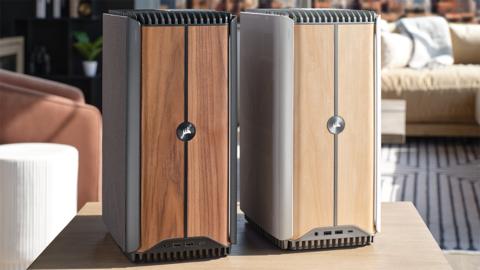
CORSAIR ONE i500
The CORSAIR ONE i500 is worth comparing if the goal is a polished compact gaming desktop rather than the smallest possible PC. Its larger case gives it a different balance of cooling, serviceability, and desk presence.
As an Amazon Associate I earn from qualifying purchases.
That makes the ideal buyer fairly specific. This is for someone who wants a premium compact Windows gaming PC, does not want to build a small-form-factor desktop, and is willing to pay heavily for size, integration, and ASUS’ ROG design. It is not the obvious choice for a budget-conscious gamer, a console shopper, or a desktop builder who enjoys choosing every component.
Who Should Consider It?
The ROG NUC 16 2026 makes the most sense in a few narrow cases. A buyer with a compact desk, a multi-monitor setup, and a preference for a prebuilt machine could find it appealing. A creator who wants high-end mobile-class GPU performance in a small box might also see the logic, especially if the memory and display output support line up with their workflow.
It is harder to recommend as a general gaming purchase at the reported price. A high-end desktop can usually deliver more performance flexibility for the money. A gaming laptop can justify expensive mobile parts by adding portability. A console delivers a simpler living-room gaming experience at a fraction of the cost. The ROG NUC 16 sits between those categories, and that middle ground is useful only if compactness is a top priority.
The other reason to wait is regional clarity. ASUS has not issued a broad global launch announcement for this specific 2026 model at the time of the source report, and the launch appears centered on China for now. If it reaches the United States, final pricing could shift with taxes, channel margins, configuration differences, and regional strategy. Based on the reported China pricing alone, it would not be surprising to see a US price near or above the $4,000 mark, but that remains an estimate rather than confirmed launch pricing.
Early Verdict
The ASUS ROG NUC 16 2026 looks like a technically impressive compact gaming PC, but its value depends almost entirely on how much a buyer cares about the form factor. The Core Ultra 9 290HX Plus, RTX 5080 Laptop GPU ceiling, high memory support, strong I/O, and revised cooling setup all make sense for a premium mini PC. The reported price is what turns it from interesting hardware into a difficult buying decision.
For space-constrained buyers who want a polished, powerful, prebuilt mini PC, the ROG NUC 16 could be compelling once final configurations and regional prices are confirmed. For most gamers, especially anyone comparing performance per dollar, this looks less like a console alternative and more like a luxury compact desktop with laptop-grade internals.
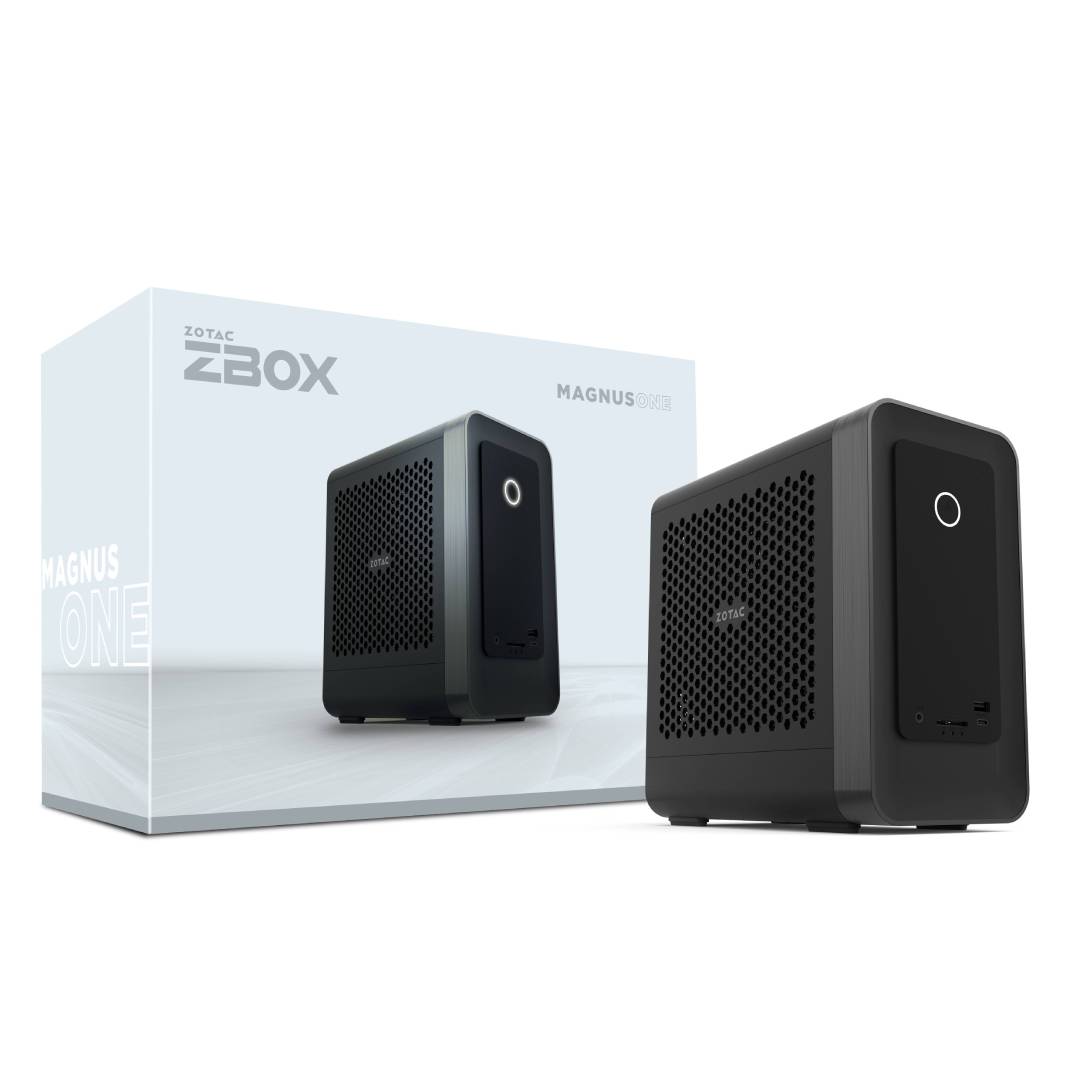
ZOTAC MAGNUS ONE
The ZOTAC MAGNUS ONE is a useful comparison for buyers who like the small footprint idea but want something closer to a mini tower. It is especially relevant if upgrade access matters more than having the smallest possible chassis.
As an Amazon Associate I earn from qualifying purchases.